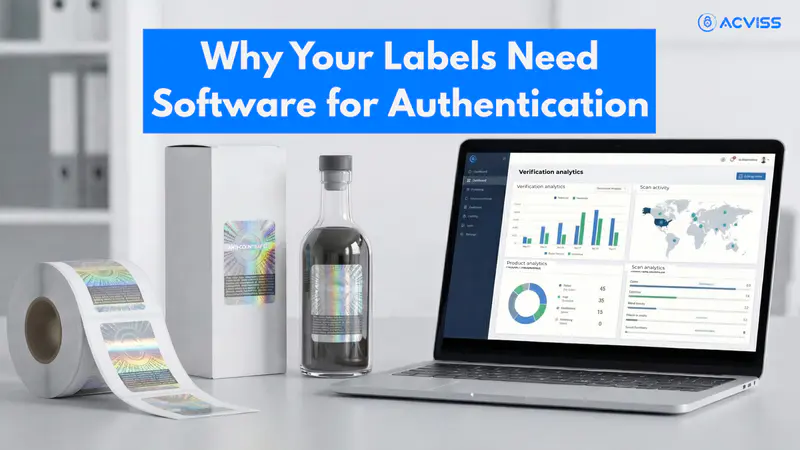
Labels are no longer judged by print alone. As supply chains grow more complex and verification becomes essential, a new expectation is emerging around connectivity, data and real-time interaction. This shift is quietly redefining the role of label manufacturers and the value they deliver.
For decades, the security printing industry has operated on a clear value proposition. Add complexity to the label, increase the cost of replication, and make counterfeiting economically unviable. Holograms, microtext, tamper-evident materials, colour-shifting inks and layered substrates became the tools of differentiation.
That model worked, for a time.
Today, however, the nature of counterfeiting has changed. Replication technologies have improved. Supply chains have fragmented. E-commerce has accelerated the movement of goods across borders. What was once difficult to copy is now increasingly reproducible at scale.
More importantly, brands are no longer satisfied with labels that are merely difficult to replicate. They want labels that can communicate, verify and generate data.
The shift is subtle but profound. The industry is moving from secure labels to connected security labels.
For label manufacturers, this is not just a technological shift. It is a business model transition.
The Shift in Security Printing: From Static Protection to Dynamic Verification
Brand owners today operate in an environment where Product Authentication is no longer optional. In sectors such as pharma, agrochemicals, electronics and luxury goods, the demand for Product Verification and Product traceability is being driven by both regulation and market pressure.
Frameworks such as EUDR and serialisation mandates require item-level traceability. At the same time, consumers expect instant Brand Authentication through simple digital interactions.
This has created a new expectation from labels.
Labels are no longer expected to only protect. They are expected to verify.
A hologram can signal authenticity. A scannable identity can prove it.
This distinction is reshaping procurement conversations between brands and label manufacturers.
What “Connected” Really Means

The term connected security label is often used loosely. In practical terms, it represents a shift from passive to active authentication.
A traditional label operates visually. It relies on human inspection and trained recognition. Even advanced features such as UV inks or microtext require specialised tools or expertise.
A connected label, by contrast, interacts with a digital system.
When scanned, it triggers Product Verification in real time. It communicates with a backend platform that validates the product identity, checks for duplication and records the interaction.
This enables:
Continuous Track and trace across the supply chain
Detection of duplicate or suspicious activity
Consumer-facing Brand Verification
Data-driven insights into product movement
The gap between a hologram and a connected label is therefore not incremental. It is architectural.
One is a feature. The other is a system.
Why Label Manufacturers Are Uniquely Positioned
There is a common misconception that the shift toward software-driven authentication reduces the relevance of label manufacturers.
The opposite is true.
Label manufacturers occupy a critical position in the value chain. They control the point at which physical identity is assigned to the product. They integrate directly with production lines. They maintain long-standing relationships with brand owners.
These factors create a strategic advantage.
First, integration is already embedded. Labels are applied at the point of manufacturing. Adding a digital identity layer at this stage ensures that Product traceability begins at the origin.
Second, trust is established. Brands rely on label manufacturers for security features that protect trademarks and IP Protection. Extending this trust into digital authentication is a natural progression.
Third, operational alignment is simpler. A connected label can be introduced without disrupting existing packaging workflows.
The opportunity is not to replace printing. It is to augment it.
The Business Case: From Transactional to Recurring Revenue

Traditional label manufacturing is inherently transactional. Revenue is tied to volume. Orders are placed, fulfilled and invoiced. Margins are influenced by material cost, complexity and scale.
Software changes this equation.
By introducing a white-label authentication software layer, label manufacturers can evolve into platform providers.
Instead of selling labels alone, they offer:
Connected security labels
Product Authentication infrastructure
Track and trace capabilities
Brand protection solutions
This creates a recurring revenue model.
Brands pay not only for the physical label but also for access to the authentication platform, analytics dashboard and verification services.
Industry data suggests that SaaS-based models can increase customer lifetime value significantly compared to one-time transactions. More importantly, they create stickiness.
Once a brand integrates Product Verification and Product traceability into its operations, switching providers becomes complex. This strengthens long-term relationships.
For label manufacturers, the shift from print to platform is not a threat. It is an expansion of value.
What It Takes to Integrate a Digital Authentication Layer

The transition to a smart label SaaS model requires both technical and commercial alignment.
Technical Considerations
At the core of a connected label is a unique, scannable identity. This may take the form of a QR code, serial number or encrypted identifier.
However, the value lies in the backend system.
A robust authentication platform must:
Generate unique, non-repeating identities
Detect duplication in real time
Integrate with ERP and Supply chain management systems
Provide Track and trace visibility
Support high-volume scan events
Equally important is the integrity of the identity itself.
Certify, built on non-cloneable technology, ensures that each product carries a secure identity that cannot be replicated through simple copying. This addresses one of the most critical vulnerabilities in traditional QR-based systems.
Without a non-cloneable identity, authentication risks becoming superficial. With it, Product Authentication becomes enforceable.
Commercial Considerations
From a commercial perspective, label manufacturers must rethink their offering.
Instead of positioning themselves purely as print vendors, they become solution providers.
This involves:
Educating clients on Product Verification benefits
Demonstrating ROI through reduced counterfeit leakage
Offering bundled solutions combining labels and software
Structuring pricing models that include platform access
The conversation shifts from cost per label to value per interaction.
The Role of Connected Labels in Brand Protection
Connected labels extend the scope of Brand protection beyond physical packaging.
They enable brands to:
Detect counterfeit infiltration through duplicate scans
Monitor product movement across regions
Identify diversion within distribution channels
Strengthen Trademark Protection and IP Protection
In sectors such as pharma, where product safety is critical, connected labels support regulatory compliance and reduce risk.
They also improve customer satisfaction by enabling consumers to verify authenticity instantly.
The label becomes a gateway to trust.
Data as the New Differentiator
One of the most overlooked benefits of connected security labels is data.
Every scan generates information.
This data can reveal:
Geographic demand patterns
Consumer engagement levels
Distribution inefficiencies
For brand owners, this insight supports better decision-making. For label manufacturers offering a digital platform, it becomes a value-added service.
Data transforms labels from static identifiers into intelligence nodes within the supply chain.
Choosing the Right White-Label Software Partner

For label manufacturers, the choice of software partner is critical.
Not all authentication platforms are built for scale or integration. Selecting the right partner determines whether the transition to a digital platform succeeds.
Key considerations include:
Ability to operate as a white-label authentication software solution
Scalability to handle large volumes across multiple clients
Integration with existing printing and packaging workflows
Support for non-cloneable identity technologies
Robust analytics and reporting capabilities
Flexibility to adapt to evolving regulatory requirements
A strong partner enables label manufacturers to offer a fully branded digital platform under their own identity.
This preserves client relationships while expanding service offerings.
The Strategic Opportunity Ahead
The security printing industry is at an inflexion point.
Brands are no longer satisfied with passive protection. They are demanding active verification, real-time visibility and data-driven insights.
Label manufacturers who continue to operate solely as print providers risk commoditisation.
Those who embrace the shift toward connected security labels and smart label SaaS models position themselves at the centre of a growing digital ecosystem.
They move from being suppliers to being partners in Brand Authentication, Product Verification and Supply Chain Management.
Conclusion
The transition from print to platform is not a disruption. It is an evolution.
Connected security labels represent the convergence of physical and digital authentication. They enable real-time Product Authentication, strengthen Brand protection and unlock new revenue streams through recurring platform models.
By integrating non-cloneable identity technologies such as Certify with white-label authentication software, label manufacturers can redefine their role in the value chain.
The question is no longer whether software will become part of the label industry. It already has.
The real question is who will lead that transformation.
Interested to learn more about how connected security labels and white-label authentication platforms can transform your business model? Get in touch with us.