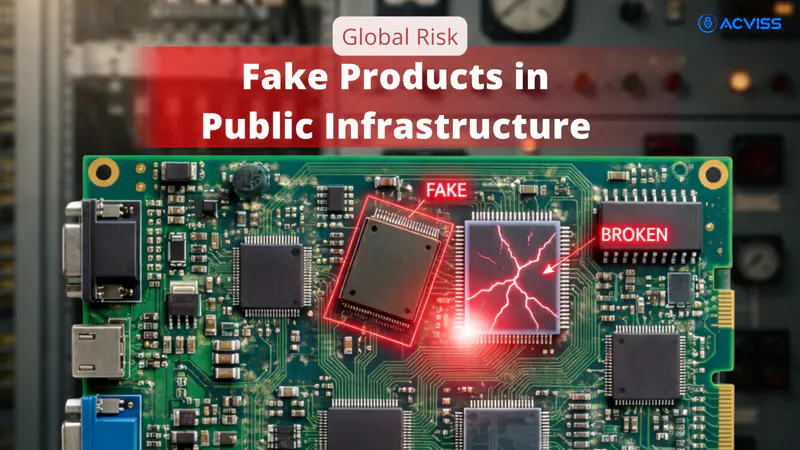
Public infrastructure is often associated with durability, safety, and trust. Roads are expected to hold, bridges to endure, electrical systems to function reliably, and medicines supplied through public health systems to heal rather than harm. Yet, beneath this assumption lies a largely unexamined risk that cuts across geographies and sectors: counterfeit products quietly entering government procurement systems.
While counterfeiting is widely discussed in the context of luxury goods, e-commerce, and consumer brands, its presence in public sector supply chains remains underreported and underestimated. This is even though governments are among the largest buyers of goods globally, often procuring at volumes that rival or exceed private industry.
This creates a paradox. The very systems designed to serve the public good are increasingly vulnerable to supply chain fraud, where fake, substandard, or misrepresented products infiltrate critical infrastructure.
The Scale of Counterfeit Products in Government Procurement
The global public procurement market is immense. According to estimates from organisations such as the World Bank and OECD, government procurement accounts for 12 to 20 per cent of GDP in many countries. This translates into trillions of dollars spent annually on goods ranging from pharmaceuticals and construction materials to electrical components and automotive parts.
Within this vast ecosystem, even a small percentage of counterfeit infiltration represents a significant risk.
In sectors such as electronics alone, reports have highlighted that up to 15 per cent of components in certain high-risk supply chains may be counterfeit or suspect. When extrapolated to public infrastructure projects, the implications are profound. A single compromised component in a power grid or transportation system can trigger cascading failures.
The issue is not limited to developing economies. Advanced procurement systems in North America and Europe have also documented cases of counterfeit electronic parts entering defence and public infrastructure programmes. The United States Department of Defence, for instance, identified over 1,800 cases of suspect counterfeit electronic parts in its supply chain during a two-year investigation period.
These figures point to a systemic vulnerability rather than isolated incidents.
Why Government Procurement Is Structurally Vulnerable
At the heart of the problem lies the structure of public procurement itself. Designed to ensure fairness, transparency, and cost efficiency, these systems often unintentionally create conditions that allow counterfeit products to enter.
1. The Lowest-Bid Paradox
Most governments tend to prioritise cost competitiveness. Contracts are frequently awarded to the lowest bidder, provided minimum compliance requirements are met.
This approach creates pressure on suppliers to reduce costs aggressively. In highly competitive categories, this often leads to sourcing from unverified or grey-market suppliers, increasing the likelihood of counterfeit or substandard products entering the supply chain.
2. Multi-Tier Vendor Chains
Government procurement rarely involves direct sourcing from original manufacturers. Instead, it operates through multi-layered vendor networks, including contractors, subcontractors, distributors, and intermediaries.
Each additional layer introduces opacity. By the time a product reaches the end point, its origin may be difficult to verify, particularly in the absence of robust track-and-trace mechanisms.
3. Weak Verification Frameworks
Unlike private enterprises that invest heavily in brand protection solutions and supplier audits, public procurement systems often rely on documentation-based verification.
Certificates of origin, compliance documents, and supplier declarations are standard practice. However, these are increasingly susceptible to forgery or manipulation. Without strong product authentication or product verification systems, documentation alone cannot guarantee authenticity.
Category Hotspots: Where the Risk Is Highest
Certain product categories within public procurement are particularly vulnerable to counterfeiting due to high demand, complex supply chains, and difficulty in visual verification.
1. Electrical Infrastructure

Transformers, circuit breakers, cables, and semiconductors are critical components in public utilities. Counterfeit versions may look identical but often fail under load, leading to outages, fires, or equipment damage.
The defence sector’s experience with counterfeit electronic components has demonstrated how even minor deviations in specifications can compromise entire systems.
2. Public Health Pharmaceuticals

The presence of counterfeit drugs in public healthcare systems is one of the most dangerous manifestations of the problem.
The World Health Organisation estimates that 1 in 10 medical products in low and middle-income countries is substandard or falsified. When such products enter government supply chains, the consequences extend beyond financial loss to direct threats to patient safety.
Here, product safety, product traceability, and brand authentication are not just operational concerns but matters of life and death.
3. Construction Materials

Steel, cement, and structural components form the backbone of infrastructure projects. Counterfeit or substandard materials can weaken structures, leading to premature degradation or catastrophic failure.
Unlike consumer goods, these failures may take years to surface, making accountability difficult.
4. Automotive and Transport Components

Public transport systems rely on a range of components, from brake systems to engine parts. Counterfeit components in these systems increase the risk of accidents and operational inefficiencies.
Real Incidents That Reveal the Extent of the Problem
The issue of counterfeit products in public infrastructure is not theoretical. Multiple documented cases highlight its real-world impact.
In the United States, counterfeit electronic components were found in military aircraft and critical defence systems, prompting regulatory reforms under the National Defence Authorisation Act.
Several countries have reported the presence of falsified medicines within public health supply chains, particularly during high-demand periods such as pandemics.
Infrastructure audits in parts of Asia and Africa have revealed the use of substandard construction materials in publicly funded projects, leading to structural failures.
These incidents underscore a common pattern: counterfeit products often enter through legitimate procurement channels, exploiting gaps in verification and oversight.
What Verification Looks Like Today and Why It Falls Short

Current verification practices in government procurement are largely documentation-driven and reactive.
1. Traceability Requirements
In advanced systems such as those implemented by defence organisations, procurement policies mandate:
Certificates of Origin
Supplier authorisation records
Chain-of-custody documentation
While these measures are essential, they are not sufficient. Documentation can be falsified, and traceability often breaks down across multi-tier supply chains.
2. Inspection and Testing
Physical inspection and laboratory testing are used to identify counterfeit products. However, these methods are:
Time-consuming
Cost-intensive
Limited to sampling rather than full-scale verification
This creates a gap between compliance and actual authenticity.
3. Reporting Mechanisms
Systems such as the Government-Industry Data Exchange Program (GIDEP) enable the reporting of suspect parts. However, these are reactive mechanisms, activated only after counterfeit products have already entered the system.
The Policy Case for Stronger Anti-Counterfeiting Frameworks

Addressing counterfeit government procurement requires a shift from reactive compliance to proactive verification.
1. Moving Beyond Documentation
Governments need to transition from paper-based verification to technology-driven product authentication. This involves embedding authenticity at the product level rather than relying solely on supplier declarations.
2. Integrating Track and Trace Systems
End-to-end track-and-trace capabilities can provide visibility across the supply chain, enabling stakeholders to verify the origin and movement of products in real time.
Such systems are already being explored in regulatory frameworks such as the EUDR, which emphasises traceability and transparency in supply chains.
3. Supplier Risk Classification
Adopting a tiered sourcing approach similar to defence procurement can help prioritise trusted suppliers while imposing stricter verification requirements on high-risk sources.
The Role of Advanced Authentication Technologies
Technological innovation is reshaping how authenticity can be established in complex supply chains.
1. Non-Cloneable Security Mechanisms
Modern anti-counterfeiting solutions are moving towards non-cloneable, tamper-evident technologies that provide each product with a unique identity.
These solutions go beyond traditional barcodes or QR codes, which can be easily replicated.
2. Digital Product Passports
By linking physical products to digital records, organisations can create a verifiable history of each item. This enhances product traceability and enables real-time product verification at any point in the supply chain.
3. Integration with Procurement Systems
When integrated into procurement workflows, these technologies allow government agencies to verify authenticity at the point of purchase, during storage, and at the point of use.
A solution such as Certify, which leverages non-cloneable codes for product authentication, can serve as a plug-in within existing procurement systems. By enabling instant verification, it reduces reliance on documentation and strengthens brand protection at scale.
How Some Governments Are Addressing the Problem
While the challenge is widespread, certain governments and organisations have taken significant steps to mitigate risks.
1. United States: Regulatory Enforcement
The introduction of DFARS regulations has made it mandatory for contractors to implement counterfeit detection and avoidance systems. Non-compliance can result in financial penalties and disqualification from contracts.
2. European Union: Traceability Initiatives
Regulatory frameworks increasingly emphasise product traceability and digital record-keeping, particularly in sectors such as pharmaceuticals and environmental compliance.
3. Defence Sector Innovations
The adoption of technologies such as Item Unique Identification (IUID) and advanced marking systems reflects a shift towards lifecycle traceability and real-time verification.
These approaches highlight a broader trend: moving from reactive detection to proactive prevention.
The Broader Implications for Brand Protection and Public Trust
The presence of counterfeit products in public infrastructure has implications that extend beyond operational risk.
1. Erosion of Public Trust
Citizens expect government systems to ensure safety and reliability. Failures caused by counterfeit products undermine confidence in public institutions.
2. Impact on Legitimate Manufacturers
Counterfeit infiltration distorts markets, affecting legitimate manufacturers who adhere to quality standards and IP protection norms.
3. Long-Term Economic Costs
The cost of replacing faulty infrastructure, addressing safety failures, and managing legal liabilities often far exceeds the initial savings achieved through low-cost procurement.
Rethinking Public Procurement for a High-Risk World
The conversation around counterfeit products must expand beyond consumer markets to include public infrastructure.
Government procurement systems need to evolve to address modern supply chain risks. This involves:
Embedding product authentication at the source
Strengthening track and trace capabilities
Integrating anti-counterfeiting technologies into procurement workflows
Enhancing supplier accountability through risk-based frameworks
Most importantly, it requires recognising that counterfeiting is not merely a compliance issue but a systemic risk to safety, trust, and economic stability.
A Call for Proactive Action
Counterfeit products in public infrastructure represent one of the most critical yet overlooked challenges in modern supply chains. As procurement volumes grow and supply chains become more complex, the risk will only intensify.
For governments, the path forward lies in combining policy reform with technological innovation. For brands and manufacturers, it presents both a challenge and an opportunity to strengthen brand protection, enhance customer satisfaction, and ensure product safety.
Solutions built around non-cloneable authentication, such as Certify, demonstrate how authenticity can be embedded directly into products, enabling seamless product verification across the supply chain.
The question is no longer whether counterfeit products are entering public infrastructure, but how effectively they can be prevented.
Interested to learn more about how advanced product authentication and track and trace solutions can safeguard your supply chain? Get in touch with us.