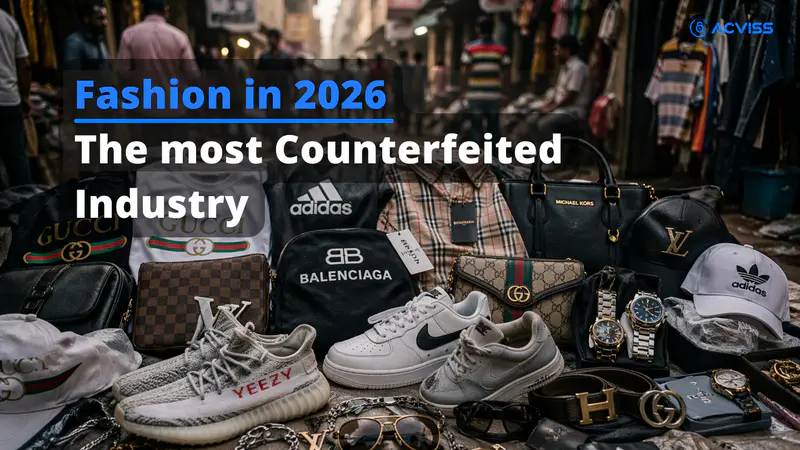
Walk into any major customs checkpoint, and the pattern is mostly the same. When seizures happen, the boxes are usually packed with clothes, shoes, and handbags.
Clothing, footwear, and leather goods make up 62% of all counterfeit items seized globally. Here is something more worrisome. The fashion and apparel sector isn't just targeted the most; it's also the least equipped to fight back. Most brands still rely on reactive legal takedowns, manual audits, and trademark filings that do little to stop a counterfeit supply chain that moves faster than any litigation process.
The gap is costly. The EU fashion industry alone loses approximately €26 billion annually to counterfeit goods. Globally, the trade in fake apparel, footwear, and accessories exceeds $450 billion a year. On the other hand, the explosion of social commerce and the incoming EU Digital Product Passport (DPP) mandate for textiles are coming into picture, making the window for a reactive approach close fast.
This blog breaks down why fashion became the world's most counterfeited industry, what's making it harder to protect, and what brands at every price point need to do about it.
Why Fashion Attracts More Counterfeiting Than Any Other Category
The fashion industry's counterfeiting problem is because of a specific combination of economics and psychology that makes it uniquely exploitable. Simple manufacturing, powerful aspiration, and a fragmented supply chain, make fashion a structurally perfect target.
Let's take a look at it in detail:
The margin disconnect: A garment manufacturing is relatively low-tech. A cotton t-shirt or a leather-look handbag can be produced in any number of unregulated factories for a few dollars. The value of a cloth lives in the brand logo, not the material. Counterfeiters understand this perfectly. They replicate the logo, not the quality, and sell it at markups that rival the original product.
Aspirational demand at scale: Fashion is one of the few industries where the product signals social identity. Consumers want the status associated with a brand even when they can't access it at full price. This creates a massive, willing market for low-quality knockoffs, as well as for what the industry now calls "superfakes": replicas so well-made that even trained buyers struggle to distinguish them from originals. In 2025, authentication scans for luxury handbags and sneakers surged 40–50% in the US, driven by buyers demanding proof before purchase.
A supply chain built for blind spots: The global apparel supply chain is one of the most fragmented in any industry. Raw materials are sourced in one country, processed in another, and assembled in massive hubs across South and Southeast Asia. This complexity creates natural blind spots, particularly the "third shift" phenomenon, where authorized factories run unauthorized production runs using the same machines, same fabrics, and same workers after official working hours end. The output is indistinguishable from the genuine product, yet it enters the market as a counterfeit.
The Counterfeiting Pipeline: From Factory to Front Door

The counterfeit apparel pipeline has evolved from physical markets in specific cities to a distributed, digitally-driven global operation.
Production still clusters in a handful of known regions. But because major textile-exporting nations are also among the world's largest legitimate garment producers, counterfeit shipments routinely hide inside legitimate trade routes. Mislabeled origin tags are common, in fact, customs officials report that nearly 30% of fake textile shipments contain falsified country-of-origin documentation specifically to bypass tariff scrutiny and inspections.
The bigger shift is in last-mile distribution. The days of bulk container shipments heading to grey markets are increasingly supplemented by a high-volume, low-detection approach: small individual parcels, shipped directly to consumers' homes. Less than 2% of shipping containers entering major ports are physically inspected, but single parcel customs checks are even more difficult to execute at scale. Counterfeiters have effectively arbitraged the logistics system to bypass bulk inspection entirely.
This is why the problem doesn't just affect luxury brands. Mid-market and even FMCG-adjacent fashion labels are now targeted, because counterfeiters aren't just chasing margin, they're chasing volume.
The Authentication Challenge Nobody Talks About
If counterfeiting is this severe, why aren't all garments authenticated? The answer is that textiles present a set of physical authentication challenges that other industries don't face.
You cannot easily print a secure, scannable QR code directly onto cotton, silk, polyester, or denim. Fabric stretches. It moves. It goes through industrial washing with harsh chemicals, high-temperature dryers, and dry-cleaning solvents that degrade most printed codes within weeks of normal use. The material that carries the authentication marker in a pharmaceutical blister pack or an electronics box simply doesn't exist on a garment.
This is why effective textile serialisation relies on tag-based systems rather than direct-print solutions.
Authentication must be embedded in:
Woven care labels using durable thread-bound security markers that survive industrial laundering
Hang tags with non-cloneable QR codes that are scanned at point-of-sale or post-purchase by the consumer
Heat-transfer security patches applied during final garment finishing, designed to show tamper evidence if removed
Effective counterfeit clothing authentication in textiles is a logistics problem as much as it is a technology problem.
Social Commerce Is the New Counterfeit Catalog
Nothing has changed the distribution economics of counterfeit fashion more dramatically than social commerce.
Roughly 20% of fashion products advertised on social media platforms are fake. Approximately 50,000 active accounts on Instagram alone are dedicated to promoting counterfeit fashion at any given time. The hashtag #dupe has generated over 2 billion views on TikTok, creating a cultural movement that has normalised finding "lookalike" versions of premium products.
The mechanics of social media counterfeiting are deliberately agile. Scammers steal legitimate brand imagery and run highly targeted ads that direct users to temporary storefronts which are often hosted on platforms built for fast setup and faster takedown. By the time a brand's legal team issues a cease-and-desist or files a platform complaint, the seller has already processed thousands of orders, collected payment, and opened a new account under a different name with a new store URL.
This is the core challenge for fashion brand anti-counterfeiting teams operating in 2026: the adversary doesn't need permanence. They only need a few hours of visibility to a targeted audience. The traditional model is too slow. It monitors, detects, files a takedown request, waits 30 days while the threat resets daily.
Instagram and TikTok Shop have also created a secondary distribution challenge: influencer-adjacent promotion. Counterfeit sellers don't always advertise directly. They seed fake products to micro-influencers, generate organic content, and build social proof before the platform even registers the account as suspicious. The result is that counterfeit apparel now reaches consumers through channels that look indistinguishable from legitimate brand marketing.
The EU Digital Product Passport Mandate: What Fashion Brands Must Know

For brands that have been delaying serious investment in authentication and traceability, the European Union is about to make the decision for them.
The EU Digital Product Passport (DPP) is part of the Ecodesign for Sustainable Products Regulation (ESPR), which officially entered into force in June 2024. For the textile and apparel sector, the timeline is clear and accelerating. The delegated act defining specific DPP requirements for textiles is expected to be published in late 2026 or early 2027, followed by a compliance period of 12 to 18 months. Under the most widely cited projections, EU DPP fashion brands will need to be operationally compliant by mid-2027 to 2028.
What this means in practice is significant. Every textile product sold in the EU market must carry a machine-readable digital record, regardless of where the brand is headquartered. It should contain:
Fibre composition and recycled content percentages
Country of origin for key production stages (weaving, dyeing, finishing)
Chemical compliance documentation
Environmental impact metrics: water consumption, carbon footprint
Care and end-of-life instructions
Traceability data across the supply chain
The DPP is accessed via a QR code or NFC tag physically attached to the product. For consumers, it's a transparency tool. For regulators, it's an audit mechanism. For brands, it's a compliance threshold: products entering the EU without a valid DPP face market exclusion, customs blockage and CE marking denial.
Here is the part that many brands haven't fully absorbed yet: a DPP is impossible to implement without item-level serialisation. You cannot create a unique, scannable digital identity for every product unit if you don't have serialisation infrastructure in place. The DPP mandate is not just a sustainability reporting requirement, it is a de facto mandate for product authentication technology.
Brands that begin building their serialisation and traceability infrastructure now will meet both requirements simultaneously. Brands that wait for the delegated act to be finalised in 2027 will be scrambling to implement in 12 months what realistically takes 18 to 36 months to do correctly across a global supply chain.
How Fast Fashion Complicates Brand Protection

The DPP compliance challenge is hardest for fast fashion brands, and the timing is particularly difficult.
Fast fashion's entire competitive model depends on speed. A design moves from concept to shelf in weeks. The supply chain is optimised for velocity, not verification. Adding serialisation and label authentication to production processes at this pace creates friction that directly impacts the core business metric.
The problem compounds at the supplier tier. Fast fashion brands frequently work with dozens of contract manufacturers, often in multiple countries, many of whom are simultaneously producing for several brands. Training these factories to apply authentication labels correctly, in sequence, without disrupting production line velocity is operationally demanding. The risk is either production slowdown or incorrect label application, both of which defeat the purpose of the system.
The solution for fast-fashion-scale apparel counterfeiting brand protection is pre-serialised authentication assets. Rather than serialising at the point of production, authentication tags are pre-numbered and shipped to factories ahead of the production run, mapped to specific SKUs and batches. Factory workers apply a pre-assigned tag to a pre-assigned product, and the serialisation record is created in the supply chain platform. This approach preserves manufacturing velocity while creating the digital audit trail the DPP requires.
A Tiered Protection Approach for Apparel Brands
Not all fashion requires the same level of security investment. Brands must match authentication strategy to their commercial reality.
Luxury and high-end fashion requires multi-layer authentication. A combination of NFC chips embedded into the garment lining and non-cloneable QR codes on authenticity cards or hang tags provides both consumer-facing verification and secondary market control. The goal is absolute proof of provenance, enabling the brand to participate in and verify resale transactions. At this tier, the authentication system also serves as a marketing asset, consumers expect and value the verification experience.
Mid-market and premium brands need scalable counterfeit clothing authentication that works at high production volume. High-durability woven care labels embedded with secure QR codes that survive industrial washing allow consumers to verify authenticity with a smartphone scan at any point in the product's life. This tier also benefits from connecting verification to loyalty programs: a genuine scan becomes a brand engagement moment, not just a compliance check.
Fast fashion and volume apparel has a different priority. At this price point, the primary risk is supply chain diversion and grey market leakage rather than individual item counterfeiting. Basic QR serialisation on hang tags, designed primarily for supply chain visibility and EU DPP compliance, is the appropriate investment. It creates the audit trail that regulators require, helps identify where genuine products are being diverted into unauthorized channels, and builds the infrastructure for future authentication layers as the brand scales.
The common thread across all three tiers is this: building the infrastructure now is cheaper than reactive enforcement later. Legal takedowns, customs seizures, and brand reputation recovery each cost multiples of what prevention infrastructure would have required.
How Acviss Helps
Fashion brands can no longer afford to treat supply chain visibility, sustainability reporting, and brand protection as three separate projects. They all depend on the same physical object—the garment—carrying a verifiable digital identity.
Acviss Certify provides non-cloneable authentication labels specifically designed for the physical demands of textile authentication. These can be integrated into hang tags, woven care labels, and adhesive patches, giving every unit a unique, unforgeable identity that consumers can verify with a smartphone scan. Unlike standard QR codes, Certify labels are built with patented multi-layer security that cannot be reproduced even if a counterfeit factory copies the visual design.
Acviss Origin provides the blockchain-backed supply chain traceability layer that the EU DPP mandate requires. Every production event, right from fabric roll to finished garment, is recorded as an immutable entry on the blockchain, creating the full provenance record that EU regulators and buyers will soon require as a condition of market access.
Together, these two tools solve the two biggest problems the fashion industry faces with a single scan: consumer-facing authentication that eliminates social commerce fakes, and supply chain traceability that satisfies the EU DPP obligation without building two separate infrastructure projects.
FAQs
What is the EU Digital Product Passport (DPP) for textiles and when does it apply?
The EU DPP is a mandatory digital record for every product sold in the EU market, covering material composition, supply chain provenance, environmental impact, and end-of-life information. For textiles, the delegated act is expected in late 2026 or early 2027, with an 18-month compliance window—meaning enforcement is likely to begin between mid-2027 and 2028.
Why can't brands just print QR codes directly on garments for authentication?
Fabric stretches, moves, and undergoes industrial washing and chemical treatment that degrades most direct-print codes rapidly. Effective textile serialisation requires durable tag-based solutions—woven care labels, hang tags, or heat-transfer patches—that survive the product lifecycle while remaining scannable.
How does social commerce make counterfeit fashion harder to stop?
Social platforms allow counterfeiters to run targeted ad campaigns using stolen brand imagery, direct consumers to temporary storefronts, collect payment, and shut the operation down before a takedown request is processed. The cycle resets within hours. Traditional monitoring and legal approaches are too slow to match this pace.
Do non-EU brands need to comply with the EU Digital Product Passport?
Yes. Regardless where it is headquartered, every brand placing products on the EU market, must comply with DPP requirements. Non-compliance means market exclusion via CE marking denial and customs blockage.
How long does it take to implement textile serialisation across a global supply chain?
Full implementation, including supplier onboarding, label production infrastructure, and system integration, typically takes 18 to 36 months depending on supply chain complexity and IT maturity. Brands targeting EU DPP compliance by 2028 should be building this infrastructure now.