Customer support has traditionally begun with a problem.
A consumer notices a defect, a missing accessory, a damaged seal, or a product that does not perform as expected. They search for a helpline number, wait on hold, repeat the serial number to an agent, and often send photographs by email. The brand then verifies purchase authenticity, checks warranty status, and attempts to trace the product batch.
The entire interaction is reactive, fragmented and time-consuming.
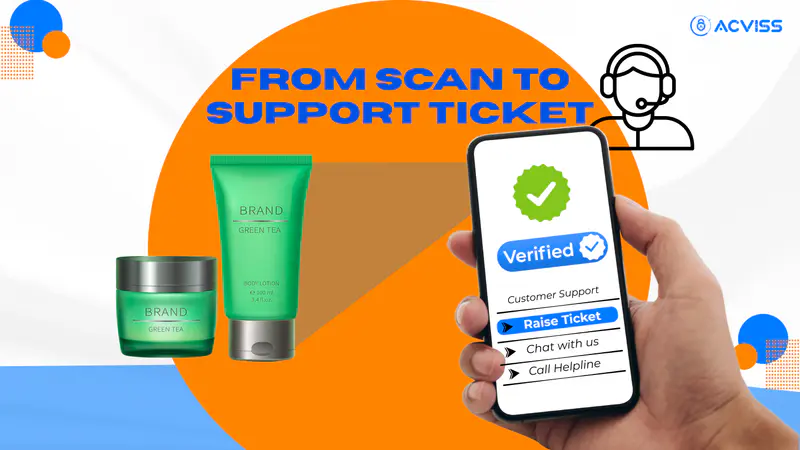
Connected packaging changes this equation. It transforms the moment of product verification into the starting point of structured, automated consumer support. With QR-based support systems, non-cloneable technology and integrated track and trace workflows, a simple scan can move seamlessly from authentication to automated support ticket creation.
For brands operating in sectors such as pharma, electronics, automotive components and FMCG, this shift is no longer optional. It is foundational to product safety, customer satisfaction and long-term brand protection.
The Growing Pressure on Consumer Support Teams
Consumer expectations have shifted dramatically in the last five years. According to Microsoft’s Global State of Customer Service report, over 90 per cent of consumers consider customer service a critical factor in brand loyalty. At the same time, customers expect instant responses and personalised solutions.
Meanwhile, counterfeit products continue to infiltrate markets. OECD estimates suggest that counterfeit goods account for over 3 per cent of global trade. For sectors such as pharma, the stakes are far higher. Substandard or falsified medicines can directly compromise product safety and human lives.
This convergence of expectations and risks creates a challenge:
Support teams must verify product authenticity quickly
They must confirm warranty eligibility
They must identify batch-level issues
They must detect fraudulent claims
Without connected systems, this process is slow and error-prone.
What Is Connected Packaging?
Connected packaging refers to the integration of digital technologies into product packaging to enable interaction, data exchange and automated workflows. At its core, it often involves secure QR codes or unique digital identifiers printed on every unit.
However, not all QR codes are equal.
A static QR that simply redirects to a website offers limited functionality. A secure, serialised QR supported by non-cloneable technology enables product authentication, product verification and backend intelligence.
Connected packaging becomes the bridge between physical products and digital systems.
From Product Authentication to Consumer Support

The true power of connected packaging lies in the journey it enables.
Step 1: Product Authentication and Brand Verification
When a consumer scans a secure QR code, the system first performs product authentication. The code is checked against a central database to confirm its validity.
If the code is unique and unused, the system confirms brand authentication. If the code has been scanned multiple times in different geographies, the system flags it as suspicious, strengthening anti-counterfeiting solutions and IP protection.
This initial scan performs critical functions:
Confirms product safety
Protects trademark integrity
Supports trademark protection and IP protection efforts
Strengthens brand protection
Only once authenticity is confirmed does the workflow proceed to the next stage.
Step 2: Automated Data Capture
Instead of asking the consumer to manually enter batch numbers, invoice details or serial codes, the scan itself carries embedded product data:
Manufacturing date
Batch number
Distribution channel
Warranty status
This is made possible through integrated track and trace systems and product traceability infrastructure.
When connected to a robust backend such as a blockchain-enabled track and trace framework, similar to a plugin of Origin, each unit carries a verifiable digital identity. That identity simplifies supply chain management while simultaneously enabling support automation.
The support team no longer needs to verify authenticity manually. The system has already done it.
QR-Based Support: Reducing Friction at Every Step

Traditional support workflows typically involve five stages:
Consumer identifies the issue
Consumer contacts helpline
Agent verifies product authenticity
The agent checks the warranty or eligibility
The ticket is created and escalated
Connected packaging compresses this process into a streamlined digital flow.
Instant Ticket Generation
Once the product is verified through secure QR scanning, the interface can present a contextual support form. The form is pre-filled with product details retrieved from the backend.
The consumer selects the issue category, uploads optional photographs and submits.
A support ticket is generated automatically, linked directly to:
Product batch
Distribution data
Warranty information
Previous scan history
This reduces average handling time significantly. Industry studies suggest that automated workflows can reduce support processing time by up to 30 per cent, while improving first-contact resolution rates.
Fraud Detection and Warranty Abuse Prevention
Warranty fraud is a persistent challenge across electronics, appliances and automotive sectors. Without robust product verification, brands struggle to detect duplicate claims.
With non-cloneable technology integrated into QR-based support systems, each scan can be logged and analysed. If the same code is used repeatedly in unrelated cases, the system flags anomalies instantly.
This protects revenue and strengthens brand authentication processes.
Connected Packaging in Pharma and Regulated Industries
In pharma, the importance of product traceability and track and trace compliance cannot be overstated. Regulatory frameworks increasingly demand detailed supply chain visibility.
Connected packaging supports:
Expiry tracking
Recall management
Compliance with evolving regulations, including EUDR
If a batch issue arises, brands can quickly identify affected units and notify consumers directly through digital channels.
This is not merely a support feature. It is a product safety imperative.
When a patient scans a medicine for product verification, the system can simultaneously:
Confirm authenticity
Display dosage information
Provide adverse reaction reporting forms
Connect directly to support services
The boundary between authentication and assistance disappears.
Enhancing Customer Engagement and Satisfaction

Consumer support is often treated as a cost centre. Connected packaging reframes it as a strategic touchpoint.
Once a secure QR is scanned, the brand has a direct line to the consumer. Beyond solving the immediate issue, the interface can:
Offer educational content
Provide maintenance guidance
Encourage feedback
Invite participation in loyalty programmes
This strengthens customer engagement and customer satisfaction.
Research consistently shows that consumers who experience fast, transparent support are more likely to remain loyal, even after encountering a product issue.
By combining product authentication with support automation, brands demonstrate accountability and responsiveness.
The Role of Non-Cloneable Technology
Standard QR codes can be copied. If a counterfeit product carries a replicated QR code, the system may not detect it immediately unless serialisation and duplication detection mechanisms are in place.
Non-cloneable technology addresses this vulnerability. Each code is generated using cryptographic logic that prevents predictable replication. When combined with backend duplication detection, it ensures:
One code equals one product
Suspicious scan patterns are flagged
Counterfeit infiltration is identified early
For brand protection and anti-counterfeiting solutions, this layer is critical.
Without secure authentication technologies, connected packaging risks becoming a cosmetic feature rather than a security asset.
Connected Workflows and Supply Chain Management
Consumer support automation is only one dimension. The data collected through QR-based interactions feeds directly into broader supply chain management systems.
Every scan contributes to:
Geographical distribution insights
Channel performance analysis
Grey market detection
Demand forecasting
If a product intended for one region appears repeatedly in another, the system highlights potential diversion.
This strengthens product traceability and brand verification across markets.
By integrating support workflows with track and trace infrastructure, brands achieve a unified view of product movement and consumer interaction.
Financial and Operational Impact
The financial implications of connected packaging extend beyond reduced call centre load.
Consider the cumulative benefits:
Lower support handling costs
Reduced fraudulent warranty claims
Improved recall efficiency
Enhanced compliance reporting
Increased customer lifetime value
According to Deloitte, organisations that successfully implement customer service automation often see cost reductions of 20 to 40 percent while improving satisfaction metrics.
When product authentication systems are integrated with support workflows, the return on investment becomes measurable.
Trademark and IP Protection Through Data
Counterfeit complaints often surface first in customer support channels. Without structured authentication, these complaints may remain anecdotal.
Connected packaging transforms scattered reports into structured intelligence.
Repeated counterfeit alerts in a specific region can trigger an investigation. Data-driven evidence strengthens trademark protection cases and IP enforcement actions.
Brand protection becomes proactive rather than reactive.
By embedding authentication technologies directly into packaging, brands defend their intellectual property at the unit level.
Designing a Future-Ready Support Ecosystem
For brands considering the transition, the key is integration.
A connected packaging ecosystem should include:
Secure QR-based product authentication
Integrated track and trace infrastructure
Automated support ticket workflows
Analytics dashboards for supply chain and support teams
A plugin architecture, such as leveraging a blockchain-enabled track and trace backbone similar to Origin, allows brands to layer consumer support automation onto existing infrastructure.
The result is a closed-loop system where authentication, traceability and support operate in synchrony.
The Human Side of Automation
Automation should never feel impersonal.
The most effective connected packaging systems use automation to eliminate friction, not empathy. When a consumer scans a product and receives instant validation and contextual assistance, the experience feels reassuring rather than robotic.
Transparency builds trust.
By clearly communicating product safety information, verification results and next steps, brands signal accountability. This strengthens long-term customer satisfaction and loyalty.
Conclusion
Connected packaging represents more than a technological upgrade. It is a structural shift in how brands manage product authentication, consumer support and brand protection.
From the first scan to the creation of a support ticket, secure QR-based systems simplify workflows, reduce fraud, enhance supply chain management and improve customer engagement.
In sectors such as pharma and regulated industries, the benefits extend to compliance, product safety and life-critical traceability.
By integrating non-cloneable technology, track and trace infrastructure and automated support solutions, brands move from reactive problem-solving to proactive intelligence.
Interested to learn more? Get in touch with us to explore how connected packaging and advanced product authentication technologies can simplify consumer support while strengthening brand protection for the years ahead.