Industrial manufacturing has long operated on a principle of precision and predictability. Machines are expected to perform within defined tolerances, components are assumed to meet certified specifications, and procurement decisions are often driven by reliability rather than risk.
Yet beneath this structured environment lies a growing and largely underestimated threat: counterfeit industrial components.
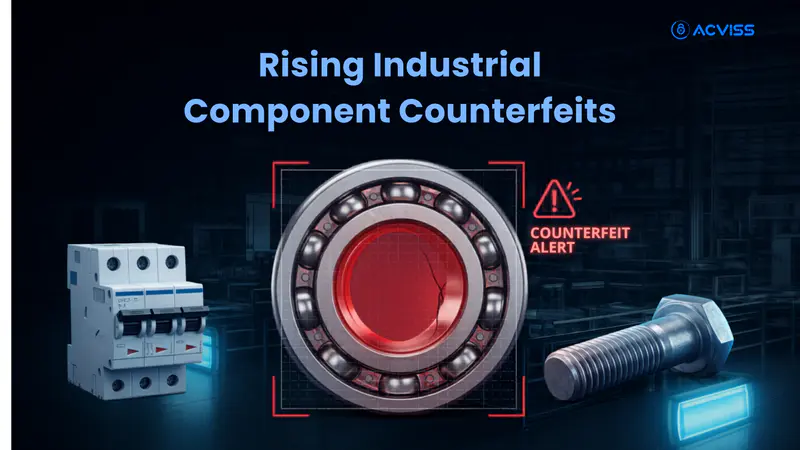
Unlike consumer counterfeits that are visible and often obvious, fake bearings, fasteners, and electrical parts are silent infiltrators. They do not announce themselves. They perform, sometimes convincingly, until the moment they fail. And when they do, the consequences are not limited to financial losses. They extend to operational shutdowns, regulatory violations, and in many cases, human safety.
The Rising Target: Why Industrial Components Attract Counterfeiters
The global trade in counterfeit goods is estimated between $467 billion and $600 billion, with industrial components forming a rapidly expanding segment. Over the last two decades, counterfeiting activity has grown exponentially, fuelled by globalised supply chains and digital procurement channels.
Three characteristics make industrial components particularly attractive:
1. High Value, High Replacement Frequency
Components such as bearings, circuit breakers, and structural fasteners are frequently replaced. This creates consistent demand and recurring procurement cycles, making them ideal targets for counterfeiters seeking repeat entry into the fake parts supply chain.
2. Technical Complexity
Industrial parts are engineered to precise specifications. However, verifying these specifications often requires specialised equipment or destructive testing. This complexity allows counterfeiters to mimic external features while compromising internal integrity.
3. Verification Gaps
Unlike consumer goods, industrial components are rarely verified at the individual unit level during goods-in inspection. Procurement teams rely heavily on supplier credibility and documentation, creating a blind spot that counterfeiters exploit.
High-Risk Sectors: Where the Stakes Are Highest
Counterfeit industrial components do not impact all sectors equally. Some industries are significantly more exposed due to their reliance on safety-critical systems.
1. Food Processing and Pharmaceutical Manufacturing
In sectors such as food production and pharmaceutical manufacturing, equipment failure can lead to contamination, regulatory non-compliance, and compromised product safety. A counterfeit bearing in a processing line can introduce metal fragments into consumables, triggering recalls and damaging customer satisfaction.
2. Oil and Gas
The oil and gas industry operates under extreme pressure and temperature conditions. Counterfeit fasteners or valves can result in leaks, explosions, or environmental disasters. The cost of failure extends far beyond equipment damage.
3. Construction and Infrastructure
Structural integrity depends on certified fasteners and load-bearing components. Substandard materials can weaken entire frameworks, increasing the risk of collapse.
4. Automotive Manufacturing
Modern automotive production relies on precision-engineered parts. Counterfeit components in assembly lines can lead to defective vehicles, warranty claims, and large-scale recalls.
When Counterfeit Components Fail: The True Cost

The immediate cost of counterfeit parts often appears attractive. These components are typically priced 20 to 30 per cent lower than genuine alternatives. However, this perceived saving is misleading.
Industry analysis shows that the total cost of ownership of counterfeit components can be up to 21 times higher than genuine parts.
1. Operational Impact
A failed bearing can halt an entire production line. In high-throughput environments, even a few hours of downtime can result in substantial revenue loss.
2. Safety Risks
Counterfeit electrical components, such as circuit breakers, frequently fail to meet safety standards. This can lead to electrical fires, equipment damage, and worker injury.
3. Legal and Compliance Exposure
Regulations governing product safety, particularly in industries like pharma and food processing, are stringent. The use of non-compliant components can result in penalties, legal liability, and loss of certifications.
4. Reputational Damage
Customers and partners expect reliability. A single incident involving counterfeit parts can erode trust built over years, impacting long-term brand verification and IP protection efforts.
How Counterfeit Components Enter the Supply Chain
The infiltration of counterfeit industrial components is rarely accidental. It is systematic and increasingly sophisticated.
1. Grey Market Distribution
The grey market operates through unauthorised resellers who may offer genuine or counterfeit products. Even when parts are authentic, they often lack traceability, proper storage records, and warranty coverage.
2. Online B2B Platforms
Digital procurement platforms have simplified sourcing but also reduced visibility. Listings with forged certifications and misleading descriptions make it difficult to distinguish between verified and counterfeit suppliers.
3. Documentation Forgery
Counterfeiters replicate certificates, test reports, and compliance documents with alarming accuracy. Procurement teams relying solely on paperwork are particularly vulnerable.
4. Blended Shipments
A common tactic involves mixing counterfeit items within batches of genuine products. This makes detection through random sampling ineffective.
Verifying Authenticity at Goods-In Without Slowing Procurement

For procurement and quality teams, the challenge lies in balancing speed with accuracy. Verification must be effective without disrupting supply chain management.
A practical inspection protocol includes:
1. Packaging and Labelling Checks
Look for inconsistencies such as poor print quality, spelling errors, or missing batch numbers. Genuine products typically use tamper-evident and high-quality packaging.
2. Physical Inspection
Examine the component for irregularities in finish, weight, and construction. Counterfeit parts often exhibit rough casting, inconsistent machining, or inferior materials.
3. Marking Verification
Authentic components use precise laser etching or stamping. Labels that can be easily scratched or removed are a red flag.
4. Documentation Cross-Verification
Certificates should be verified against official databases. Claims of compliance must align with recognised standards.
5. Digital Product Authentication
This is where modern anti-counterfeiting solutions begin to play a critical role. By enabling product verification at the unit level, organisations can authenticate components without relying solely on visual inspection.
6. Serialisationand Track and Trace at Component Level
Traditional supply chains track products at the batch or shipment level. However, counterfeit risks demand a shift towards unit-level product traceability.
7. Unique Identifiers on Components
Each component can carry a unique, non-cloneable identity that allows verification at any point in the supply chain. This ensures that even individual parts can be authenticated.
8. Box-Level vs Part-Level Traceability
While tracking boxes provides logistical visibility, it does not prevent substitution within shipments. True industrial brand protection requires traceability at the component level.
9. Digital Track and Trace Systems
Advanced track and trace solutions create a digital history for each component, capturing its journey from manufacturing to deployment. This enhances supply chain management, supports regulatory compliance, and strengthens trademark protection.
In this context, solutions that integrate secure product authentication with traceability frameworks become essential.
Technologies such as non-cloneable identifiers for product authentication, while Origin by Acviss establishes a robust track and trace backbone. Together, they provide a seamless mechanism for product verification without altering existing procurement workflows.
Building a Supplier Verification Framework That Works

Preventing counterfeit entry requires a shift from reactive inspection to proactive governance.
Authorised Sourcing
Procurement should prioritise authorised distributors and OEM-certified suppliers. This remains the most effective first line of defence.
Multi-Layer Verification
Supplier evaluation must go beyond pricing and availability. It should include verification of certifications, audit history, and compliance with standards.
Digital Integration
Integrating product authentication technologies into procurement systems allows real-time verification without manual intervention.
Continuous Monitoring
Supply chains are dynamic. Regular audits and performance reviews help identify emerging risks and maintain integrity.
Collaboration Between Teams
Procurement, quality assurance, and operations must work together. Counterfeit detection is not a single function responsibility. It requires coordinated effort.
The Role of Technology in Modern B2B Anti-Counterfeiting
Industrial environments are increasingly adopting digital solutions to address counterfeit risks.
Product Authentication Technologies
Secure, non-cloneable identifiers ensure that each component can be verified instantly. This eliminates ambiguity and reduces reliance on subjective inspection.
Track and Trace Systems
End-to-end visibility across the supply chain enables organisations to detect anomalies, trace origins, and respond quickly to potential threats.
Data-Driven Insights
Analytics derived from traceability systems provide insights into supplier performance, risk patterns, and operational efficiency.
These technologies not only enhance product safety but also contribute to improved customer engagement and customer satisfaction by ensuring consistent quality.
A Strategic Imperative for Industrial Brands
Counterfeit industrial components are not merely a procurement issue. They represent a strategic risk to operations, safety, and brand integrity.
The shift towards robust product authentication and traceability is no longer optional. It is becoming a foundational requirement for organisations that aim to maintain competitive advantage and regulatory compliance.
As global supply chains continue to evolve, the ability to verify, trace, and trust every component will define the resilience of industrial operations.
Conclusion
The quiet nature of counterfeit industrial components makes them particularly dangerous. They operate unnoticed, embedded within complex systems, until failure exposes their presence.
For procurement leaders, quality managers, and industrial manufacturers, the question is no longer whether counterfeit risks exist, but how effectively they are being managed.
A combination of disciplined sourcing, structured verification protocols, and advanced Anti-counterfeiting solutions offers a path forward. Technologies that enable product authentication and track and trace at scale are redefining how industrial supply chains approach trust and verification.
The cost of inaction is high. The opportunity to build resilient, transparent, and secure supply chains is higher.
Interested in learning more? Get in touch with us to explore how advanced product authentication and traceability solutions can safeguard your industrial supply chain.