Serialisation has quietly become one of the most talked-about pillars of modern supply chain management, particularly in regulated industries such as pharma, food, and high-value consumer goods. Yet, despite its widespread adoption, a surprising number of decision-makers still treat it as a checkbox exercise rather than a strategic lever.
The nuance lies not in whether you serialise, but how deep you go.
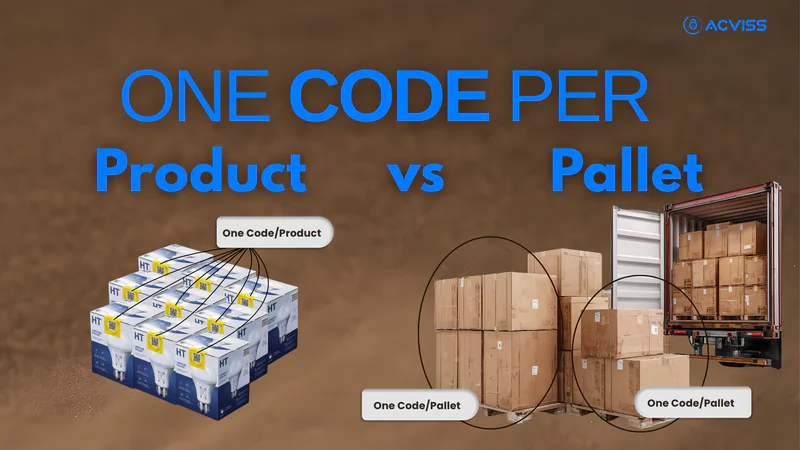
Choosing between unit-level, case-level, or pallet-level serialisation is not a technical detail. It fundamentally shapes your ability to authenticate products, ensure product safety, strengthen brand protection, and deliver meaningful product traceability.
This is where many organisations miscalculate.
What Serialisation Really Means at the Unit Level
At its core, serialisation is the assignment of a unique identifier to an individual product unit. Not a batch. Not a lot. A single, saleable item.
This distinction is critical.
A batch code tells you that 10,000 units were produced together. A serial number tells you that this exact unit was produced, moved, and sold through a defined path.
In industries like pharma, this is no longer optional. Regulations such as the Drug Supply Chain Security Act and the EU Falsified Medicines Directive have made unit-level serialisation a baseline requirement. By 2020, it was estimated that nearly 90% of prescription drugs globally were serialised at the unit level.
Why such precision?
Because counterfeit risk operates at the unit level. A single fake product entering a legitimate supply chain cannot be detected through batch-level visibility.
Unit-level serialisation enables:
Individual product verification at the point of dispensing or purchase
Precise recall management down to specific units
Stronger IP protection and trademark protection enforcement
Real-time product authentication by end consumers
Without it, what you have is visibility in aggregate, but blindness in reality.
Serialisation vs Aggregation: Understanding the Hierarchy
Serialisation is only the first layer. The real operational complexity emerges with aggregation.
Aggregation creates a structured relationship between packaging levels. It links individual units to cases, cases to pallets, and pallets to shipments.
Think of it as a digital family tree.
A pallet becomes the parent
Cases are its children
Individual units are the grandchildren
This parent-child relationship allows something powerful: inference.
Instead of scanning 1,000 individual items, a warehouse operator can scan a single pallet code and infer everything inside it.
This is what keeps modern logistics functional.
Without aggregation, large-scale track and trace systems would collapse under operational inefficiency.
However, this convenience introduces a trade-off.
The more you rely on higher-level aggregation, the further you move away from granular visibility.
The Traceability Gap: What You See Depends on Where You Look

Every level of serialisation answers a different question. The problem arises when businesses assume they all answer the same one.
Pallet-Level Serialisation
Answers: Where is the shipment?
Cannot answer: Which exact unit reached the consumer?
Case-Level Serialisation
Answers: Which distributor received which case?
Cannot answer: Which specific product was sold or tampered with?
Unit-Level Serialisation
Answers: Where did this exact product originate, and is it genuine?
This is the traceability gap.
A pallet can move through five intermediaries and arrive intact. Yet, one compromised unit inside it can still reach a consumer unnoticed.
For industries dealing with temperature-sensitive goods, high-value products, or regulated substances, this gap becomes a direct threat to product safety and customer satisfaction.
True product traceability is only achieved when visibility extends to the unit level.
Why Unit-Level Serialisation Protects the Consumer

Brand protection is often discussed in terms of enforcement, legal action, and IP protection. But the moment of truth happens much later.
It happens when a customer holds a product in their hand.
At that moment, none of the upstream safeguards matter unless the product can be verified instantly.
Unit-level serialisation enables:
Direct-to-consumer product verification through mobile scanning
Brand authentication in real time
Detection of counterfeit or diverted goods
Transparent product history access
Without unit-level visibility, product authentication becomes indirect and unreliable.
This is particularly critical in sectors like pharma, where a single counterfeit unit can have life-threatening consequences.
It is also increasingly relevant in premium FMCG, where customer engagement and trust are tied to transparency.
Consumers today do not just want assurance. They expect proof.
The Operational Cost Is The Honest Trade-Off
If unit-level serialisation is so powerful, why does every company not adopt it universally? The answer is operational complexity and cost.
Implementing unit-level serialisation requires:
Printing and verifying unique codes on every product
Vision systems for inspection at high-speed production lines
Data management infrastructure to handle millions of serial numbers
Exception handling processes for damaged, returned, or sampled goods
Aggregation adds another layer of complexity. A single error in parent-child relationships can disrupt entire shipments. In regulated industries, this can lead to product quarantines, compliance risks, and financial losses.
For example:
Removing one unit from a case requires disaggregation and reaggregation
Damaged goods must be decommissioned digitally
Partial shipments require updates across the entire hierarchy
This is why many organisations initially adopt case-level or pallet-level serialisation.
It is operationally simpler. But it comes at the cost of visibility.
The decision, therefore, is not about capability. It is about priorities.
Regulatory Reality: Different Industries, Different Requirements

Regulations have played a major role in shaping serialisation strategies. In pharma, unit-level serialisation is mandatory in most major markets. The DSCSA, with its 2024 enforcement milestone, requires interoperable electronic tracing at the unit level.
In contrast:
Food and beverage industries often operate at the batch or case level
Luxury goods focus on authentication rather than regulatory traceability
Agrochemicals and industrial products fall somewhere in between
However, there is a clear trend.
Regulatory frameworks are moving towards greater granularity, not less.
This is driven by:
Rising counterfeit incidents
Increasing global trade complexity
Growing consumer demand for transparency
What is optional today is likely to become mandatory tomorrow.
The Technology Layer: Barcodes, RFID, and Beyond
The choice of serialisation level is closely tied to the technology used.
2D Barcodes (GS1 DataMatrix)
Cost-effective and widely adopted
Require line-of-sight scanning
Ideal for unit-level serialisation in pharma
RFID
Enables bulk scanning without line-of-sight
Faster in high-volume environments
Higher implementation cost
Each technology supports both serialisation and aggregation, but their efficiency varies depending on scale and operational design.
Increasingly, companies are also integrating digital layers such as blockchain-based track and trace systems to enhance data integrity and transparency.
This is where solutions like Origin begin to play a role.
The Role of Advanced Systems, From Serialisation to Intelligence
Serialisation is not just about compliance. It is about unlocking intelligence.
When implemented correctly, it enables:
Real-time supply chain visibility
Advanced analytics on product movement
Detection of diversion and grey market activity
Improved customer engagement through verified interactions
Origin by Acviss extends this capability by combining track-and-trace with secure, non-cloneable identifiers.
This ensures that even if a code is copied, it cannot be reused or replicated successfully.
In the broader context of anti-counterfeiting solutions and brand authentication, this shifts the focus from detection to prevention.
It also bridges the gap between operational data and consumer-facing verification.
Read on Which Label Should Your Business Choose?
How to Decide What Level Your Brand Actually Needs
There is no universal answer. But there is a structured way to approach the decision.
1. Risk Profile
High counterfeit risk or safety impact requires unit-level serialisation
Lower-risk products may operate at case level initially
2. Regulatory Environment
Mandatory compliance requirements dictate the baseline
Future regulations should be factored into long-term strategy
3. Supply Chain Complexity
Multi-country distribution increases the need for granular traceability
Simpler supply chains may manage with aggregated visibility
4. Customer Expectations
Premium brands and sensitive products demand higher transparency
Customer satisfaction increasingly depends on product verification capabilities
5. Operational Readiness
Infrastructure, cost, and process maturity must support implementation
A phased approach can balance cost and capability
The key is to treat serialisation not as a standalone initiative, but as part of a broader supply chain management and brand protection strategy.
The Strategic Shift: From Compliance to Competitive Advantage
What began as a regulatory requirement is rapidly becoming a competitive differentiator.
Companies that invest in deeper serialisation levels gain:
Stronger brand verification and consumer trust
Better control over distribution channels
Faster and more targeted recall capabilities
Enhanced IP protection and trademark enforcement
More importantly, they gain visibility.
And in today’s fragmented, globalised supply chains, visibility is control.
The Level You Choose Defines the Protection You Deliver
Serialisation is often misunderstood as a binary decision. Implemented or not implemented.
In reality, it is a spectrum. Choosing between one code per pallet and one code per product is a strategic decision that impacts everything from compliance and cost to customer trust and product safety.
Higher levels of aggregation offer efficiency. Unit-level serialisation offers certainty. The organisations that succeed are those that recognise the difference and align their strategy accordingly.
If your goal is not just to move products, but to protect them, verify them, and build lasting trust around them, the level of serialisation you choose will define how far you can go.
Interested in strengthening your product authentication, track and trace, and brand protection strategy? Get in touch with us to explore how advanced serialisation and non-cloneable technologies can transform your supply chain.