Authentication, in most industries, has traditionally meant one thing. Confirm that the product is genuine. Verify that it came from the right manufacturer. Ensure that the packaging has not been duplicated.
For ambient goods, that approach has been largely sufficient. A unique code, a hologram or a scannable identity can confirm origin with reasonable certainty.
Cold chain products are different.
In vaccines, biologics, premium dairy, frozen foods and temperature-sensitive chemicals, authenticity is not only about origin. It is about the condition. A product may be genuine, correctly labelled and fully traceable, yet unsafe, ineffective or even dangerous because it was mishandled somewhere along the supply chain.
This is the gap that conventional Product Authentication systems fail to address. And it is precisely where cold chain authentication must evolve.
The Unique Vulnerability of Cold Chain Products
Temperature-sensitive products operate within tightly controlled thermal regimes. Even minor deviations can alter their chemical or biological properties.
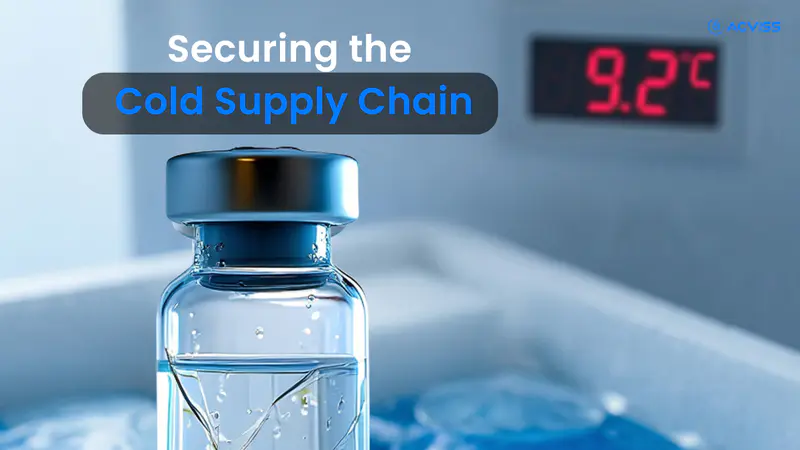
In pharma, most vaccines require storage between 2°C and 8°C. Some biologics demand cryogenic conditions as low as 90 °C. A brief exposure outside these thresholds can degrade potency irreversibly.
Food products face similar risks. A frozen product that partially thaws and is then refrozen may look identical to a properly stored one, yet its quality and safety may be compromised.
The challenge is not visibility. It is invisibility.
Damage caused by temperature excursions rarely leaves obvious external signs. Packaging remains intact. Labels remain valid. Serial numbers remain unchanged.
From a traditional Product Verification perspective, everything appears correct.
The Double Fraud Problem

Cold chain products introduce a more complex form of risk that can be described as a double fraud problem.
The first scenario is familiar. A counterfeit product enters the supply chain, imitating a genuine one. This is where standard Anti-counterfeiting solutions and Brand Authentication systems operate.
The second scenario is more subtle and often more dangerous.
A genuine product is exposed to improper temperature conditions during storage or transit. It may be left unrefrigerated, exposed to freezing or subjected to repeated temperature fluctuations. Once compromised, it is reintroduced into the supply chain as if nothing has changed.
The product remains genuine in origin but invalid in condition.
From the outside, it is indistinguishable from a safe product.
This is where traditional Track and trace and Product traceability systems fall short. They can confirm where a product has been, but not what has happened to it.
How Counterfeiters Exploit Cold Chain Gaps
Cold chain vulnerabilities are not accidental. They are actively exploited.
At distribution hubs, genuine products may be swapped with compromised or counterfeit versions. Temperature-sensitive goods may be deliberately mishandled and later resold as authentic stock.
In markets with fragmented Supply chain management, control diminishes at each stage. Studies have shown that oversight weakens significantly as products move from manufacturers to wholesalers and then to clinics or retailers.
This creates opportunities for:
Product switching at distribution points
Temperature abuse followed by resale
Mixing of genuine and compromised inventory
Reintroduction of expired or degraded stock
In vaccine supply chains, this risk is particularly severe. More than half of the most counterfeited pharmaceutical products require strict temperature control.
The implication is clear. Cold chain counterfeiting is not only about fake products. It is about compromised products masquerading as safe ones.
What Standard QR Authentication Cannot Tell You?
A QR code or serial number can confirm identity. It can validate Product Authentication and support Brand Verification. It can even enable Track and trace across the supply chain.
What it cannot tell you is whether the product has been stored correctly.
A scan may return a message confirming authenticity, yet provide no insight into:
Whether the product experienced temperature excursions
Whether it was exposed to freezing or overheating
Whether it has degraded over time due to improper handling
In cold chain environments, this limitation is critical.
Authentication without condition awareness creates a false sense of security.
Condition-Sensitive Authentication: The Missing Layer
To address this gap, authentication must evolve from identity-based to condition-aware.
Condition-sensitive authentication combines Product Authentication with environmental monitoring. It ensures that a product is not only genuine but also safe.
This requires the integration of multiple technologies.
IoT Sensors and Real-Time Monitoring

Modern cold chain systems increasingly rely on IoT sensors that capture temperature data at frequent intervals, often every minute.
These sensors transmit data to central systems where it is analysed for anomalies. Advanced implementations use layered architectures where real-time alerts are triggered immediately, while aggregated data is stored for compliance and audit purposes.
This approach supports both operational responsiveness and regulatory accountability.
Smart Packaging and Time-Temperature Indicators
Smart packaging technologies such as enzymatic time-temperature indicators provide visual evidence of temperature exposure.
These indicators change colour irreversibly when a product is exposed to unsuitable conditions. For example, a green indicator may gradually shift to orange and then red as cumulative temperature exposure increases.
This allows even non-technical users to assess product condition at a glance.
Blockchain-Backed Traceability
To ensure data integrity, temperature records can be anchored to blockchain systems. Rather than storing every data point on-chain, efficient systems record periodic summaries or cryptographic hashes.
This creates a tamper-evident record of the product’s environmental history.
Such systems align with emerging regulatory expectations for Product traceability and compliance.
The Regulatory Imperative
Regulatory bodies are increasingly recognising the need for robust cold chain monitoring.
In India, vaccine cold chain guidelines mandate strict adherence to temperature ranges, with real-time monitoring becoming standard practice in many public health programmes.
Globally, frameworks such as the Drug Supply Chain Security Act reinforce the need for end-to-end visibility and Product Verification.
Regulation is moving in one direction. Authentication systems must follow.
What an End-to-End Cold Chain Authentication System Requires

A comprehensive cold chain authentication system must combine identity verification with condition monitoring.
Key components include:
Item-level Product Authentication using secure, non-cloneable identities
Continuous temperature monitoring through IoT sensors
Real-time alert systems for temperature excursions
Tamper-evident data storage and audit trails
Integration with Supply chain management and Track and trace platforms
Visual indicators for on-ground verification
Certify, powered by non-cloneable technology, plays a critical role in this architecture by ensuring that each product unit carries a secure identity that cannot be duplicated.
When combined with environmental data, this creates a dual-layer authentication system. One layer confirms origin. The other confirms integrity.
Together, they enable true Product Verification.
Beyond Compliance: The Business Case
While regulatory compliance is a major driver, the benefits of cold chain authentication extend further.
Brands that implement condition-sensitive authentication can:
Reduce product recalls caused by temperature abuse
Improve customer satisfaction by ensuring product safety
Strengthen Brand Protection and Trademark Protection
Enhance IP Protection by preventing product substitution
Build trust in high-value and high-risk markets
In sectors such as pharma and premium food, trust is a competitive advantage.
Cold chain authentication transforms trust from a promise into a verifiable fact.
The Shift from Visibility to Assurance
Supply chains have long focused on visibility. Knowing where a product is has been considered sufficient.
For temperature-sensitive products, visibility is no longer enough.
The future lies in assurance.
Assurance means knowing not only where a product has travelled, but how it has been handled at every stage. It means combining Product traceability with real-time condition data. It means ensuring that every product reaching a customer is both authentic and safe.
This requires a shift in thinking.
Authentication must evolve from static validation to continuous verification.
Conclusion
Cold chain products demand a different approach to authentication because their integrity is defined not only by origin but by condition.
Traditional Product Authentication systems confirm identity. They do not confirm safety. In environments where temperature exposure can alter a product without visible signs, this limitation creates risk.
Condition-sensitive authentication, powered by IoT monitoring, smart packaging and secure non-cloneable identities such as Certify, closes this gap.
It enables true Product Verification, strengthens Brand protection and ensures product safety across the supply chain.
For industries handling vaccines, biologics, food and sensitive chemicals, this is not an incremental improvement. It is a necessary evolution.
Interested in learning more about building a robust cold chain authentication system that ensures both authenticity and integrity? Get in touch with us.