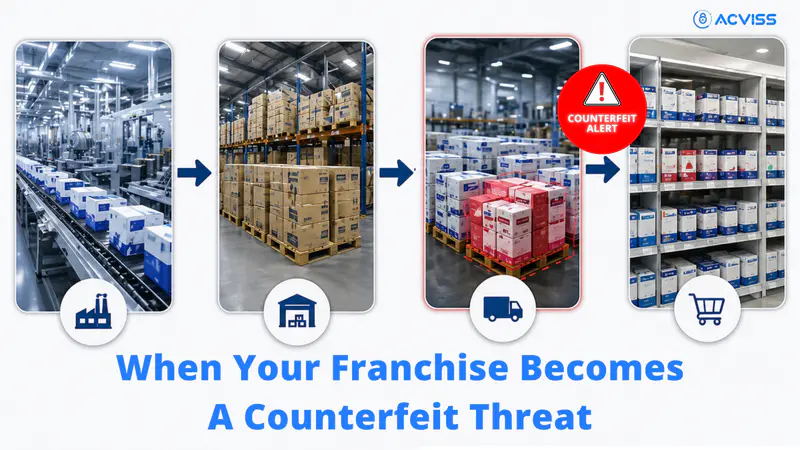
Franchising has long been positioned as one of the most reliable engines of scalable growth. A proven model, replicated across geographies, powered by local entrepreneurship. On paper, it is a system built for consistency.
In reality, it is also a system built on trust. And that trust, increasingly, is where the problem begins.
While most discussions around counterfeiting focus on external threats, grey markets, parallel imports, or organised counterfeit networks, franchise-driven businesses face a quieter, more complex risk. The dilution of brand authenticity from within their own authorised network.
This is not a story of outsiders imitating your brand. It is a story of insiders slowly reshaping it.
The Structural Vulnerability of Franchise Networks
Franchise systems are designed to balance two opposing forces: control and independence.
The franchisor defines the brand, standards, and systems. The franchisee owns the day-to-day operations, cost structures, and local profitability. This duality is what makes franchising scalable, but it also creates a persistent tension.
At the unit level, margins are everything.
A franchisee dealing with rising input costs, supply disruptions, or competitive pressure has a clear incentive to optimise expenses. Often, this optimisation begins with sourcing decisions.
Even in well-structured systems where 85% to 95% of inputs are expected to come from approved suppliers, deviations occur. Not always malicious. Often justified as an operational necessity.
But every deviation introduces risk. Because in a franchise network, consistency is not just operational discipline. It is the very foundation of brand equity.
Where It Breaks: The Three Most Common Compromises
Brand dilution within franchise systems rarely happens in dramatic ways. It happens in incremental decisions that seem harmless in isolation.
1. Unauthorised Suppliers
A franchisee finds a local supplier offering the same packaging, raw materials, or components at a lower cost. On the surface, the product looks identical. The savings are immediate.
What is invisible is the lack of quality control, traceability, and compliance with brand standards.
Over time, these substitutions fragment the supply chain. What was once a controlled ecosystem becomes a patchwork of unknown inputs.
2. Non-Compliant Ingredients and Inputs
This is particularly critical in sectors like pharma, food service, cosmetics, and nutraceuticals.
A slight variation in ingredient quality, storage conditions, or sourcing origin can alter product safety and efficacy. In temperature-sensitive categories, even minor deviations can compromise integrity.
The consumer, however, sees the same brand.
Which means the risk is absorbed entirely by the brand owner.
3. Counterfeit Branded Materials
Packaging, labels, warranty cards, QR codes, and branded consumables are often replicated locally to reduce costs or bypass procurement delays.
These are not always sourced from counterfeit markets. They are sometimes printed through local vendors using copied designs.
But without controlled product authentication mechanisms, these materials become indistinguishable from genuine ones.
At that point, the brand has effectively lost control over its own identity.
Why Internal Counterfeiting Is Harder to Detect

External counterfeiting leaves signals. Suspicious marketplaces, pricing anomalies, unauthorised sellers. Internal counterfeiting does not.
It operates within authorised locations, under licensed branding, using partially compliant systems. To a consumer, everything appears legitimate. Even to the franchisor, the deviation often remains invisible until something breaks.
A product fails quality testing. A customer reports an inconsistency. A regulatory body raises a concern. By then, the damage is already in motion. This is what makes franchisee supply chain compliance one of the most under-addressed risks in modern brand protection.
The Hidden Cost: Reputation, Liability, and Trust
The consequences of internal brand dilution are not limited to operational inefficiencies. They compound across three critical dimensions:
1. Brand Perception
Consumers do not differentiate between franchisee and franchisor. A single compromised experience reflects on the entire network.
In sectors driven by trust, such as pharma or food, this erosion can be irreversible.
2. Legal Exposure
Franchisors often face vicarious liability when a franchisee’s actions cause harm. Courts evaluate both actual control and perceived authority.
If a consumer believes they are interacting directly with the brand, liability extends upward. A contaminated ingredient, a failed product, or a safety incident sourced from an unauthorised supplier can escalate into large-scale litigation.
3. Regulatory Risk
Global compliance frameworks, including emerging regulations like the EUDR (European Union Deforestation Regulation), are pushing for deeper product traceability. Inconsistent sourcing within franchise networks directly conflicts with these requirements.
What appears as a local deviation can become a global compliance failure.
Extending Authentication into the Franchise Supply Chain
The instinctive response to this problem is tighter control. More audits, stricter contracts, heavier penalties. In practice, this often backfires.
Franchise relationships depend on alignment, not enforcement alone. The more effective approach is to embed franchise authentication into the supply chain itself.
Not as a policing mechanism, but as an operational layer.
1. Non-Cloneable Product Authentication
Each unit, whether it is packaging, ingredient batches, or finished products, can be assigned a non-cloneable identity. This ensures that every item entering a franchise location is verifiable at the unit level.
If an unauthorised supplier introduces material into the system, it becomes immediately detectable.
2. Track and Trace Systems
End-to-end track and trace frameworks allow franchisors to monitor the movement of goods across the supply chain. From manufacturer to distributor to franchise outlet, every transaction is recorded.
This transforms supply chain management from reactive auditing to proactive visibility.
3. Real-Time Verification
Franchisees themselves can verify incoming stock using simple scanning tools. This shifts the dynamic from enforcement to enablement. Compliance becomes easier than non-compliance.
Conducting a Franchise Brand Protection Audit Without Breaking Trust

Audits are necessary. But poorly executed audits can damage franchise relationships.
The goal is not to catch franchisees doing something wrong. The goal is to identify systemic gaps.
A well-designed franchise brand protection audit typically includes:
1. Supply Chain Mapping
Understanding actual sourcing patterns across franchise locations. Not what is documented, but what is happening on the ground.
2. Product Verification Checks
Randomised testing of materials, ingredients, and packaging. This is where product verification and brand authentication technologies become essential.
3. Digital Audit Trails
Leveraging technology to create tamper-proof logs of procurement and usage. This reduces reliance on manual reporting.
4. Mystery Audits
Deploying anonymous checks to identify the use of non-compliant materials. Often, this is the only way to detect subtle deviations.
The key is transparency.
When franchisees understand that these audits protect the collective brand, rather than target individuals, participation improves significantly.
Making Supplier Compliance Enforceable

Most franchise agreements already include clauses around approved suppliers.
The problem is enforcement. Paper-based compliance is easy to bypass. To make it effective, compliance must be embedded into the system.
1. Digital Supplier Verification
Every approved supplier can be integrated into a verification platform. Franchisees can only procure materials that are digitally authenticated.
2. Smart Contracts and Conditional Procurement
Procurement systems can be designed to reject unauthorised purchases automatically. This reduces the need for post-facto enforcement.
3. Incentivised Compliance
Rather than relying solely on penalties, brands can introduce incentives for high compliance scores. This aligns economic motivation with brand integrity.
The Role of Technology in Closing the Gap
Traditional anti-counterfeiting solutions were designed for external threats.
Franchise networks require a different approach.
One that integrates:
Product authentication at the unit level
Supply chain traceability across stakeholders
Real-time verification at the point of use
Data-driven compliance monitoring
Solutions built on non-cloneable technology and advanced track and trace capabilities are increasingly becoming foundational.
They do not just prevent counterfeiting. They restore control.
A Shift in Perspective: From Policing to Partnership
Franchise systems succeed when alignment outweighs enforcement.
The most resilient brands recognise that franchisees are not adversaries. They are stakeholders operating under economic pressures.
The objective is not to eliminate flexibility. It is to ensure that flexibility does not compromise product safety, brand protection, and customer satisfaction.
This requires a shift.
From:
Static rules to dynamic systems
Periodic audits for continuous visibility
Assumed compliance to verified compliance
When done right, franchise brand protection becomes an enabler of growth, not a constraint.
Protecting the Brand Where ItIs Most Exposed
The biggest threat to a franchise brand is not always outside the network.
It is often within it.
A system built for scale can, without the right safeguards, become a system that scales inconsistency.
Addressing this requires more than policies. It requires infrastructure.
Infrastructure that ensures every product, every component, and every transaction aligns with the brand’s promise.
If you are exploring how to strengthen franchisee supply chain compliance, implement product authentication, and build a robust track and trace framework across your network, it may be time to rethink how your supply chain operates at the unit level.
Interested in learning more? Get in touch with us.