Most ERP systems are usually built around a single security question: who are you? Once that question is answered at login, the system moves on. The user is in, the session is trusted, and every action that follows is treated as implicitly legitimate.
That is a significant gap, and it is where most internal fraud, unauthorised transactions, and compliance failures actually happen. Not at the login screen. Inside the session, after authentication has already passed.
According to PwC's Global Economic Crime Survey, 47% of companies experienced fraud in the past 24 months. A significant share of that fraud occurred inside systems with functioning access controls — because authentication and validation are not the same thing, and most ERP environments only enforce the first one.
This blog breaks down the difference, explains how authentication metadata becomes an active validation signal for every high-stakes action inside your ERP, and covers where the supply chain dimension adds a layer most security frameworks miss entirely.
1. The Login Is Over - Why Authentication Data's Real Job Starts There

ERP implementations treat authentication like a bouncer at the front door. Once the system confirms who you are, you're inside, and the system largely trusts you for the rest of your session. The assumption is that verified identity equals safe action, for as long as the session runs.
This assumption becomes dangerous in today's environment, where compromised credentials, insider misuse, and session hijacking are very common.
The login event itself doesn't stop being useful once it grants access. Every authentication event captures a forensic footprint: who logged in, from what device, at what time, from which location, via which verification method, and after how many failed attempts. This data is typically logged, which is ignored in ERP environments once the user is logged in.
2. What Authentication Metadata Contains
When a user logs into an ERP, the system captures more than a yes/no decision. It records a structured set of identity and session signals. Most organisations store this data in logs, which they review only after an incident. Forward-thinking security architectures use this data actively, in real time.
This metadata is available in virtually every modern ERP environment. The question is whether it is being activated as a validation input or simply archived.
3. The Shift: From Authentication to Validation

Authentication and validation are not the same question, and treating them as interchangeable is what creates security gaps inside ERP systems.
Authentication asks: "Are you who you say you are?" It is a binary check — pass or fail — performed at the start of a session.
Validation asks: "Should this specific action be allowed, under these specific conditions, right now?" It is a contextual, continuous check — and it draws on authentication signals as one of its primary inputs.
Consider this example. A Finance Manager is authenticated — correct credentials, MFA completed, role confirmed. Validation then asks a different set of questions before allowing a payment release:
Has this user ever processed a payment to this vendor before?
Did this user also create or modify this vendor's bank details in the same session?
Is this transaction occurring outside normal business hours for this user's role?
Was the authentication method used strong enough for a transaction of this value?
If any of those contextual checks fail, the ERP should not allow the action — regardless of whether authentication succeeded. This is the paradigm shift modern ERP security is built around: moving from static access control to dynamic transaction validation.
4. How ERP Systems Use Auth Data as a Runtime Validation Layer

Modern ERPs like SAP, Oracle, and Microsoft Dynamics 365 have built-in frameworks for contextual validation. Most implementations, however, leave these frameworks under-configured, defaulting to broad role assignments rather than granular, context-aware controls. There are three levels at which authentication data operates as a runtime validation input.
Role-Based Permission Gates: The baseline check — does this user's role allow this action at all? RBAC sets the boundary. But it only answers "can they?" not "should they, right now?"
Segregation of Duties (SoD) Checks: A simple but critical rule: the same person who initiates a transaction should not be the one who approves it. Authentication logs are what make this enforceable without them, SoD is a policy on paper, not a control in practice.
Context-Aware Step-Up Authentication: When a transaction crosses a risk threshold — high value, odd timing, unfamiliar device — the ERP asks the user to re-verify before proceeding. The authentication metadata from login is what triggers that threshold in the first place.
5. Real-World Use Cases: Where Auth Data Validates Critical ERP Actions
Take the vendor bank account change as a practical example. This is one of the most common vectors for Business Email Compromise (BEC) fraud — where an attacker gains access to an ERP and redirects payments. The authentication signal that matters here is not just the login. It is the combination of: Is this the same device this user always uses? Has this user ever modified vendor banking data before? Is this happening during normal working hours?
When those three signals are evaluated together, a first-time bank account change from a new device at 11:45 PM looks completely different from the same change made from a corporate laptop at 10:30 AM by someone with a track record of vendor management. The ERP has all the data it needs to tell these apart — most implementations simply are not configured to use it.
6. Detecting Anomalies: When Auth Patterns Flag Fraud Before It Completes

Over time, authentication logs build a behavioural baseline. It clearly defines what normal looks like for every user, every role, every transaction type. Deviations from that baseline are the early warning system most organisations never activate.
According to IBM's 2024 Cost of a Data Breach Report, the average time to identify and contain a breach is 258 days. Much of that detection lag exists because authentication anomalies were visible in logs, but no system was evaluating them against a behavioural baseline in real time.
Key anomaly patterns that authentication data can surface:
Impossible travel: A user logs in from Mumbai at 9:00 AM, then attempts to approve an invoice from a European IP address at 10:15 AM. The ERP flags the geographic impossibility before the transaction processes.
Off-hours high-volume activity: An accounts payable clerk who typically processes 15–20 invoices during business hours attempts 140 approvals at 3:00 AM. The volume and time combination create a composite anomaly signal.
Same-session initiation and approval: A user creates a purchase order and attempts to approve it within the same session. SoD policy should block this — but only if the system is using session authentication data to enforce it.
Role-action mismatch: A user authenticated as a Logistics Coordinator attempts to access financial approval workflows. The role-action gap triggers an immediate alert.
Authentication method downgrade: A user originally authenticated with a hardware key but re-authenticated with a weaker SMS OTP before a high-value payment. The assurance level mismatch flags the transaction for review.
AI and ML-based anomaly detection is making this layer significantly more precise. Rather than rules-based triggers alone, behavioural models trained on authentication logs can identify subtle pattern shifts that no static rule would catch.
7. Authentication Logs as a Compliance Audit Trail
Regulatory frameworks do not just require that you know what changed in your ERP. They require that you can prove the full context of that change — who made it, from where, using what authorisation, and with what level of identity assurance.
The practical outcome becomes clear during an audit. Without authentication metadata appended to transaction records, the best you can show an auditor is that "User_Priya" approved a batch release. With authentication metadata, you can demonstrate that "User_Priya, from a corporate device, via biometric MFA, from the manufacturing facility IP range, at 11:23 AM on Tuesday" approved the release — eliminating any repudiation argument and satisfying the contextual proof requirement most frameworks explicitly demand.
This is not just about passing audits. It is about being able to answer the question "how do we know that approval was genuine?" with evidence, not assumption.
The Supply Chain Dimension: Product Authentication as an ERP Validation Signal

Most conversations about ERP authentication focus on user identity — who logged in. But there is a second authentication stream that most supply chain operations generate, and almost none integrate into their ERP validation logic: product authentication events.
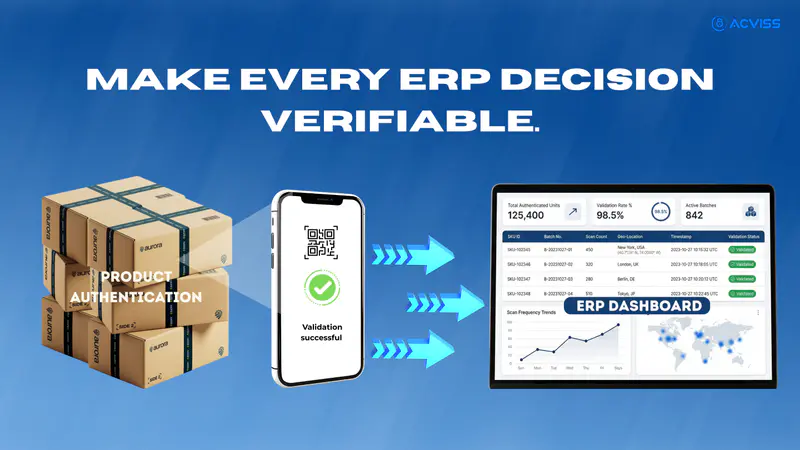
Every time a product with a serialised security code is scanned at a supply chain node — factory dispatch, warehouse receipt, distributor intake, retailer verification — that scan generates a structured event record. It contains a timestamp, geolocation, device identifier, product ID, and supply chain stage. This is authentication data in the same functional sense as a user login event.
When this product authentication data is fed into the ERP as a validation signal, it enables a class of checks that pure user-identity validation cannot provide:
Inventory receipt validation: Did a verified product authentication event precede the ERP inventory receipt entry for this batch? If the ERP shows 2,000 units received but only 1,400 have authentication records, that discrepancy is a validation failure — and a red flag for either counterfeiting or diversion.
Warranty claim verification: Was a warranty claim filed for a product that has no authentication record in the claimed geography? A claim from Hyderabad for a product whose authentication history only shows scans in Pune and Chennai is an anomaly that the ERP can surface automatically.
Dispatch-to-receipt matching: Does the blockchain record from the supply chain match the ERP's recorded dispatch timestamp for this SKU? A mismatch between the immutable blockchain log and the ERP entry suggests either manual data manipulation or product substitution.
This is a validation layer where physical product authentication feeds digital ERP validation logic. Most pure-SaaS ERP security approaches miss entirely. User identity controls cannot catch product-level fraud if the product itself is never verified as genuine before it enters the system as a trusted record.
Where Most ERP Implementations Still Fall Short
Despite the frameworks being available, most ERP deployments leave significant gaps in how authentication data is used for validation.
Here is what to audit in your own environment:
MFA is enforced only at login, not at the transaction level: High-value approvals, vendor master changes, and bulk data exports should each trigger their own authentication challenge.
Authentication logs are stored but never analysed: The data exists, but there is no behavioural baseline. Without active monitoring, those logs are forensic evidence you will examine after a loss, not a prevention mechanism.
RBAC is configured broadly rather than granularly: Most implementations assign broad department-level roles rather than the fine-grained, transaction-specific permissions that make SoD enforcement meaningful.
Product authentication is not feeding into ERP validation:Supply chain authentication events are generated at every scan, but never consumed by the ERP as a real-time validation input.
Anomaly detection is retrospective: Reviews happen after the period closes, not in real time. By the time the anomaly is spotted, the transaction has long since been processed.
Start by auditing three things in your ERP today:
→ How many high-value transaction types require step-up authentication (most organisations will find the answer is zero)
→ Whether your authentication logs are actively monitored against a behavioural baseline
→ Whether your supply chain authentication data has any integration with your ERP validation layer.
The gaps you find will tell you exactly where your validation signals are missing.
How Acviss Helps
Most ERP systems trust the data entered into them. Acviss makes sure that data is worth trusting in the first place.
Certify by Acviss gives every physical product a unique, non-cloneable identity. Every time that product is scanned across the supply chain, it generates a verified event. That event feeds directly into your ERP via API.
What that means practically:
Inventory receipts only update when a real product scan backs them up
Fake warranty claims get flagged before they enter your records
Ghost inventory and grey-market diversions show up as anomalies, not accepted entries
Your ERP stops taking data on faith. It starts validating it.
Certify integrates with SAP, MS Dynamics, Oracle and others. Most implementations go live in under 45 days without touching your existing workflows.
Conclusion
Authentication should not just be a login checkbox. It should be a continuous intelligence layer. It should generate signals about identity, context, and intent that should follow every user action through the system.
The organisations should make this shift and start treating auth data as a living validation engine rather than a one-time gate. This will allow them to catch fraud before it completes, pass audits without scrambling for evidence, and build supply chains where the data inside the ERP actually reflects what happened in the physical world.
As AI-driven behavioural analytics mature and product authentication becomes more deeply integrated with enterprise systems, the boundary between "who scanned what" and "what the ERP should allow next" will blur entirely, in the best possible way. The question for every supply chain and compliance leader right now is not whether this integration is worth building. It is how long you can afford to operate without it.
Frequently Asked Questions
1. What is authentication metadata in an ERP system?
Authentication metadata is the structured data captured when a user logs into an ERP — including device fingerprint, IP address, geolocation, timestamp, MFA method, and session details. When used actively, this data validates every subsequent action taken inside the system, not just the initial login.
2. How does role-based access control reduce fraud in ERP transactions?
RBAC restricts which transaction types each user role can access. When combined with authentication metadata — device, location, session history — it enables dynamic validation: blocking a transaction not just because the role lacks permission, but because the context of the attempt is anomalous relative to the user's established baseline.
3. What is the difference between ERP authentication and ERP validation?
Authentication confirms identity at login. Validation determines whether a specific action should be allowed, given the user's current context — device, location, time, MFA strength, prior actions in the session. Validation uses authentication signals as inputs but applies additional contextual logic before approving high-stakes transactions.
4. How do authentication logs support compliance audits?
Regulations like SOX, FDA 21 CFR Part 11, and CDSCO require proof of the context behind every data change — not just who made it. Authentication logs provide that context: the device, location, session, and authorisation method behind every transaction, creating an audit trail that eliminates repudiation.
5. Can product authentication data integrate with ERP validation workflows?
Yes. Product authentication events — scan timestamp, geolocation, device, product ID, supply chain stage — are structured data records that modern ERPs can consume as validation signals. This enables the ERP to verify that a physical product was genuinely authenticated before processing related transactions such as inventory receipts or warranty claims.
6. What anomaly signals in authentication logs indicate potential ERP fraud?
Key signals include impossible travel (logins from geographically inconsistent locations within a short window), off-hours high-volume transaction activity, same-session initiation and approval of the same transaction, role-action mismatches, and MFA method downgrades immediately preceding high-value actions. Each pattern deviates from an established behavioural baseline and warrants investigation.