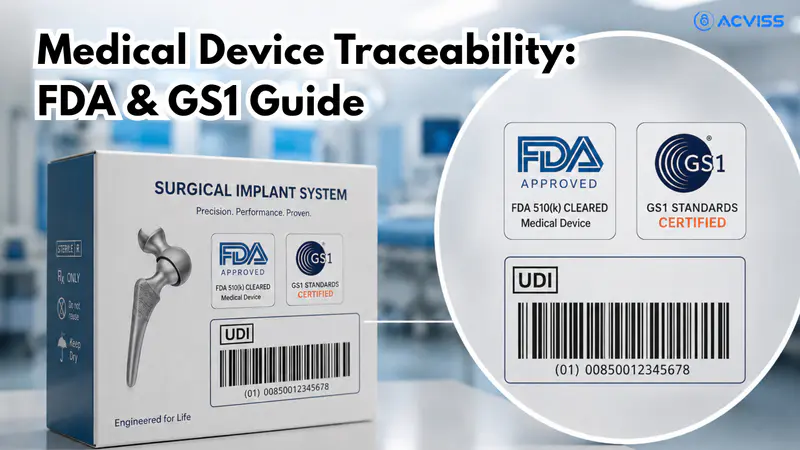
Medical device recalls rarely begin with a dramatic failure. Most begin with uncertainty.
A hospital cannot identify which implant batch reached which patient. A distributor cannot verify whether a returned product is genuine or diverted. A regulator requests traceability data, and multiple spreadsheets from disconnected systems produce conflicting answers. Somewhere between manufacturing, packaging, warehousing, shipping, procurement, and clinical use, the device lost its identity.
That is precisely the problem the FDA’s Unique Device Identification framework was designed to solve.
Yet many medical device brands operating in the United States still approach UDI compliance as a labelling exercise rather than a traceability strategy. They print a code, upload data to GUDID, satisfy minimum requirements, and move on. The reality is more demanding. UDI only becomes valuable when it is connected to real-world product traceability across the supply chain.
This is where GS1 standards, track and trace systems, and modern supply chain management practices become critical.
For medical device manufacturers, compliance is no longer just about satisfying regulators. It is about protecting patients, defending brand reputation, improving product verification, reducing counterfeit exposure, and enabling end-to-end visibility in increasingly complex healthcare supply chains.
The brands that understand this shift are building infrastructure around traceability, product authentication, and real-time data integrity. The brands that do not are finding themselves exposed to recalls, grey market diversion, counterfeit infiltration, operational inefficiencies, and growing regulatory scrutiny.
Why UDI Exists in the First Place
The FDA introduced the Unique Device Identification system to create a standardised method of identifying medical devices throughout distribution and usage.
Under the FDA UDI Rule, most medical devices distributed in the United States must carry a Unique Device Identifier in both human-readable and machine-readable formats. These identifiers are submitted to the Global Unique Device Identification Database, commonly known as GUDID.
The purpose is straightforward:
Improve patient safety
Accelerate recalls
Enhance adverse event reporting
Improve product traceability
Reduce medical errors
Support healthcare digitisation
Strengthen supply chain transparency
The challenge is that healthcare supply chains are fragmented by nature.
A single device may move through:
Component suppliers
Contract manufacturers
Packaging vendors
Third-party logistics providers
National distributors
Hospital procurement teams
Clinical storage systems
Surgical departments
Post-operative tracking systems
Without standardised identification and traceability, visibility disappears rapidly.
The FDA recognised this years ago. That is why UDI was never intended to function as a standalone barcode initiative. It was meant to create a digital identity system for medical devices.
Understanding the Core Structure of UDI
A UDI consists of two key components:
Device Identifier (DI)
The DI is the fixed portion of the UDI. It identifies the manufacturer and the specific version or model of the device.
This information is submitted to GUDID and becomes part of the public regulatory record.
Production Identifier (PI)
The PI contains variable production information, such as:
Lot number
Batch number
Manufacturing date
Expiry date
Serial number
Together, these identifiers create a granular framework for product verification and product traceability.
For example, if a defect is discovered in one production lot of an infusion pump, the manufacturer can theoretically isolate affected units quickly instead of recalling every device ever manufactured.
That distinction can save millions of dollars while protecting patient safety and customer satisfaction.
The Role of GUDID in FDA Compliance
The Global Unique Device Identification Database functions as the FDA’s central repository for UDI information.
Every labeller organisation must maintain accurate device records within GUDID. The system is designed to provide healthcare providers, distributors, regulators, and procurement teams with a trusted source of device information.
Several operational requirements within GUDID are often underestimated by manufacturers.
DUNS-Based Organisational Structure
Every organisation is identified using a DUNS number. This creates consistency between corporate identity and device registration records.
The label DUNS must align with the company information appearing on the device label itself.
This may appear administrative, but it has broader implications for Trademark Protection, IP Protection, and regulatory accountability. Inconsistent entity records can create compliance complications during audits or investigations.
Structured User Roles
The FDA framework separates operational responsibilities into distinct functions:
This structure reflects a broader regulatory expectation that traceability data should be governed systematically rather than informally.
Data Integrity Controls
One of the most important aspects of GUDID is its strict approach to data accuracy.
Published records enter a seven-day grace period where corrections are permitted. After that, modifications become tightly controlled through an unlock process.
This is significant because FDA systems increasingly treat traceability records as regulatory evidence.
Poor governance of UDI data can create downstream operational risks in recalls, investigations, warranty disputes, and adverse event reporting.
Why GS1 Standards Matter Beyond Compliance

Many medical device companies comply with FDA UDI requirements using GS1 standards, but often fail to understand why GS1 has become globally dominant.
GS1 does not simply provide barcode formats. It provides a common supply chain language.
That language enables interoperability between manufacturers, hospitals, distributors, logistics systems, and regulators.
In practical terms, GS1 standards help create consistency across:
Product identification
Batch traceability
Shipping records
Warehouse management
Clinical inventory systems
Procurement systems
Electronic health records
Without a common standard, every supply chain participant would interpret product data differently.
That fragmentation creates risk.
For medical devices, GS1 identifiers commonly include:
The GS1 DataMatrix code has become particularly important for healthcare environments because it enables compact, high-density encoding suitable for smaller device packaging.
More importantly, it enables rapid scanning and Product Verification throughout the supply chain.
The Counterfeit Risk Most Medical Device Brands Underestimate

Counterfeit pharmaceuticals receive enormous public attention. Counterfeit medical devices receive far less visibility despite creating equally serious risks.
The global counterfeit medical device market includes:
Surgical instruments
Diagnostic kits
Orthopaedic implants
PPE products
Dental devices
Cardiac products
Imaging accessories
The problem intensified during and after the pandemic, when global procurement pressures exposed weaknesses in healthcare supply chains.
Traditional UDI implementation alone does not prevent counterfeiting.
A copied barcode is still a copied barcode.
This is where Acviss's advanced product authentication and Anti-counterfeiting solutions become necessary.
Medical device brands increasingly require:
Secure serialisation
Non-cloneable identifiers
Dynamic product verification
Digital authentication layers
Supply chain event tracking
Real-time scan intelligence
The distinction matters enormously.
A barcode identifies a product. A modern Brand Authentication system verifies whether the product itself is genuine.
That difference can determine whether counterfeit devices enter clinical environments unnoticed.
Why Real-World Traceability Is Becoming a Competitive Advantage
Most discussions around FDA UDI compliance focus narrowly on regulatory obligation.
The more important conversation is operational intelligence.
When device brands implement effective track and trace systems linked to GS1 identifiers, they gain visibility that extends far beyond compliance.
1. Faster Recall Execution
The average medical device recall can cost millions in logistics, legal exposure, operational disruption, and reputational damage.
With granular Product traceability, manufacturers can isolate affected lots rapidly instead of initiating broad recall actions.
2. Supply Chain Transparency
Healthcare procurement teams increasingly expect visibility into sourcing, movement, and distribution pathways.
This is becoming especially relevant as global regulations increasingly emphasise supply chain transparency, sustainability, and risk governance.
Although EUDR primarily targets commodities linked to deforestation, its broader influence is reshaping expectations around traceability infrastructure across industries.
Medical device brands should pay attention to this trend.
3. Better Product Safety Monitoring
Connected traceability systems improve visibility into:
Device usage patterns
Adverse event clusters
Regional defect trends
Grey market diversion
Unauthorised resellers
This enhances both product safety and customer satisfaction.
4. Improved Brand Protection
Medical device brands invest heavily in R&D, regulatory approvals, clinical validation, and Trademark development.
Counterfeit infiltration damages not only revenue but also trust.
Strong Brand protection strategies increasingly combine:
UDI infrastructure
Product Verification
Supply chain monitoring
IP Protection
Trademark Protection technologies
This convergence is becoming essential for modern healthcare manufacturing.
The Gap Between Compliance and Actual Traceability
One of the largest misconceptions in the industry is assuming that UDI compliance automatically creates end-to-end traceability.
It does not.
A compliant label without a connected data infrastructure provides limited operational visibility.
True traceability requires event capture across the product lifecycle.
That includes:
Without connected systems, identifiers become static labels rather than intelligent traceability assets.
This is why many healthcare manufacturers are now integrating track and trace platforms with ERP systems, warehouse systems, regulatory systems, and authentication technologies.
The Growing Importance of Digital Product Identity

The future of medical device compliance is moving beyond printed codes.
Increasingly, regulators and healthcare ecosystems are moving toward digital product identity models where every device carries a continuously verifiable digital footprint.
That footprint may include:
Manufacturing history
Distribution journey
Environmental conditions
Authentication records
Chain-of-custody events
Ownership transitions
Recall status
Warranty verification
For high-risk devices, this level of visibility is becoming strategically valuable.
The emergence of AI-driven healthcare analytics will only increase the importance of structured traceability data.
Hospitals, insurers, regulators, and procurement systems are increasingly relying on interoperable digital records.
Brands without a strong traceability infrastructure may eventually face operational disadvantages beyond compliance alone.
Why Traceability Is Also About Trust
Healthcare is fundamentally built on trust.
A surgeon trusts that an implant is genuine. A hospital trusts that inventory records are accurate. A patient trusts that the device being used is safe.
When traceability breaks, that trust erodes rapidly.
That is why modern Supply chain management in healthcare can no longer operate independently from Brand Verification and product authentication strategies.
The conversation has shifted from simple compliance to verifiable integrity.
Medical device companies that approach UDI as a strategic infrastructure investment rather than a regulatory checkbox are building stronger resilience across:
Compliance operations
Product safety
Recall readiness
Brand protection
Customer engagement
Operational efficiency
Customer satisfaction
Anti-counterfeiting solutions
Building a Future-Ready Traceability Strategy
For US medical device brands, the path forward is becoming increasingly clear.
FDA UDI requirements established the foundation. GS1 standards created interoperability. The next challenge is connecting those identifiers to real-world visibility and actionable intelligence.
The companies leading this transition are not treating traceability as isolated compliance software. They are integrating traceability into a broader operational strategy.
That includes:
Secure Product Authentication technologies
Product Verification workflows
Real-time supply chain monitoring
IP and Trademark Protection infrastructure
Brand Authentication Systems
Data governance frameworks
Counterfeit detection mechanisms
As healthcare supply chains become more globalised and regulated, the ability to prove authenticity, movement, and integrity will become increasingly valuable.
Not just to regulators.
Not just to hospitals.
But to patients themselves.
Conclusion
FDA UDI compliance is no longer simply about uploading identifiers into GUDID and printing GS1 barcodes onto labels. The real challenge for medical device brands lies in transforming those identifiers into living traceability systems that protect products, patients, and reputations across the supply chain.
The medical device industry is entering an era where Product traceability, Brand protection, Product Verification, and Anti-counterfeiting solutions are becoming interconnected operational priorities rather than separate initiatives.
Brands that invest early in connected track and trace infrastructure will be better positioned to improve product safety, strengthen customer satisfaction, defend against counterfeiting, and navigate future regulatory expectations with confidence.
Interested in learning more about building secure supply chain traceability and product authentication systems for medical devices? Get in touch with us to explore how intelligent track and trace solutions can strengthen your compliance, Brand Authentication, and operational visibility strategies.