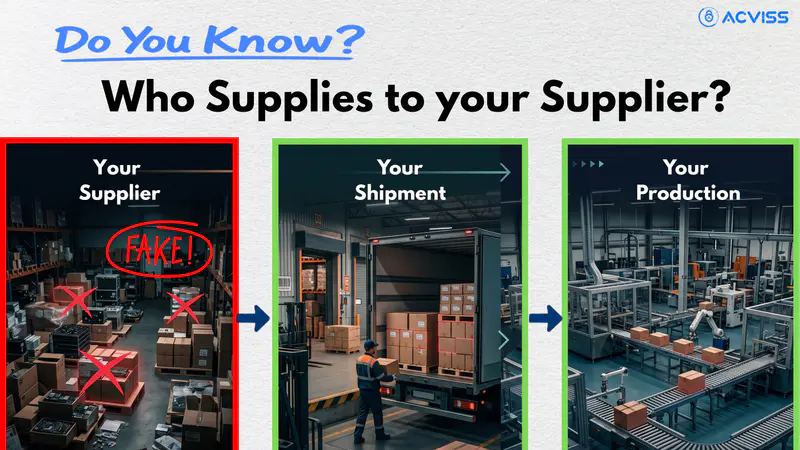
Most companies today can confidently name their direct suppliers. Procurement teams maintain approved vendor lists, compliance departments conduct supplier audits, and ERP systems track transactions across manufacturing and distribution networks with increasing sophistication. On the surface, this creates the impression of operational control.
Yet for many organisations, that control ends far earlier than expected.
Beyond Tier 1 suppliers lies an extensive network of sub-suppliers, raw material providers, contract processors, logistics operators, warehousing facilities, and sourcing intermediaries that often remain only partially visible to the brand itself. This hidden layer of the supply chain is where some of the most serious risks now emerge, including counterfeit infiltration, unauthorised substitutions, forged documentation, diversion, cargo theft, and forced labour exposure.
According to McKinsey’s Supply Chain Risk Pulse, only 42% of companies report meaningful visibility beyond their direct suppliers. That statistic reflects a larger operational reality. While most organisations have improved visibility at the surface level of Supply chain management, the deeper tiers that support modern global manufacturing still operate with significant blind spots.
For industries such as pharma, automotive, electronics, food, chemicals, and luxury goods, this has become far more than a procurement issue. It is now directly tied to Brand protection, Product traceability, Product safety, Trademark Protection, customer satisfaction, and regulatory compliance.
The problem is not that companies do not know their suppliers. The problem is that they often do not know who supplies them.
Understanding How Multi-Tier Supply Chains Actually Work

The term “multi-tier supply chain visibility” is widely used across compliance and procurement discussions, but the structure itself is often misunderstood. Most supply chains are not linear systems. They are layered operational ecosystems involving hundreds or sometimes thousands of interconnected entities moving materials, components, and products across regions.
Tier 1 Suppliers
Tier 1 suppliers are the companies with which brands maintain direct commercial relationships. These suppliers are usually well documented inside procurement and compliance systems.
Examples include:
Contract manufacturers
Packaging vendors
Assembly partners
Logistics providers
Direct component suppliers
Most organisations already maintain relatively strong oversight at this level through audits, contracts, quality checks, and supplier performance reviews.
Tier 2 Suppliers
Tier 2 suppliers operate one level deeper. They provide goods or services to Tier 1 suppliers rather than directly to the brand itself.
This category often includes:
Raw material processors
Chemical manufacturers
Packaging converters
Semiconductor providers
Regional subcontractors
Although these suppliers may directly influence the integrity of the final product, they frequently operate outside the visibility perimeter of the buying organisation. This is where Tier 2 supplier risk becomes increasingly difficult to manage.
Tier 3 and Beyond
Further upstream, Tier 3 suppliers may include agricultural producers, commodity traders, mining operations, speciality material manufacturers, or local sourcing entities supplying critical inputs into larger manufacturing ecosystems.
At this level, visibility becomes fragmented very quickly.
A single Tier 1 supplier may depend on dozens of Tier 2 suppliers operating across multiple countries. Those Tier 2 suppliers may themselves rely on hundreds of smaller upstream entities. The deeper organisations move into the supply chain, the harder it becomes to monitor sourcing integrity, inventory movement, documentation authenticity, and operational risk.
Why the Most Serious Risks Hide Beyond Tier 1
The strongest oversight in most supply chains exists at the direct supplier level because that is where contracts, audits, and procurement governance are concentrated.
Lower tiers function very differently.
Many upstream suppliers operate with reduced digital maturity, inconsistent compliance systems, limited cybersecurity infrastructure, and far less operational scrutiny. In highly fragmented industries, subcontracting relationships may also change frequently based on pricing pressure, material shortages, seasonal demand, or logistics disruptions.
This creates conditions where counterfeit products and unauthorised substitutions can enter legitimate supply chains without immediate detection.
The pattern is increasingly visible across global trade networks.
The 2021 TT Club and BSI Connect SCREEN report examining cargo crime in Gulf countries found that 76% of cargo theft incidents occurred within warehouses and facilities rather than during transportation. In the UAE, the number rose to 87%.
That distinction matters because warehouses, transhipment hubs, and free trade zones are often where visibility weakens significantly. Goods may be unpacked, consolidated, relabelled, repackaged, or rerouted through multiple operators before continuing downstream.
The report identified several recurring risks across these environments:
These vulnerabilities are especially dangerous because they often emerge several tiers away from the brand itself.
How Counterfeit Components Enter Through Lower-Tier Suppliers
For years, counterfeiting was viewed primarily as a downstream retail problem involving fake finished products sold through informal channels or unauthorised online marketplaces.
That model no longer reflects reality.
Today, counterfeit infiltration increasingly occurs upstream through component substitution, material fraud, and unauthorised sourcing practices buried deep within legitimate supply chains.
The Sub-Supplier Substitution Problem
A Tier 1 supplier may appear fully compliant during audits while unknowingly sourcing materials from unauthorised lower-tier vendors through subcontractors or emergency procurement channels.
This usually happens during:
Raw material shortages
Price volatility
Capacity constraints
Regional disruptions
Expedited production cycles
In such situations, lower-tier suppliers may substitute materials or components without fully updating sourcing records.
The consequences can be severe.
In Pharma
Counterfeit or diluted active ingredients introduced upstream can compromise Product safety, regulatory compliance, and patient trust.
In Automotive
Unauthorised electronic components or low-grade mechanical parts can introduce operational failure risks that may not appear until products are already in circulation.
In Electronics
Cloned semiconductors and counterfeit integrated circuits are increasingly entering global distribution channels through brokers and grey market sourcing networks.
In Food Supply Chains
Undocumented ingredient substitutions may pose contamination risks, increase allergen exposure, or lead to false origin declarations.
Counterfeit operators exploit free trade zones and bonded warehouses for “layering” activities, where counterfeit goods are stored alongside genuine products before redistribution into legitimate channels.
By the time these products reach the market, distinguishing authentic inventory from compromised inventory becomes significantly harder.
The Structural Problem With Supply Chain Visibility

Most organisations understand the importance of sub-supplier traceability. The challenge is that traditional systems were never designed to deliver deep operational visibility across multiple supply chain tiers.
Most ERP and procurement platforms focus on direct supplier transactions rather than dynamic supplier ecosystems.
As a result, organisations still depend heavily on:
Supplier declarations
Manual audits
Spreadsheet-based supplier mapping
Periodic compliance reporting
Paper documentation
Static procurement records
These methods create several major problems.
Supply Chains Change Constantly
Modern sourcing networks are highly dynamic.
Supplier relationships shift because of:
Commodity price fluctuations
Geopolitical instability
Shipping disruptions
Emergency sourcing decisions
Seasonal demand spikes
Regulatory restrictions
A supplier that appears compliant during an annual audit may, only weeks later, temporarily source from entirely different vendors.
Documentation Can Be Manipulated
The Gulf cargo crime report highlighted increasing risks tied to forged certificates of origin, falsified shipment records, and manipulated customs documentation.
This is particularly common inside high-volume transhipment environments and free trade zones where simplified administrative procedures can reduce oversight.
Audits Capture Snapshots, Not Continuous Activity
Manual auditing still plays an important role in Supply chain management, but audits are periodic by nature.
They capture moments in time.
Modern supply chains operate continuously.
Temporary sourcing substitutions, counterfeit insertion, or unauthorised distribution activity can occur entirely between audit cycles without immediate detection.
What Multi-Tier Supply Chain Mapping Actually Involves
Effective multi-tier supply chain visibility requires far more than maintaining supplier lists. It involves continuously mapping relationships, material flows, and operational events across the network.
Step 1: Supplier Relationship Discovery
The first step involves identifying direct and indirect suppliers connected to critical product lines.
This often reveals previously undocumented dependencies involving:
Contract manufacturers
Third-party warehouses
Regional sourcing partners
Component brokers
Packaging subcontractors
Material processors
For many organisations, this stage alone exposes how limited their existing visibility actually is.
Step 2: Product and Material Lineage Mapping
Once suppliers are identified, organisations begin mapping the movement of components and materials across the product lifecycle.
This enables Product traceability across multiple tiers.
Key questions include:
Where did the material originate?
Which facility processed it?
Which warehouse handled it?
Was the shipment repackaged?
Did sourcing change during shortages?
This level of Track and Trace visibility becomes critical during recalls, investigations, or regulatory reviews.
Step 3: Risk Layering
After mapping relationships, organisations can begin assigning risk indicators across suppliers and logistics environments.
These typically include:
Geographic exposure
Counterfeit prevalence
Cargo theft history
Political instability
Forced labour risk
Regulatory sensitivity
Corruption exposure
At this point, supply chain mapping becomes a risk intelligence function rather than a documentation exercise.
Step 4: Real-Time Event Visibility
The final stage involves monitoring operational events continuously rather than relying solely on static records.
This includes:
Shipment movement tracking
Warehouse transfer events
Tamper alerts
Distribution routing changes
Product Verification activity
This is where traceability evolves into infrastructure.
Regulatory Pressure Is Pushing Visibility Beyond Tier 1
Regulators are increasingly demanding evidence-based visibility across supply chains rather than surface-level supplier declarations.
The European Union Deforestation Regulation (EUDR) requires organisations to demonstrate that products entering the EU are not linked to deforestation activities. This demands detailed sourcing traceability extending deep into agricultural and raw material supply chains.
Similarly, the Corporate Sustainability Due Diligence Directive (CSDDD) expands corporate accountability for environmental and human rights violations occurring across supplier ecosystems, including indirect suppliers.
Forced labour regulations are creating additional pressure across industries ranging from textiles to electronics and agriculture.
Increasingly, organisations are expected to answer operational questions such as:
Where did this material originate?
Which supplier handled it?
Was the sourcing route changed?
Can the company verify the chain-of-custody records?
This shift is fundamentally reshaping expectations around Brand protection, IP Protection, Product Verification, and supply chain governance.
Why Traceability Infrastructure Matters More Than Ever

Manual auditing alone cannot support the complexity and speed of modern supply chains.
This is why organisations are increasingly investing in digital traceability infrastructure capable of capturing real-time operational data across multiple supplier tiers.
Origin by Acviss Track and trace system enables organisations to:
Monitor product movement across the supply chain
Strengthen product authentication processes
Detect anomalies earlier
Reduce counterfeit infiltration risks
Improve recall response times
Protect customer engagement and customer satisfaction
Support regulatory compliance requirements
For organisations implementing anti-counterfeiting solutions, the objective is no longer simply identifying fake products after they appear in the market.
The objective is to prevent counterfeit infiltration before compromised products move downstream.
That requires visibility beyond Tier 1.
Solving The Operational Risk
Supply chains today are larger, faster, and more interconnected than at any point in modern commerce. Yet many organisations still operate with limited visibility into the deeper supplier networks supporting their products.
That gap has become one of the defining operational risks of global trade.
Counterfeit infiltration, unauthorised sourcing substitutions, forged documentation, cargo theft, and diversion increasingly emerge beyond direct suppliers where oversight weakens and visibility declines. At the same time, regulations such as EUDR and CSDDD are forcing organisations to prove far greater transparency across supplier ecosystems.
For modern businesses, multi-tier supply chain visibility is no longer optional. It is becoming central to Product traceability, Brand Authentication, Trademark Protection, Product safety, and long-term operational resilience.
Organisations investing in stronger Track and trace infrastructure, Product Verification systems, and real-time supply chain visibility will be significantly better positioned to detect risk earlier, respond faster, and protect both their products and their reputation.
Interested in strengthening your supply chain visibility and improving sub-supplier traceability across your network?
Get in touch with us to explore how Acviss Origin helps brands build deeper multi-tier traceability, improve Brand protection, and strengthen operational visibility across modern global supply chains.