Reality check. If a customer bought a premium sneaker or a branded watch on a resale platform and the product starts falling apart because it was a fake, the buyer will go online and leave a one-star review, not for the resale platform, but for your brand.
Reason: the buyer doesn’t know whether or not it was a counterfeit; to them, it is a legitimate product because everything looks the same, and they even got a receipt.
You had nothing to do with that transaction. And yet your brand took the hit.
This is the resale problem that most brands have not solved yet. The global resale market was valued at USD 594 billion in 2025 and is projected to approach USD 854 billion by 2030. The younger buyers are actively choosing pre-owned. Resale is no longer a niche category. It is a mainstream market.
The problem is that most brands treat the first sale as the finish line. Once the product leaves the store, the brand's connection to it ends completely. No verification. No data. No visibility. And in that gap, counterfeits move in.
This blog breaks down why one-time authentication is no longer enough, what product lifecycle authentication looks like in practice, and how brands, including mid-market ones, can take back control of their products in the secondary market.
The Resale Economy Is Booming and Brands Are Largely Absent From It
The resale economy has changed a lot in the last five years. What used to be limited to garage sales and second-hand stores is now a fast-growing digital marketplace.
Secondhand apparel alone is worth an estimated USD 288 billion in 2026, growing at 15% CAGR through 2030. Electronics, luxury accessories, automotive parts, and consumer goods are not far behind. Platforms like eBay, Poshmark, StockX, Vestiaire Collective, and dozens of category-specific resale apps are driving billions in transactions every year, without the original brand present in any meaningful way.
Here is what brands are missing out on when they ignore the secondary market:
Revenue signal: They do not know which products are being resold, how often, at what price, or in which geographies.
Customer data: The secondary buyer is completely unknown to the brand. No email, no location, no product preference captured.
Brand presence: When a fake product ends up in the secondary market and passes as genuine, the brand's reputation suffers without the brand having any role in the transaction.
The circular economy is now a real part of consumer behaviour. Brands that treat post-sale as the end of the conversation are leaving themselves exposed and leaving a lot of value on the table.
How Counterfeits Enter the Resale Market
This is the part that most brand protection teams underestimate.
Fakes do not just get listed openly on resale platforms. The smarter counterfeiters use what is called an "injection point", a specific moment where a fake product enters a legitimate channel and becomes almost impossible to detect.
Here is how it typically works:
A fraudster buys a genuine product from an authorised store. They keep the real item but hold on to the original box, receipt, and any certificates that came with it. They then ship a high-quality fake, a "superfake", inside the genuine packaging, complete with the original receipt. On a resale platform, the listing looks completely legitimate.
Most platform-level authentication at this point relies on photos. A human expert or an AI image tool reviews the pictures and checks for signs of tampering. But when the fake is inside the original box, and the receipt is genuine, that check often passes.
The numbers confirm how widespread this is. In 2024, authentication platform Entrupy found that 8.4% of resale goods scanned were counterfeit or unidentifiable. The same study noted that counterfeit-related fraudulent returns cost brands an estimated USD 24 billion annually. And 61% of people who bought counterfeits online said they did not realise the product was fake until it arrived.
The result: the buyer blames the brand. Not the fraudster. Not the platform. The brand, because the name on the product is yours.
Why One-Time Authentication Fails in a Multi-Owner World

Most brand protection strategies are built around a single moment: the first sale.
A product is authenticated at the factory. It is scanned at the warehouse. It is sold to customer number one. After that, the brand's visibility ends.
This made sense when products changed hands once and stayed with one owner. But today, high-value goods move between multiple owners across their lifetime. A premium smartphone gets resold two or three times before it is retired. A designer handbag might change hands four or five times over a decade. A luxury watch could circulate across multiple owners across different countries.
Traditional authentication tools like paper certificates, hologram stickers, and one-time serial numbers are not built for this. They can be removed from a genuine product and placed on a fake one. They can be photographed and replicated. Once separated from the product, they are useless as proof.
There is also a regulatory signal worth paying attention to. The European Union's Digital Product Passport (DPP) mandate requires product-level identity to travel with goods across their full lifecycle, including resale, by 2030. This is not just a compliance requirement; it is a signal that product identity needs to extend well beyond the first sale.
The gap in current practice is clear:
The fix is not a better one-time check. It is an identity that follows the product, permanently, no matter how many times it changes hands.
What Product Lifecycle Authentication Actually Looks Like

Product lifecycle authentication is not a complicated concept. At its core, it means this: every product gets a secure digital identity at the time of manufacturing, and that identity can be verified at any point in the product's life, regardless of who owns it or where it is being sold.
Here is how it works in practice:
The physical anchor: A tamper-proof, non-cloneable label is embedded into the product itself, not just the packaging. Unlike a paper certificate or a hologram sticker on the box, this label cannot be removed and reapplied to a different product without destroying it. It stays with the product permanently.
The digital layer: Every time the label is scanned, it connects to a secure cloud record that stores the product's verified history, where it was manufactured, that it is genuine, and a chain of ownership events over time.
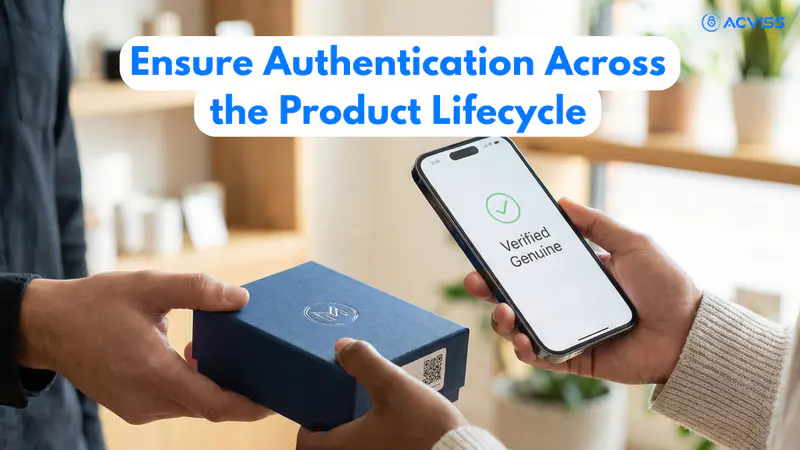
The consumer experience: A secondary buyer on a resale platform does not need a special app or any technical knowledge. They scan the label through WhatsApp or a standard web browser and instantly get confirmation from the brand that the product is genuine. One scan. A few seconds. No friction.
This is exactly what Certify by Acviss is built to do. Using patented, non-cloneable QR labels embedded into product packaging, Certify gives every product a permanent digital identity that travels with it through every resale transaction. The label cannot be replicated or reused. Verification works on mobile via WhatsApp or web — no app download required for the end consumer. Brands also get real-time analytics and geolocation data on scan activity, including alerts when a product is scanned in a geography that does not match expected distribution patterns.
The key shift here: authentication stops being a one-time event at the factory and becomes a permanent feature of the product.
[Stop fakes at every handoff. Try Certify.] > Book a Demo
What Luxury Brands Are Getting Right, and What Most Are Still Getting Wrong
Luxury brands have started to wake up to the resale problem, and some are taking real steps to address it.
Here’s one of the best examples from a top brand.
Rolex Certified Pre-Owned (CPO)
Rolex launched a program to certify pre-owned watches through authorised retailers. Only watches that have been physically inspected and re-certified by Rolex carry the CPO designation.
The program has gained traction, approximately 8,500 Rolex watches were available under CPO across 227 points of sale worldwide, contributing an estimated USD 120 million in sales by Q2 2025. CPO watches also command a meaningful price premium over uncertified resale listings, which shows that authenticated resale has real commercial value.
What they are getting wrong: Every one of these programs is centralised and high-friction. The Rolex CPO requires the watch to be physically sent to an authorised retailer for inspection. The LVMH blockchain requires participation in a consortium. These models work when a product is worth tens of thousands of dollars, because the cost and effort of re-certification make sense at that price point.
But they do not scale.
A brand selling premium sneakers at USD 200, a mid-market electronics label, or a high-quality FMCG product cannot build a Rolex-style inspection network. The economics do not work. The friction is too high. And the result is that most mid-market brands that have the resale market risk — have no practical solution at all.
The Hidden Opportunity: Turning Resale Into a Customer Acquisition Channel

Here is the angle most brand protection conversations miss entirely.
When you solve the resale authentication problem, you do not just stop counterfeits. You open a customer acquisition channel that previously did not exist.
Think about who the secondary buyer is. They actively sought out your brand's product on a resale platform. They trusted the brand enough to want a genuine version of it. They are already engaged — they just happen to have entered through a third-party channel. Without lifecycle authentication, you will never know they exist. You capture zero data, form zero relationships, and lose the chance to bring them into your brand ecosystem.
Now think about what happens when authentication is in place.
When the secondary buyer scans the label to verify their pre-owned product, that moment is both a security check and a brand touchpoint. By layering Bonus by Acviss on top of the authentication step, brands can turn that scan into a personalised engagement:
"Register your pre-owned device to activate a 6-month extended warranty."
"You just verified a genuine product. Here is 15% off your next purchase from our official store."
"Welcome to the brand. Scan to join our loyalty programme and claim your welcome reward."
In each of these scenarios, the brand has just acquired a net-new customer, their contact information, location, product preference, and buying behaviour, from a transaction that previously left zero trace.
Bonus by Acviss makes this possible through a custom-branded loyalty app released under the brand's own name on the App Store and Play Store. The scan-to-claim mechanism is built directly into the authentication flow. The brand gets full visibility into who is scanning, where, and what they are doing after that first interaction.
The secondary market stops being a threat to manage and becomes a customer pipeline to nurture.
A Practical Resale Authentication Program for Mid-Market Brands
You do not need to build a physical inspection network. You do not need to join a blockchain consortium. A practical resale authentication program for a mid-market brand comes down to three clear steps.
The operational lift for this is low. Labels are applied during the existing packaging process, no major line changes are needed. Verification requires no app download on the consumer side. Integration with existing CRM or e-commerce systems is straightforward.
The returns are significant:
Every fake scan triggers a counterfeit alert with geolocation data, so brands know exactly where fakes are circulating.
Every genuine scan from a secondary buyer is a customer acquisition event.
Brands gain visibility into their product's entire post-sale journey, who owns it, where, and how many times it has changed hands.
The mid-market brand that builds this infrastructure now is not just protecting itself. It is building a structural advantage that competitors without lifecycle authentication cannot easily replicate.
8. How Acviss Helps
Certify by Acviss
Non-cloneable, patented QR labels that give every product a permanent digital identity from the moment of manufacturing
Mobile verification via WhatsApp or web, no app download required for the consumer
Real-time analytics and geolocation alerts for fake scan activity across resale geographies
Tamper-proof labels that cannot be removed and reapplied to a counterfeit product
Customisable scan attempt limits and white-label branded verification experience
Bonus by Acviss
Custom-branded loyalty app deployed under the brand's own name on App Store and Play Store
Scan-to-claim rewards triggered directly from Certify labels, turning authentication into engagement
Fraud-proof reward redemption that prevents duplicate claims across resale chains
Multi-tier engagement that can onboard secondary buyers into primary loyalty programmes
Deep sales and engagement analytics to track which resale regions are generating genuine scan activity
What Brands Gain
Every resale scan is either a counterfeit alert or a customer acquisition event; nothing is wasted
Secondary buyers enter the brand ecosystem with zero friction
Brands gain first-party data from a market that was previously completely dark to them

Frequently Asked Questions
What is product lifecycle authentication?
Product lifecycle authentication means giving every product a secure, non-cloneable digital identity at the time of manufacturing. This allows the product to be verified as genuine not just at the first point of sale, but every time it changes hands — including in the secondary and resale market. The identity travels with the product permanently.
How can brands capture customer data from second-hand sales?
By requiring users to scan a secure product label to verify authenticity, brands create a direct touchpoint with secondary buyers. Platforms like Acviss Bonus then allow brands to offer warranty transfers, loyalty points, or first-purchase discounts in exchange for registration — turning the anonymous secondary buyer into a first-party data contact.
Is lifecycle authentication practical for mid-market brands, not just luxury?
Yes. The key difference from luxury CPO programs is that lifecycle authentication using non-cloneable labels and mobile verification does not require centralised inspection infrastructure. Labels are applied during existing manufacturing processes, and consumers verify via WhatsApp or web with no app required. The model works cost-effectively across a wide range of price points.