Most anti-counterfeiting strategies still begin too late. Authentication labels, QR codes, serialisation systems, and track and trace technologies are often added after packaging has already been designed, even though the packaging structure itself can play a major role in preventing replication. As counterfeit operations become more sophisticated, visually convincing packaging can now be reproduced at scale using commercially accessible print and manufacturing infrastructure.
The weakness is not only technological but architectural. Packaging teams usually optimise for branding, sustainability, and production efficiency, while brand protection teams focus on authentication and enforcement later in the process. The result is that many brands deploy advanced product verification technologies on packaging formats that remain relatively easy to imitate. Increasingly, the strongest anti-counterfeiting strategies are emerging from packaging systems designed from the beginning to make replication operationally difficult and commercially unattractive.
Why Conventional Packaging Design Creates Replication Risk
Most packaging design systems were never developed with replication resistance as a core objective. They were built around manufacturability, cost efficiency, branding consistency, and production scalability.
From a commercial perspective, that logic remains understandable. Global brands managing hundreds or thousands of SKUs require packaging ecosystems that can scale across regions, suppliers, co-packers, and regulatory environments without introducing excessive production complexity. Simplified structures reduce tooling costs, accelerate production onboarding, minimise line calibration requirements, and lower rejection rates during high-volume manufacturing.
Unfortunately, those same efficiencies also reduce the operational barriers for counterfeiters.
A standard folding carton printed through conventional CMYK workflows using commonly available substrates and predictable finishing processes can often be reproduced using commercially accessible digital print infrastructure. The counterfeit may not withstand close technical inspection, but counterfeit supply chains rarely depend on technical inspection. In fragmented retail ecosystems, especially across cross-border e-commerce and online marketplaces, packaging authenticity is frequently judged within seconds through photographs, partial visual checks, or familiarity with branding cues rather than forensic validation.
This problem becomes more severe in sectors where purchasing decisions increasingly occur remotely. Consumers buying pharmaceuticals, supplements, cosmetics, electronics accessories, or premium packaged goods online often never physically compare products against known genuine packaging. In many cases, they may never have handled the original product previously at all.
The OECD report on counterfeit and pirated trade has repeatedly highlighted how counterfeit networks exploit fragmented global logistics and digital commerce ecosystems that reduce inspection visibility and increase opportunities for infiltration.
Under those conditions, packaging architecture itself becomes strategically important because it determines how difficult the product is to reproduce before authentication technologies are even introduced.
Understanding the Counterfeiter’s Operational Economics
Many anti-counterfeiting discussions focus excessively on whether a feature is technically “copy-proof”. Counterfeit operations rarely evaluate packaging that way. Their assessment is primarily economic and operational.
A counterfeit packaging format becomes unattractive when the cumulative burden of replication begins affecting throughput, production consistency, procurement reliability, and profit margins. Sophisticated counterfeiters are capable of reproducing surprisingly advanced visual elements when the economics remain favourable. What they avoid are packaging systems that create recurring operational instability.
Several variables strongly influence that calculus:
The distinction between “difficult to imitate” and “expensive to imitate consistently” is important. Most effective anti-counterfeiting packaging systems operate through cumulative friction rather than singular breakthrough technology.
This is precisely why structurally sophisticated packaging often performs better operationally than overtly dramatic security features. Counterfeiters are generally more vulnerable to manufacturing inefficiency than to visual complexity alone.
Structural Packaging Features That Increase Copy Resistance

Complex Die-Cut Architectures
Structural complexity remains one of the most underused anti-counterfeiting tools available to packaging teams.
Most counterfeit operations rely on packaging formats that minimise tooling investment and simplify assembly workflows. Complex die-cut structures disrupt that model because they require tighter tolerances, more precise folding behaviour, higher tooling quality, and greater assembly consistency during production.
Packaging featuring asymmetrical folds, interlocking mechanics, concealed compartments, integrated tamper pathways, or multi-stage opening sequences introduces production dependencies that are difficult to replicate reliably using low-cost manufacturing infrastructure. Even minor inaccuracies become operationally visible when folds fail to align properly, closure tension changes, or opening mechanics degrade during logistics handling.
Luxury spirits manufacturers, premium cosmetics brands, and certain medical device companies have increasingly incorporated structural packaging complexity for precisely this reason. The objective is not merely aesthetic differentiation. It is to create manufacturing conditions where counterfeit replication becomes commercially unstable at scale.
However, these strategies also create legitimate operational trade-offs for genuine manufacturers.
Highly engineered structures can increase:
automated line stoppages
folding inconsistencies during high-speed packing
warehouse compression failures
export handling damage
sustainability compliance complications
and production onboarding challenges across regional converters
This is why anti-counterfeiting packaging cannot be isolated from manufacturing engineering or logistics planning. Security architecture that performs well in design presentations but disrupts production efficiency frequently gets simplified later through procurement pressure or operational compromise.
Multi-Layer Material Construction
Single-substrate packaging formats are easier to imitate because counterfeiters can substitute visually similar materials without significantly affecting perceived authenticity.
Multi-layer constructions create a different operational challenge. Combining paperboard, polymer films, textured coatings, destructible layers, metallic substrates, or embedded security materials introduces sourcing complexity that counterfeit ecosystems often struggle to manage consistently.
This becomes particularly effective when material behaviour itself contributes to authentication. Certain coatings, fibre compositions, laminates, or substrate textures interact with lighting, abrasion, moisture, or print chemistry in ways that are difficult to reproduce using generic materials available through informal supply chains.
Importantly, the deterrence effect often comes less from the material itself and more from the procurement discipline required to reproduce it accurately across repeated production cycles.
Counterfeit operations typically prioritise manufacturing flexibility and rapid substitution capability. Packaging systems dependent on controlled sourcing environments, specialised converters, or regulated substrate specifications introduce friction before printing even begins.
Yet this is also where many legitimate deployments become operationally complicated.
Security-oriented material specifications increasingly collide with:
recyclability requirements
packaging reduction mandates
regional sourcing limitations
food-contact regulations
pharmaceutical migration standards
and sustainability reporting obligations
As environmental regulation expands globally, packaging security teams are being forced to balance anti-counterfeiting resilience against circular economy expectations. The evolving EU Deforestation Regulation framework and broader traceability expectations are accelerating scrutiny around material sourcing transparency and packaging governance across supply chains.
Print Precision as a Security Mechanism
The print specification itself is often one of the strongest forensic indicators of packaging authenticity, even though consumers rarely recognise it directly.
Counterfeiters can reproduce logos, colours, and general layouts with increasing sophistication. Maintaining industrial-grade print precision across large production volumes is considerably harder.
Registration Accuracy and Fine Alignment Systems
Advanced packaging workflows frequently depend on highly controlled registration behaviour involving layered print elements, metallic overlays, varnish alignment, and micro-pattern structures. Genuine manufacturing environments maintain calibration systems designed to preserve consistency across production runs, substrates, humidity conditions, and regional print facilities.
Counterfeit operations usually struggle with this level of repeatability.
Small deviations in registration may appear insignificant during casual inspection but become detectable during forensic review or trained field verification. Fine alignment inconsistencies often emerge around:
micro-line intersections
layered foil transitions
latent imagery positioning
guilloche structures
fine vector geometries
and edge-to-edge registration boundaries
These characteristics are difficult to maintain when counterfeit production relies on fragmented or inconsistent print infrastructure.
Pantone Control and Spectral Consistency
Colour matching is another area where legitimate manufacturing discipline creates an operational barrier.
Sophisticated packaging systems increasingly maintain tightly governed spectral profiles involving approved ink chemistry, calibrated substrates, regional print tolerances, and controlled environmental conditions during production. Counterfeiters frequently approximate these specifications visually but struggle to maintain consistency across batches.
This becomes especially important in regulated industries such as pharma, where subtle packaging inconsistencies can affect not only brand trust but also compliance and patient safety.
The US FDA Drug Supply Chain Security Act guidance continues to reinforce the importance of traceability, integrity, serialisation governance, and secure product identification across pharmaceutical supply chains, particularly as verification expectations become more digitised and interoperable.
Micro-Text, Fine Patterns, and Covert Print Behaviour
Micro-text and fine-screen structures remain effective largely because counterfeit print systems often degrade under magnification or during repeated production scaling.
The same principle applies to:
stochastic screening
engineered moiré structures
covert vector patterns
latent imagery
hidden registration systems
and ultra-fine typography
These features are not necessarily impossible to imitate individually. Their value comes from requiring production precision that counterfeit manufacturing environments frequently cannot sustain economically over time.
Why Packaging Teams and Brand Protection Teams Rarely Align

One of the most persistent operational weaknesses in anti-counterfeiting strategy is organisational fragmentation.
Packaging design decisions are commonly distributed across marketing teams, creative agencies, procurement departments, print vendors, and product development groups. Brand protection functions, meanwhile, typically sit within legal, compliance, investigations, or supply chain security operations.
As a result, packaging decisions affecting counterfeit resistance are often made without meaningful input from the people responsible for enforcement and authentication.
This disconnect becomes increasingly problematic in global enterprises managing:
regional packaging variants
multiple converters
localisation requirements
and SKU proliferation across markets
Over time, specification drift begins to emerge. Regional substitutions, procurement-led simplifications, print vendor changes, and cost optimisation exercises gradually weaken packaging consistency. Counterfeiters are often extremely effective at identifying these inconsistencies because fragmented packaging governance creates exploitable ambiguity around what “genuine” packaging should actually look like across markets.
Many failed anti-counterfeiting programmes are not technology failures at all. They are governance failures disguised as packaging inconsistencies.
Designing Packaging for Authentication from the Beginning
Effective counterfeit-resistant packaging usually begins with a fundamentally different design brief.
Traditional packaging briefs focus heavily on aesthetics, dimensions, sustainability goals, production timelines, retail display requirements, and legal content placement. Security considerations are either minimal or introduced later through overlay technologies.
A packaging security brief should instead define:
threat models
verification environments
supply chain exposure points
enforcement requirements
inspection workflows
and authentication responsibilities
This changes how packaging decisions are evaluated from the beginning.
For example, a smartphone-based product verification system may appear operationally simple in theory. In practice, reflective laminates, damaged print surfaces, inconsistent warehouse lighting, poor camera calibration, or low-resolution print reproduction can significantly reduce scan reliability across real-world supply chains.
Similarly, serialisation systems frequently fail operationally because packaging redesigns were never aligned properly with ERP workflows, distributor onboarding requirements, aggregation logic, or reverse logistics handling.
The GS1 traceability standards framework has repeatedly emphasised that traceability effectiveness depends as much on physical implementation discipline as on data architecture itself.
Weak packaging execution undermines otherwise sophisticated digital authentication infrastructure.
How Authentication Technologies Fit into Counterfeit-Resistant Packaging

Authentication technologies perform best when layered onto packaging already designed for replication resistance.
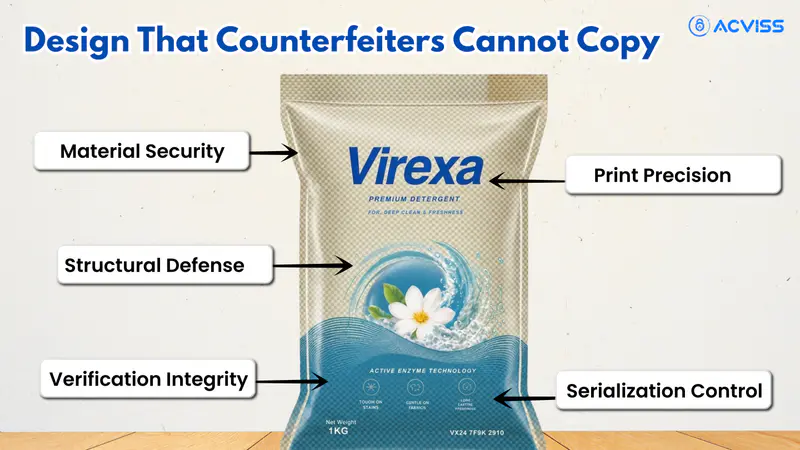
This is where non-cloneable label technology becomes strategically valuable. When deployed within a structurally secure packaging environment, authentication systems benefit from multiple reinforcing layers:
material complexity
print precision
structural deterrence
serialization governance
and verification consistency
The overall security posture becomes significantly stronger because counterfeiters must replicate both the packaging architecture and the authentication layer simultaneously.
Technologies such as Phantom Code by Acviss are particularly relevant in this context because smartphone-readable authentication increasingly needs to function across fragmented global distribution environments where consumers, field investigators, retailers, and distributors may all participate in product verification workflows differently.
The operational success of these systems depends heavily on packaging design discipline. Authentication technologies placed on structurally weak or visually inconsistent packaging environments frequently suffer from:
low consumer trust
verification abandonment
scan inconsistency
counterfeit substitution
and enforcement ambiguity
Physical packaging resistance and digital authentication are not separate anti-counterfeiting strategies anymore. Increasingly, they are interdependent layers within the same verification ecosystem.
The Future of Packaging Security Will Depend on Integration
The packaging industry is gradually moving away from treating anti-counterfeiting as an isolated visual feature problem.
Future packaging security systems are likely to combine:
structural engineering
covert print architecture
intelligent serialization
smartphone verification
AI-assisted inspection
material traceability
and integrated supply chain analytics
The companies likely to perform best operationally will not necessarily be those deploying the most visually sophisticated security labels. They will be the organisations capable of maintaining disciplined packaging governance across manufacturing, procurement, compliance, authentication, and distribution environments simultaneously.
That is considerably harder than deploying a hologram or adding a QR code.
It requires packaging to be treated not only as a branding surface, but as part of the organisation’s broader security infrastructure.
Conclusion
Counterfeit-resistant packaging is no longer defined solely by the visibility of its security features. Increasingly, the strongest deterrence comes from how difficult the packaging is to reproduce operationally, consistently, and profitably across fragmented counterfeit supply chains.
Brands that continue approaching anti-counterfeiting primarily through isolated labels, overt graphics, or post-production authentication overlays are likely to face growing limitations as counterfeit manufacturing capabilities continue improving globally. Packaging architecture, material behaviour, print precision, structural engineering, and verification workflows are becoming inseparable from broader product authentication and traceability strategies.
This shift has important implications beyond counterfeit prevention alone. Packaging decisions increasingly affect serialisation governance, regulatory compliance, customer trust, warranty management, supply chain visibility, and marketplace enforcement capability. As digital verification systems become more common across industries, the physical packaging environment supporting those systems will matter even more.
The organisations gaining the strongest long-term advantage are not simply deploying more security features. They are redesigning packaging ecosystems so that replication itself becomes operationally inefficient.
Interested in learning more? Get in touch with us.