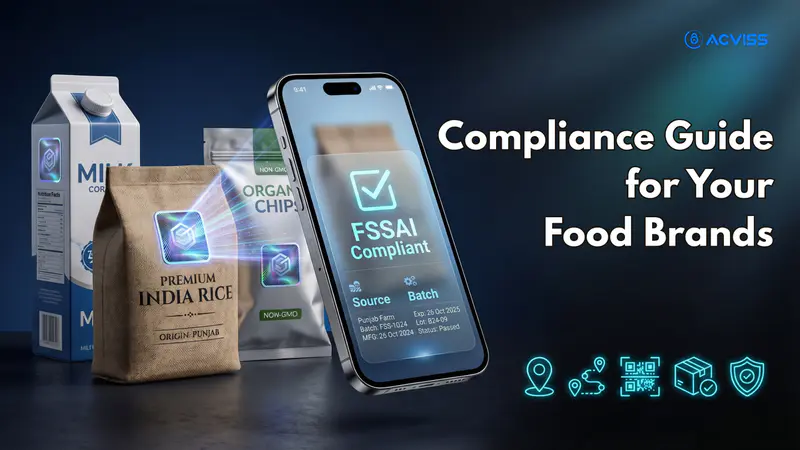
The regulatory landscape for India’s food industry is undergoing a quiet but significant transformation. While earlier frameworks focused heavily on hygiene, testing, and licensing, the current shift is towards data-backed accountability across the entire supply chain. At the centre of this evolution is traceability.
For many food businesses, however, the concept remains ambiguous. Unlike sectors such as pharma, where product traceability and product authentication have long been standardised, the food industry is only now beginning to grapple with what traceability truly means in operational and compliance terms.
This has led to a growing number of practical questions among Food Business Operators: Is track and trace mandatory under FSSAI? What exactly needs to be recorded? And how deep does this requirement go?
This guide aims to answer those questions in clear, practical terms, while unpacking the broader implications for supply chain management, brand protection, and customer satisfaction.
The Direction of FSSAI: Moving Beyond Regulation to Traceability
The Food Safety and Standards Authority of India has not introduced a single, standalone “track and trace regulation.” Instead, it has embedded traceability requirements across multiple regulatory updates, digital systems, and enforcement practices.
This distinction is important. Rather than announcing a sweeping mandate, FSSAI has been incrementally building a framework where traceability becomes unavoidable in practice.
The expansion of FoSCoS, the introduction of batch-level reporting requirements, and the rollout of traceability-specific applications such as fortified rice tracking systems all point in the same direction. Regulators increasingly expect that any food product in circulation can be traced backwards to its source and forwards through its distribution path.
This shift aligns India with global movements, including frameworks such as the European Union Deforestation Regulation, where traceability is no longer optional but foundational to market access.
Is FSSAI Track and Trace Mandatory?
From a strictly legal standpoint, there is no single clause that states “track and trace is mandatory for all food products.” However, interpreting compliance in that narrow sense would be misleading.
In reality, traceability is already mandatory through a network of interconnected requirements.
Food businesses are now required to maintain and report detailed records through FoSCoS, particularly concerning rejected and expired products. High-risk categories such as dairy, meat, packaged water, and infant nutrition are subject to even stricter controls, where batch-level traceability is not just expected but routinely scrutinised.
Additionally, specialised initiatives such as fortified rice traceability require manufacturers to upload detailed batch data, including composition, sourcing, and testing information. When viewed collectively, these requirements create a system where operating without traceability is no longer feasible.
In practical terms, therefore, the answer is clear: track and trace is functionally mandatory, even if not labelled as a single regulation.
Why Traceability Has Become Central to Food Safety
The urgency behind these changes becomes clearer when one considers the nature of risk in the food industry.
Unlike counterfeit electronics or luxury goods, food fraud is rarely visible. Products can be diluted, substituted, or relabelled without obvious signs, making detection difficult until harm has already occurred. This is precisely why regulators are focusing on product verification and product authentication as complementary layers to traceability.
One of the most pressing concerns is the re-entry of unsafe food into the supply chain. Without proper tracking, expired or rejected batches can be diverted and resold, often through informal channels. The requirement to report disposal methods through FoSCoS directly addresses this risk.
Equally important is the growing consumer trust deficit. Today’s consumers are more informed and more sceptical. They expect transparency not just in marketing claims but in the actual journey of the product. Traceability, therefore, is no longer just a compliance requirement; it is a cornerstone of customer engagement and long-term brand credibility.
What Data Does FSSAI Expect for Traceability?

To understand what compliance looks like in practice, it is useful to break traceability into three distinct layers: upstream, internal, and downstream.
Upstream Traceability: Knowing Your Sources
At the sourcing level, food businesses must maintain detailed records of raw materials. This includes supplier identification, batch numbers, and quality certifications. For fortified products, the requirements also include micronutrient composition, blending ratios, and laboratory test reports.
The objective is straightforward: if an issue arises, regulators should be able to identify the origin of the problem without ambiguity.
Internal Traceability: Mapping Production Processes
Within the manufacturing facility, traceability requires a clear linkage between raw materials and finished products. Businesses must be able to track which batches were processed on which lines, at what time, and under what conditions.
An important development here is the reclassification of packaging materials from “non-critical” to “critical.” This change underscores the role of packaging in product safety and brand authentication, particularly in preventing tampering and contamination.
Downstream Traceability: Tracking Distribution
Once products leave the facility, the focus shifts to distribution. Businesses must maintain records of where products are sent, in what quantities, and through which intermediaries.
This is often the weakest link in traditional systems, yet it is critical for effective recalls and for identifying leakages into grey markets. Robust track and trace systems are essential at this stage to ensure end-to-end visibility.
Digital Compliance: The Role of FoSCoS and Consumer Interfaces

FSSAI’s approach to enforcement is increasingly digital. The Food Safety Compliance System (FoSCoS) serves as the central platform for licensing, reporting, and data submission.
With the introduction of perpetual licences in 2026, the regulatory model is shifting from periodic renewals to continuous compliance. This makes real-time or near real-time data management far more important than before.
On the consumer side, initiatives such as the Food Safety Connect App signal a move towards greater transparency. By enabling consumers to verify licences, lodge complaints, and report misleading claims, FSSAI is effectively turning consumers into active participants in the compliance ecosystem.
For brands, this creates both a challenge and an opportunity. While scrutiny increases, so does the potential to build trust through transparent brand verification mechanisms.
The Link Between Labelling and Traceability
Recent labelling reforms further reinforce the importance of traceability. Requirements such as bold declarations of sugar, sodium, and saturated fat, along with the prohibition of vague claims like “100%,” are designed to ensure that product information is both accurate and verifiable.
This introduces a critical shift. Labels are no longer just marketing tools; they are compliance statements backed by traceable data. Any discrepancy between label claims and actual product composition can now be more easily scrutinised and challenged.
Where Food Brands Typically Fall Short
Despite clear regulatory direction, many food businesses struggle with implementation. One of the most common issues is the fragmentation of data across departments, leading to inconsistent or incomplete records.
Manual processes further complicate matters, making it difficult to achieve real-time visibility. In many cases, businesses may have traceability in theory but lack the systems needed to execute it effectively.
Perhaps the most significant gap, however, lies in the absence of robust product authentication. Even when supply chain data is available, there is often no mechanism to ensure that the product itself has not been duplicated or tampered with.
From Traceability to Authentication: Closing the Loop

Traceability and authentication serve different but complementary purposes. While traceability maps the journey of a product, authentication confirms its legitimacy.
Technologies such as non-cloneable labels introduce a critical layer of security by assigning unique, tamper-resistant identifiers to each unit. These identifiers can be verified by both businesses and consumers, enabling real-time product verification and brand authentication.
Solutions such as Certify support this process by enabling secure, consumer-facing verification mechanisms, while Origin extends traceability across the supply chain through immutable records.
Together, these systems transform compliance from a reactive obligation into a proactive brand protection solution, strengthening both IP protection and trademark protection.
The Strategic Advantage of Getting This Right
Forward-looking brands are beginning to recognise that traceability is not merely a regulatory burden. When implemented effectively, it delivers tangible business benefits.
Improved traceability enhances recall efficiency, reduces financial losses, and minimises reputational damage. It also provides valuable insights into supply chain performance, enabling better decision-making.
More importantly, it strengthens consumer trust. In a market where authenticity and transparency are increasingly valued, the ability to offer verifiable product authentication can significantly enhance customer satisfaction.
What Food Brands Should Do Now
For businesses looking to align with FSSAI’s evolving expectations, the path forward involves both immediate actions and long-term investments.
In the short term, organisations should focus on digitising records, integrating with FoSCoS, and ensuring that supplier and production data is consistently captured.
Over the longer term, the emphasis should shift towards implementing integrated track and trace systems, supported by advanced anti-counterfeiting solutions and consumer-facing verification tools.
This dual approach ensures not only compliance but also resilience in an increasingly complex and regulated market.
The Future of Compliance and Traceability
The evolution of FSSAI regulations reflects a broader shift in how food safety is defined and enforced. Traceability, once considered an operational detail, is now central to compliance, product safety, and brand protection.
While the framework may still appear fragmented, its direction is unmistakable. Food businesses are expected to know their products, their supply chains, and their risks with far greater precision than before.
Those that respond proactively will not only meet regulatory requirements but also position themselves as trusted, transparent brands in a competitive market.
If you are exploring how to align with FSSAI expectations while strengthening product authentication, track and trace, and overall brand protection solutions, it may be time to evaluate a more integrated approach.
Interested to learn more? Get in touch with us.