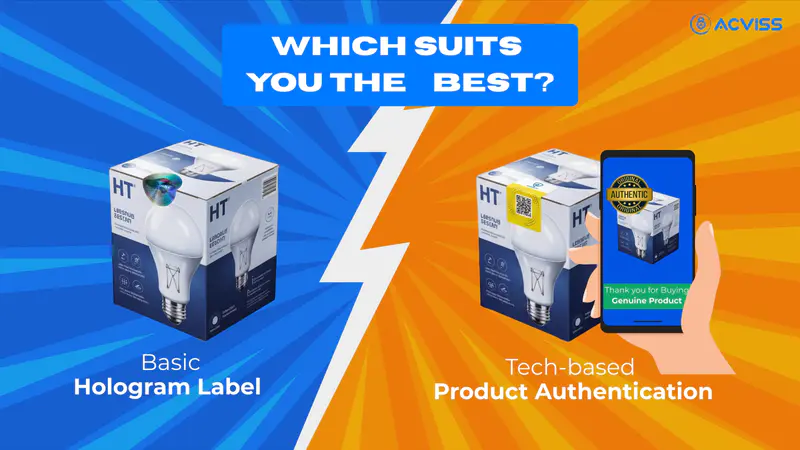
For decades, the hologram has been the trusted symbol of product authentication. It has sat quietly on cartons, labels and blister packs, reflecting light in a reassuring shimmer that told distributors and consumers alike, “This is genuine.”
But the market has changed. Counterfeiters are no longer small operators with limited reach. They are organised, digitally enabled, and deeply aware of how brands protect themselves. At the same time, regulatory pressure in sectors such as pharma, agrochemicals, electronics and luxury goods is intensifying. Consumers expect instant product verification. Governments are enforcing traceability mandates such as EUDR.
The question is no longer whether you need anti-counterfeiting solutions. The question is whether the traditional hologram is enough for the next three years, or whether tech-based authentication is the upgrade your brand cannot afford to delay.
This is not a cosmetic decision. It is a strategic one that impacts supply chain management, product safety, IP protection, customer engagement and ultimately brand trust.
The Rise of the Hologram: Why It Worked
Holograms gained popularity in the 1990s and early 2000s when counterfeiting became a visible threat across industries. They offered three key advantages:
Visual deterrence
Relative difficulty of replication at the time
Low implementation complexity
For sectors like pharma and FMCG, a hologram added a layer of product safety reassurance. It signalled authenticity and, in many cases, tamper evidence. Brands invested in customised holographic foils with embedded logos, microtext and colour shifts.
For a time, this worked.
According to OECD estimates, counterfeit and pirated goods account for nearly 3.3 per cent of global trade. In markets such as India and parts of Southeast Asia, the impact is even more severe in high-value categories like pharmaceuticals and electronics. As counterfeiters evolved, so did their ability to replicate holograms with alarming precision.
Today, a standard hologram can often be copied for a fraction of the cost of the original. Once a hologram design leaks or is reverse-engineered, it becomes a static security feature in a dynamic threat landscape.
The core limitation is this: a hologram is a passive feature. It does not generate data. It does not interact. It does not adapt.
Where Holograms Fall Short in 2026 and Beyond

1. Static Security in a Dynamic World
Counterfeiters now operate with advanced printing capabilities, access to global suppliers and even stolen design files. A hologram that once required specialised equipment can now be imitated convincingly.
Unlike technology-driven product authentication solutions, a hologram cannot change per unit. Every sticker in a batch often carries the same design. That means once it is copied, the entire production run is compromised.
2. No Real-Time Product Verification
Holograms do not enable real-time product verification. A retailer or consumer may visually inspect the label, but there is no backend system confirming authenticity.
In contrast, modern product verification systems generate unique, serialised codes for each unit. When scanned, they confirm whether the code has been used before, whether it matches the production batch and whether it is being scanned in an expected geography.
Without data, there is no intelligence. Without intelligence, there is no proactive brand protection.
3. Limited Support for Supply Chain Management
In a world moving towards full product traceability and track and trace compliance, static labels offer minimal value. Regulations such as EUDR are forcing brands to map their supply chains in detail. Pharma regulations in many countries require serialisation and traceability down to the unit level.
A hologram alone does not enable supply chain management insights. It cannot show where a product was diverted, duplicated or grey-marketed.
4. No Direct Customer Engagement
Brands increasingly seek to turn product authentication into a touchpoint for customer engagement and customer satisfaction. A hologram does not allow for interaction. It cannot lead to loyalty programmes, warranty activation or personalised content.
It is security without connection.
The Emergence of Tech-Based Authentication

Tech-based authentication solutions combine secure QR codes, serialisation, backend databases and analytics. Instead of a static image, each product carries a unique digital identity.
This is where the shift becomes strategic rather than cosmetic.
Unique Identity at the Unit Level
Modern product authentication technologies assign a non-repeating code to every single unit produced. When scanned, the code communicates with a secure server. If the same code is scanned multiple times in different locations, the system flags it as suspicious.
This is not simply brand authentication. It is real-time brand verification powered by data.
One such example is non-cloneable code technology that ensures each code cannot be replicated or predicted. In advanced implementations, the code acts as a digital certificate of authenticity, enabling consumers to verify manufacturing details and confirm product origin.
Real-Time Product Traceability
With tech-based systems, brands gain end-to-end product traceability. Every scan becomes a data point.
Where was the product scanned?
When was it scanned?
How many times has it been scanned?
This intelligence strengthens supply chain management. It helps detect diversion, parallel imports and stock anomalies. For sectors like pharma, where product safety is critical, such visibility can be life-saving.
According to WHO estimates, around 10 per cent of medical products in low- and middle-income countries are substandard or falsified. A tech-driven track and trace system directly addresses this risk by making it harder for fake products to circulate undetected.
Secure QR vs Hologram: A Direct Comparison

1. Security Depth
A hologram offers visible deterrence.
A secure QR backed by a serialised database offers both visible and invisible security layers.
When enhanced with non-cloneable technology, the QR becomes resistant to duplication. Even if the graphic is copied, the backend intelligence can detect abnormal scan behaviour.
2. Data and Analytics
Hologram: Zero data.
Tech authentication: Continuous data flow.
This data fuels IP protection strategies. It helps brands protect trademarks and intellectual property not just legally, but operationally. Trademark protection becomes proactive rather than reactive.
3. Regulatory Alignment
Track and trace requirements are tightening globally. In the pharma and food sectors, serialisation and digital records are increasingly mandatory.
Tech-based authentication aligns naturally with these requirements. Holograms may remain as supplementary tamper-evident features, but they cannot fulfil digital compliance obligations alone.
4. Customer Experience
A hologram reassures visually.
A secure QR engages interactively.
When a consumer scans a product for product verification, the brand has an opportunity to:
Confirm authenticity
Educate about product safety
Offer loyalty rewards
Collect feedback
This transforms anti-counterfeiting solutions into customer engagement engines.
The Upgrade Story Brands Need to Hear
For many brands, holograms are not simply labels. They represent years of procurement contracts, vendor relationships and standard operating procedures. Changing systems can feel disruptive.
However, the next three years will be defined by three forces:
Digital-first consumers
Stricter regulatory scrutiny
Smarter counterfeit networks
A static approach will struggle against a dynamic threat.
The smarter upgrade path is not necessarily an abrupt replacement. It is an evolution. Some brands adopt a hybrid approach initially, retaining tamper-evident visual features while integrating secure QR-based product authentication.
In such models, technologies like Certify by Acviss act as a digital authentication layer, embedding non-cloneable codes directly into packaging. Each code becomes a gateway to brand authentication, product traceability and customer interaction.
The transformation is subtle externally but profound internally.
Industry-Specific Considerations
Pharma
In pharma, product safety is non-negotiable. Counterfeit medicines can lead to severe health consequences and legal liability. Tech-based product verification supports regulatory compliance, strengthens supply chain management and protects patient trust.
Holograms alone are insufficient in high-risk therapeutic categories.
FMCG and Agrochemicals
Here, the scale of distribution increases the risk of diversion and duplication. Secure QR-based track and trace systems help monitor channel performance and identify suspicious clusters of scans.
They also enable direct-to-consumer communication, improving customer satisfaction and loyalty.
Luxury and Electronics
For high-value goods, brand authentication is directly tied to brand equity. A digital authentication system strengthens IP protection and enhances resale verification in secondary markets.
Cost vs Value: A Strategic Perspective
A hologram may appear less expensive per unit. However, cost should be evaluated against risk exposure.
Consider:
Revenue loss due to counterfeit infiltration
Legal costs from IP disputes
Reputational damage from product safety incidents
Lost customer trust
Tech-based authentication is not merely a label cost. It is an investment in brand protection solutions that generate operational intelligence.
Moreover, the data captured through secure QR interactions often reveals distribution inefficiencies and grey market leakages that far exceed the cost of implementation.
The Next Three Years: What Will Define the Winners
The brands that will lead over the next three years are those that treat product authentication as infrastructure, not decoration.
They will:
Embed unique digital identities into every unit
Use track and trace systems for supply chain transparency
Integrate authentication with customer engagement
Strengthen trademark and IP protection through data
Holograms may still have a role as a visible deterrent. But on their own, they belong to a previous era of anti-counterfeiting technologies.
The real differentiator will be intelligence.
Final Thoughts
The choice between a hologram vendor and tech-based authentication is not simply a procurement decision. It is a strategic statement about how seriously a brand takes product authentication, product traceability and brand protection.
If your goal is to maintain the status quo, a hologram may suffice temporarily.
If your goal is to strengthen product verification, enhance supply chain management, comply with evolving regulations such as EUDR and build meaningful customer engagement, then secure QR-based, non-cloneable technology represents the future.
The next three years will reward brands that invest in adaptive, data-driven anti-counterfeiting solutions.
Interested to learn more? Get in touch with us to explore how advanced product authentication and brand verification technologies can protect your brand, your customers and your intellectual property for the years ahead.