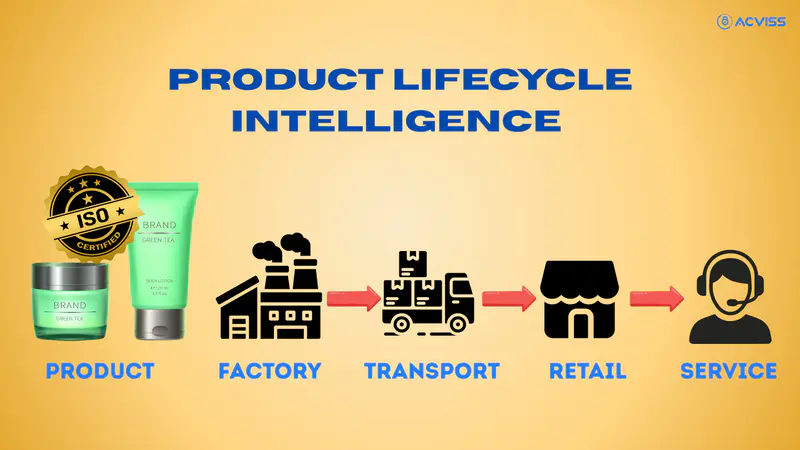
The system documented what happened to a product from concept to retirement.
But documentation is not intelligence.
Today, forward-looking brands are asking a more strategic question. Can product lifecycle intelligence move beyond storage and become a measurable profit driver?
The answer lies in how deeply organisations are willing to rethink lifecycle data. When lifecycle tracking evolves into scan-driven, item-level, continuously verified intelligence, it begins to influence revenue protection, lifecycle profitability and commercial optimisation in ways traditional PLM data analytics never could.
From Lifecycle Tracking to Lifecycle Intelligence
Traditional PLM systems were designed to manage engineering and manufacturing information. They captured static data such as specifications, version histories and compliance documentation.
However, most PLM environments stop at internal control. Once a product leaves the factory, visibility diminishes. Distribution complexity increases. Secondary sales become opaque. Warranty claims depend on trust. Grey market movement distorts forecasting. Counterfeit leakage erodes Brand protection.
Lifecycle intelligence changes the equation.
Instead of asking, “What was the product designed to do?” organisations begin asking:
Where is each item right now?
Has it been authenticated at every stage?
Is it being sold in authorised regions?
Is its usage pattern aligned with forecast assumptions?
What lifecycle costs are emerging beyond manufacturing?
This transition from record-keeping to real-time product tracking is redefining lifecycle profitability.
Authentication Across the Lifecycle
Lifecycle intelligence becomes powerful when Product Authentication is embedded at every stage of the product journey.
1. Manufacturing Validation
At the production stage, item-level authentication ensures that every unit leaving the line carries a secure identity. In sectors such as pharma serialization lifecycle management or medical device lifecycle compliance, this is not optional.
Manufacturing validation anchored in item-level authentication supports:
Product safety
Regulatory compliance
IP Protection
Trademark Protection
It ensures that lifecycle data begins with verifiable authenticity rather than assumed integrity.
In industries like automotive aftermarket traceability, component authenticity determines both safety and brand credibility. Lifecycle intelligence must therefore begin at the origin.
2. Distribution Traceability

Once products enter distribution networks, complexity increases. Multiple warehouses, third-party logistics partners and regional distributors introduce risk.
Product traceability solutions that enable real-time product tracking provide visibility into movement patterns. Scan-based lifecycle monitoring reveals whether products follow authorised pathways.
Distribution traceability helps answer questions such as:
Are goods being diverted to unintended markets?
Are high-risk regions experiencing unusual movement patterns?
Is there evidence of counterfeit infiltration?
According to industry estimates, diversion and grey market leakage can account for 5 to 10 per cent of revenue in certain sectors. Lifecycle intelligence transforms this from an assumption into measurable data.
Channel Compliance and Brand Protection
Channel compliance is often the weakest link in Supply chain management. Authorised distributors may operate alongside unauthorised resellers. E-commerce channels further complicate visibility.
Lifecycle intelligence supported by Product Verification mechanisms ensures that channel performance is validated through scan data, not declarations.
When item-level authentication is required at distribution nodes, Brand Authentication becomes enforceable rather than aspirational.
This strengthens Anti-counterfeiting solutions and reinforces Trademark Protection across markets.
Warranty Verification and After-Sales Insight
Warranty fraud is a silent margin eroder. Industry reports suggest that fraudulent or unverifiable warranty claims can represent up to 3 to 5 per cent of total warranty spend.
Scan-based lifecycle monitoring allows organisations to validate:
Whether the product is genuine
Whether it was sold through authorised channels
Whether the warranty period is valid
Whether the product has already been claimed
Product Verification at the after-sales stage converts warranty processing from trust-based to evidence-based.
In sectors such as medical device lifecycle compliance, this level of traceability supports both patient safety and regulatory obligations.
End-of-Life Intelligence
Lifecycle intelligence does not end at sale. Understanding when and where products reach end-of-life provides insight into:
Replacement cycles
Refurbishment opportunities
Recycling compliance under frameworks such as EUDR
Secondary market behaviour
FMCG product journey analytics can reveal regional consumption rates. Automotive aftermarket traceability can highlight parts replacement frequency.
End-of-life insights feed directly into lifecycle cost optimisation strategies.
Revenue Protection Through Verification

Lifecycle intelligence is not merely operational visibility. It is a financial defence.
1. Preventing Counterfeit Leakage
Counterfeit infiltration damages revenue and erodes customer satisfaction. Without Product Authentication embedded across the lifecycle, fake goods can enter legitimate distribution streams.
Item-level authentication reduces this risk by ensuring each unit’s identity is continuously verifiable. When integrated with Product traceability systems, duplicate detection becomes immediate rather than retrospective.
This protects lifecycle profitability by safeguarding legitimate revenue streams.
2. Reducing Warranty Fraud
Warranty verification linked to scan-based lifecycle monitoring ensures that claims are processed only for genuine products. This reduces financial leakage and improves margin predictability.
3. Stopping Diversion
Diversion erodes pricing strategy and distorts demand forecasting. Lifecycle intelligence highlights anomalies in region-wise movement validation.
If a product intended for one territory consistently appears in another, the system surfaces behavioural patterns that require intervention.
4. Protecting Loyalty Budgets
Loyalty programmes often depend on declared sales volume. Without verification, incentives may reward diverted or counterfeit-linked transactions.
Bonus, functioning as a loyalty intelligence layer, aligns reward distribution with verified product movement. When connected to non-cloneable identity systems, it ensures that incentive payouts reflect authentic, item-level transactions.
This integration protects loyalty budgets from misuse while strengthening Brand protection and Product Authentication frameworks.
Data-Driven Commercial Optimisation

Lifecycle intelligence does more than prevent loss. It actively drives growth.
Real Secondary Sales Visibility
Traditional ERP-fed lifecycle logs capture primary billing but lack visibility into actual market movement.
Scan-based lifecycle monitoring bridges this gap. Verified secondary sales data improves forecasting accuracy and reduces overproduction.
In pharma serialisation lifecycle environments, this clarity supports regulatory compliance and supply balancing.
Demand Forecasting Based on Scan Data
Forecast models that incorporate real-time product tracking outperform those relying solely on historical billing.
Region-wise movement validation enables dynamic adjustments to manufacturing schedules and inventory allocation.
Lifecycle profitability improves when production aligns with verified demand rather than assumptions.
Dealer Performance Intelligence
By analysing scan frequency, recency and regional spread, organisations can identify high-performing dealers and detect behavioural inconsistencies.
This enhances Supply chain management coordination and informs commercial strategy.
Zero-Trust Lifecycle Architecture

The future of lifecycle intelligence lies in zero-trust supply chain design.
A zero-trust lifecycle architecture assumes nothing is authentic without verification. Every stage requires confirmation.
This means:
Item-level authentication at origin
Continuous scan-driven lifecycle monitoring
Real-time product tracking across distribution
Blockchain lifecycle traceability where appropriate
Integration between PLM data analytics and live verification feeds
Traditional lifecycle logs rely on ERP-fed records. Zero-trust architecture relies on continuously verified scan events.
The distinction is significant. ERP logs record transactions. Scan-based lifecycle intelligence validates reality.
Industry-Specific Implications
In pharma, serialisation lifecycle compliance is already mandated. Lifecycle intelligence enhances product safety and Brand Authentication while supporting regulatory audits.
In medical device lifecycle compliance, traceability supports patient protection and recall precision.
In automotive aftermarket traceability, authenticity ensures performance reliability and IP Protection.
In FMCG product journey analytics, regional consumption insights improve promotional efficiency and lifecycle cost optimisation.
Across industries, lifecycle intelligence is shifting from compliance burden to profit enabler.
From Cost Centre to Profit Driver
Product lifecycle intelligence becomes a profit driver when it influences three dimensions simultaneously:
Revenue protection through counterfeit prevention and diversion control
Cost optimisation through warranty fraud reduction and lifecycle cost management
Growth acceleration through demand forecasting and dealer intelligence
When Product Authentication, Track and trace, and item-level verification are integrated into commercial analytics, lifecycle data evolves from a historical record to a strategic advantage.
The question is no longer whether organisations should implement lifecycle intelligence. The real question is whether they can afford not to.
If you are ready to transform lifecycle tracking into a verified, scan-driven engine of profitability and Brand protection, interested to learn more, get in touch with us.