A Tier-1 automotive supplier ships 10,000 brake master cylinders to a major OEM. The outer housing passes every quality check. The serial numbers scan correctly. Three months later, a recall notice lands: brake failures across multiple vehicle models. The investigation reveals a counterfeit rubber seal from an unauthorised lower-tier vendor. The supplier had no way to trace which specific batch of seals went into which cylinder assemblies.
This isn't a problem with final product authentication. It's a problem with what happens before the final product exists.
Most anti-counterfeit solutions protect the box, not what's inside it. They verify the packaging, the label, and the serial number on the finished assembly. But in industries where products contain hundreds or thousands of components from multiple suppliers, the real risk isn't at the retail shelf. It's in the assembly line, the service centre, and the spare parts network where unauthorised components slip through undetected.
Why Multi-Component Products Break Traditional Authentication
Traditional authentication operates on a simple premise: one product, one verification point. Scan the QR code, check the serial number, and confirm authenticity. This works perfectly for single-unit products like consumer packaged goods or pharmaceuticals.
It fails completely for multi-component assemblies.
Consider an automotive engine with over 1,000 individual parts sourced from dozens of suppliers across multiple tiers. A standard authentication approach puts a serial number on the completed engine. When that engine fails in the field two years later, you know which engine failed. What you don't know is which specific component inside that engine caused the failure, which supplier provided it, or whether it was even an authorised part.
The problem isn't technical capability. Part marking is the first step to achieving traceability, but the real value is the information behind the serial number as the part is being assembled and how it is used. Most manufacturers mark final assemblies but lose complete visibility at the component level, creating blind spots where counterfeits, unauthorised parts, and quality issues enter undetected.
This gap has real consequences. OEMs now require 100% traceability down to the smallest component, yet 75% of manufacturers can't fully trace a product from its original design to a defect in the field. The result is over-recalls, extended warranty fraud, liability exposure, and customer safety risks that proper component-level authentication would prevent.
Counterfeit and Unauthorised Parts Entering Assembly Chains
Counterfeit infiltration is bigger than most brands realise. In 2024 alone, U.S. Customs seized 211,212 fake auto parts, nearly double the year before, costing the industry an estimated $3B every year. Global counterfeit trade has reached $467B, with automotive and electronics parts growing the fastest.
And that's just what gets caught. The real danger is what passes through undetected.
The "Trojan Horse" Scenario
Fakes rarely enter at the OEM level. They slip in through weaker links — lower-tier suppliers, grey-market distributors, or workshops sourcing cheaper unofficial spares.
Example:
A Tier-1 supplier buys sensors from a Tier-3 vendor. → That vendor, trying to cut costs, sources from an even cheaper supplier. → Counterfeit components get mixed into legitimate assemblies. → OEM receives final assemblies that look genuine externally, but contain hidden failures waiting to happen.
Electronics follow the same pattern, only worse. 40% of counterfeit electronics are ICs and chips, causing 5–10% assembly failures. A U.S. Senate probe uncovered 1M+ fake parts inside military aircraft and weapons systems — not smuggled in, but entering through approved supply channels with no component-level authentication.
The Grey Market Pressure Point
When shortages hit, brands start sourcing from the grey market: the Wild West of component procurement. This is exactly where counterfeiters thrive. They pull parts from e-waste, refurbish old chips to look new, and push them into unofficial channels at scale.
The result?
80% of manufacturers say fragmented supply chains make authentication difficult, and without verification at the component level, grey-market parts look identical to genuine ones — until things start failing in production or in the field.
Why Serial Numbers and QR Codes Fail in Complex Assemblies
Standard serialisation creates the illusion of traceability without delivering actual visibility. The limitations become obvious in multi-component contexts:
1. The Hidden Component Problem
If you place a QR code on a piston, it becomes inaccessible once the engine is assembled. You can't verify it without disassembly. This means authentication only works before assembly or after catastrophic failure, the two moments when it's least useful.
2. The Batch Code Blind Spot
Most manufacturers track components by batch, not by individual unit. If Batch A contains 10,000 parts and quality issues emerge, they recall all 10,000 units. With unit-level traceability, they could identify the specific 500 assemblies containing defective parts and recall only those. The difference in cost and customer impact is massive.
3. The Data Disconnect
A QR code on a spare part typically links to generic information: "This is Part X, compatible with Models Y and Z." What it should provide is specific provenance: "This is Part X, manufactured on March 15, 2025, at the Mumbai facility, authorised for Assembly #5402, and verified as genuine by the OEM."
Without this digital thread connecting components to assemblies, authentication becomes reactive instead of preventive. You discover problems after they've already caused damage.
4. The Replication Risk
Basic serial numbers and barcodes are relatively easy to replicate. Perpetrators often copy distinguishable marks, creating counterfeit parts with genuine-looking identifiers. Without advanced authentication features like encrypted 2D codes or blockchain verification, these fakes pass inspection until they fail in operation.
Requirements for True Part-Level Authentication
Solving multi-component authentication requires thinking deeply about how identity and verification work in manufacturing.
These five technical requirements define a truly effective system:
1. Component Marking at Source
Authentication must begin at the component level, not the assembly level. Every critical part receives a unique, non-cloneable identifier before it enters the production line. Laser part marking creates high-contrast, permanent codes that withstand harsh environments and remain legible throughout the product's lifecycle, enabling effective traceability on a microscopic level.
2. Real-Time Data Capture
Manufacturing traceability solutions must collect data from the part's journey at critical stages and consolidate it in a centralised, accessible database. This isn't about scanning parts at the end of production. It's about capturing associations as they happen: when Component A enters Sub-Assembly B, when Sub-Assembly B integrates into Final Assembly C.
3. Aggregation and Parent-Child Relationships
This is where most systems fail. True component-level authentication creates digital genealogy:
Level 1 (Child): Unique ID on the capacitor
Level 2 (Parent): Unique ID on the circuit board containing that capacitor
Level 3 (Grandparent): Unique ID on the appliance containing that circuit board
The system must track these relationships so that scanning the finished appliance reveals every component inside it. When you verify the washing machine, you should know exactly which capacitor, which circuit board, and which motor are contained within it.
4. Advanced Anti-Counterfeiting Features
Level 2 anti-counterfeiting involves proprietary unique identifiers created through laser marking precision that are encrypted and extremely difficult to replicate. These aren't simple barcodes that counterfeiters can copy. They're digital signatures that require an authentication infrastructure to verify.
5. Integration with Existing Systems
Component authentication can't exist in isolation. It must integrate with ERP systems, Manufacturing Execution Systems (MES), and quality management platforms. Track and trace modules should provide end-to-end visibility from suppliers through production to customer delivery, with time-sensitive material monitoring and data collaboration across the ecosystem.
How a Traceability Layer Creates Component-to-Assembly Lineage
The solution isn't just marking parts. It's building the digital thread that connects components to assemblies to final products across time and location.
Here's how effective component-to-assembly authentication works in practice:
Step 1: Serialisation at Component Level
Critical components receive unique, tamper-proof identifiers before entering the assembly process. This could be a 2D matrix code laser-etched onto a metal part, an RFID tag embedded in a housing, or an encrypted QR code on a circuit board. The identifier is recorded in the traceability system along with manufacturing date, batch number, supplier information, and quality inspection results.
Step 2: Association During Assembly
As components move through assembly stations, operators scan both the component identifier and the sub-assembly or chassis identifier. This "marrying" of codes creates the parent-child relationship in the system. The database now knows that Battery #ABC was installed in Chassis #123 on a specific date by a specific operator at a specific workstation.
This happens at multiple levels. Individual electronic components are associated with circuit boards. Circuit boards are associated with control units. Control units are associated with final assemblies. Each scan builds the genealogy.
Step 3: Digital Twin Creation
The traceability system creates a digital twin of the physical assembly, a complete record showing which specific components were used, when they were installed, and how they were tested. This digital twin contains the entire "as-built" configuration, not just what the engineering BOM specified, but what actually went into that specific unit.
Step 4: Downstream Verification
Years later, when the product requires service, a technician scans the main assembly identifier. The system instantly displays which components should be inside based on the original build record. If the technician finds different components during inspection or repair, it immediately flags potential counterfeits, unauthorised replacements, or warranty fraud.
This is the fundamental shift: from verifying products to verifying provenance. Authentication stops being a one-time check and becomes a continuous verification of product integrity across its entire lifecycle.
Industry Use Cases: Where Assembly Authentication Matters Most
The need for component-level authentication varies by industry, but patterns are clear across sectors where safety, liability, and high-value components converge.
1. Automotive: Warranty Fraud and Safety-Critical Systems
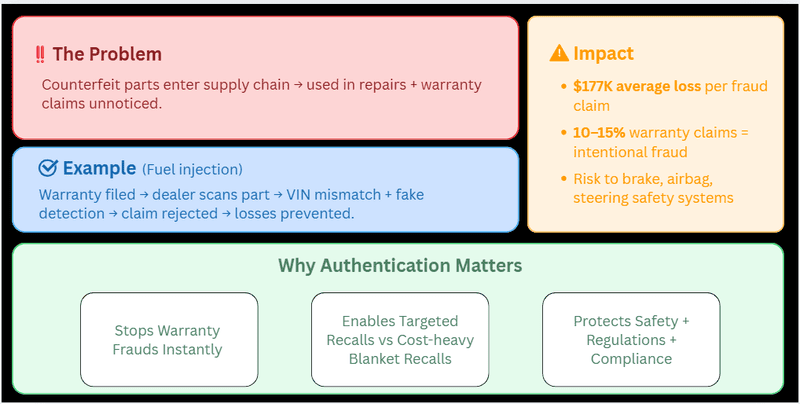
Counterfeit components enter automotive supply chains through lower-tier vendors, repairs, and grey-market sourcing. Without verification, they blend into genuine assemblies until failure or warranty claims expose the gap.
Authentication tools let OEMs verify parts at service points, catching mismatched VINs, rejecting fraudulent claims, and preventing safety hazards. Instead of recalling entire batches, brands can trace affected units precisely — saving cost, reputation, and customer trust.
2. Electronics: PCB Assembly and Counterfeit ICs
Electronics supply chains face higher counterfeit infiltration because ICs are small, high-value and easy to substitute. PCB failures often surface only after shipping, turning one fake component into thousands of device failures. AI-based part authentication and QR/UID traceability let manufacturers detect anomalies early, isolate contaminated batches and attribute responsibility to the supplier. This prevents field failures, improves yield stability and protects consumer-facing electronics from silent, large-scale defects.
3. Aerospace and Defence: Mission-Critical Compliance
Aerospace is zero-tolerance: one counterfeit chip in navigation or propulsion can risk lives and national defence integrity. UID, RFID and laser-mark serialisation ensure every component is traceable across decades of operation. Authentication intercepts fake parts before assembly, protects against compliance penalties and keeps fleets airworthy. Brands using serialised traceability have reduced counterfeit exposure by double-digit margins while cutting regulatory audit costs significantly.
4. Industrial Machinery: Spare Parts Ecosystem
Industrial OEMs struggle with spare-part counterfeits entering through repair networks or unauthorised vendors. A single fake bearing, seal, or turbine blade can halt factories, damage assets and trigger million-dollar downtime. Authentication allows OEMs to verify parts at repair and service points, proving origin and rejecting unauthorised replacements. This secures long-lifecycle equipment, preserves warranty integrity and prevents operational shutdowns.
How Acviss Helps Manufacturers to Enable Multi-Level Authentication
Authentication should not end at the factory gate. Acviss enables traceability at the component level and authenticity verification in the field — covering the entire lifecycle from assembly to aftermarket.
Outcomes ✔ 60% fewer counterfeit infiltrations ✔ 40% reduction in process waste ✔ Faster failure identification & compliance confidence
Acviss Certify — Field Authentication for Spares & Service Networks
Stops counterfeits after the product enters the market.
What it enables
QR/NFC scan to verify authenticity in seconds
Dealer & consumer-side authentication
Prevents fake spares in repair networks
Validates warranty claims with provenance data
Outcomes ✔ Blocks counterfeit spare parts in distribution ✔ Protects warranty cost, brand safety & reputation ✔ Builds customer trust at point-of-use
Build component-level authentication into your manufacturing process. Book a Free Demo Here
Building Your Component Authentication Strategy
Moving from assembly-level to component-level authentication requires strategic planning. Here's a practical framework for manufacturers ready to close authentication gaps:
Phase 1: Audit Current State
Map your supply chain to identify authentication blind spots. Which components are single-sourced versus multi-sourced? Which carries the highest counterfeit risk? Which are safety-critical or high-value? Where in your assembly process could unauthorised parts enter undetected? Document current serialisation and traceability capabilities to establish your baseline.
Phase 2: Prioritise Critical Components
You don't need to authenticate every washer and bolt. Start with components that create the most risk: safety-critical parts, high-value items, components with known counterfeit issues, parts from high-risk supply regions, and items frequently involved in warranty claims. This focused approach delivers ROI faster while building infrastructure for broader deployment.
Phase 3: Implement Component Marking
Deploy marking technologies appropriate to your components and environment. Laser etching works for metal parts exposed to harsh conditions. 2D matrix codes balance readability with data capacity. RFID tags enable automated scanning but add cost. The key is choosing marking methods that survive your product's lifecycle and operating conditions.
Phase 4: Build Assembly Associations
Integrate component scanning into your assembly workflow. Train operators to scan components and assemblies at critical stations. Configure your MES or traceability system to capture these associations automatically. The goal is building genealogy without adding significant cycle time or labour.
Phase 5: Enable Downstream Verification
Provide field service technicians, warranty processors, and quality teams with tools to verify component authenticity and provenance. This could be mobile apps that scan and validate, web portals that look up build records, or API integrations with service management systems.
Phase 6: Measure and Optimise
Track metrics that demonstrate ROI: warranty fraud detection rate, recall cost reduction, rework caused by counterfeit components, time to root-cause analysis for quality issues, and supplier accountability improvement. Use these metrics to justify expanding authentication to additional components and product lines.
Conclusion
The future of manufacturing authentication is about tracking the components inside those products from the supplier to the assembly to service.
In industries where a single counterfeit component can cause safety failures, warranty fraud, or million-dollar recalls, authentication must happen at the part level, not the package level.
Manufacturers who continue treating authentication as a final product problem will keep experiencing the same issues: undetected counterfeit infiltration, extended warranty fraud, over-recalls, and inability to trace defects to root causes. Those who build digital threads connecting components to assemblies will prevent these problems before they occur.
The question isn't whether to authenticate components. It's whether you can afford not to.
Frequently Asked Questions
What is multi-component product authentication?
Multi-component product authentication tracks and verifies individual parts within an assembly, not just the finished product. It creates digital lineage showing which specific components were used in which assemblies, enabling traceability from raw materials through sub-assemblies to final products with tamper-proof records at each level.
Why can't I just authenticate the final assembly?
Final assembly authentication can't identify which specific component caused a defect, prevent counterfeit parts from entering during assembly, or detect unauthorized component substitution in warranty claims. It creates a single verification point that leaves every internal part unverified and vulnerable.
How do counterfeit parts enter assembled products?
Counterfeit components infiltrate through grey market procurement during shortages, unauthorized lower-tier suppliers, electronic waste harvesting and remarketing, and service networks using non-authorized spare parts. They enter before final assembly authentication occurs, making them invisible to traditional verification.
What is part-level traceability in manufacturing?
Part-level traceability tracks individual components from suppliers through sub-assemblies to final products, recording which specific parts were used in which assemblies with real-time data capture. It creates digital genealogy showing parent-child relationships between components and assemblies throughout the product lifecycle.
How does component authentication prevent warranty fraud?
By verifying every part within returned products, manufacturers detect counterfeit components, unauthorized replacements, and parts from different assemblies used in fraudulent claims. The system confirms whether specific components were originally installed in claimed products, catching fraud that costs manufacturers an average of $177,000 per incident.
What industries need assembly-level authentication most?
Automotive manufacturers face safety liability and warranty fraud from counterfeit parts. Electronics need PCB component verification to prevent assembly failures. Aerospace requires mission-critical component tracking for regulatory compliance. Industrial machinery protects expensive spare parts ecosystems from counterfeits causing catastrophic equipment failures.
IMG COPY
1st:
Problem: Counterfeit parts enter the supply chain → used in repairs + warranty claims unnoticed.
Protect Your Brand with Cutting-Edge Anti-Counterfeiting Solutions
Defend your brand. Choose Acviss for unparalleled anti-counterfeiting solutions.
Acviss | Blog
Acviss protects global brands from supply chain fraud while driving deeper user engagement. From non-cloneable product encoding and real-time track-and-trace to removing online brand impersonations and fake listings, we provide end-to-end omnichannel security. Trusted by industry leaders, our technology has already secured over 2 Billion products.