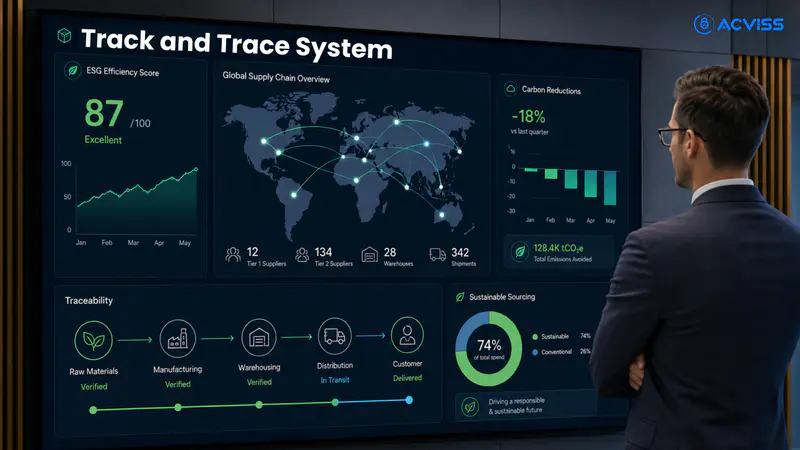
Sustainability reporting has quietly become one of the most data-intensive exercises modern businesses have ever faced. What began as broad environmental commitments and annual ESG statements has evolved into something far more demanding: audit-ready, product-level, supplier-linked, digitally verifiable disclosure.
For many brands, especially those operating across global supply chains, this shift feels expensive. New reporting frameworks appear to require new software, new teams, new audits, new consultants, and entirely new operational processes.
But there is a problem with that assumption.
A significant percentage of the data companies now need for ESG reporting already exists inside their existing supply chain traceability and brand protection infrastructure.
The same systems originally deployed for anti-counterfeiting solutions, product authentication, product verification, and supply chain transparency are already collecting the exact operational intelligence regulators increasingly want to see.
Batch-level movement records. Supplier chain documentation. Product origin data. Shipment histories. Manufacturing records. Distribution pathways. Warehouse scans. Product traceability checkpoints.
Most brands simply have not connected these datasets to ESG reporting workflows yet.
That disconnect is becoming costly.
Because the organisations that understand this overlap early will not only reduce compliance costs, they will build a shared infrastructure layer that supports Brand protection, sustainability reporting, supply chain management, product safety, and regulatory compliance simultaneously.
The companies that fail to recognise this convergence will continue building fragmented systems for problems that increasingly require the same data foundation.
ESG Reporting Has Moved Beyond Sustainability Teams
One of the biggest misconceptions in the market is that ESG reporting remains largely a communications or investor-relations exercise.
That era is ending.
Frameworks such as the EU Corporate Sustainability Reporting Directive (CSRD), India’s Business Responsibility and Sustainability Reporting (BRSR), the Corporate Sustainability Due Diligence Directive (CSDDD), and sector-specific regulations like the EU Deforestation Regulation (EUDR) are operational regulations disguised as reporting frameworks.
They do not merely ask companies what they believe. They ask companies to prove what happened across their supply chain. That distinction matters enormously.
Under CSRD, organisations must provide detailed disclosures on environmental impact, labour practices, supplier governance, emissions, risk exposure, and due diligence processes throughout the value chain. These disclosures must increasingly be externally assured and digitally tagged.
India’s BRSR framework is moving in a similar direction. Large listed companies are expected to disclose sustainability-linked operational metrics tied to suppliers, workforce conditions, resource usage, waste generation, and responsible sourcing.
These are not high-level declarations anymore. They require evidence, and evidence means traceability.
What Regulators Actually Want From Supply Chains
Strip away the legal terminology, and most sustainability regulations are ultimately asking companies five core questions:
1. Where did the product come from?
This includes origin records, sourcing geography, supplier identity, raw material lineage, and production information.
2. Who handled the product?
Authorities increasingly want visibility across multiple supplier tiers, logistics partners, distributors, and intermediaries.
3. What happened to the product across its lifecycle?
Movement tracking, storage conditions, transfers, processing steps, returns, and redistribution are becoming central to compliance.
4. Can the company prove the integrity of its claims?
This includes sustainability claims, ethical sourcing claims, deforestation-free declarations, labour compliance assertions, and product safety guarantees.
5. Is the data auditable?
Spreadsheets are no longer enough. Regulators increasingly expect structured, timestamped, digitally retrievable records.
Now consider what modern Track and trace systems already collect for Brand protection and IP Protection purposes.
The overlap is impossible to ignore.
The Hidden ESG Value Inside Anti-Counterfeiting Infrastructure

Most companies originally invested in Track and trace infrastructure to solve a very different problem.
Counterfeit goods.
Unauthorised distribution.
Fake warranty claims.
Trademark Protection.
Product Authentication.
Product Verification.
Customer safety.
This is especially true across sectors like pharma, agrochemicals, luxury goods, automotive components, electronics, premium food products, and industrial manufacturing.
To fight counterfeit activity, brands implemented systems capable of tracing products across the supply chain using serialisation, QR codes, secure labels, blockchain-linked records, and verification technologies.
But those same systems unintentionally became highly sophisticated ESG data engines.
Consider what a modern supply chain traceability platform already knows:
Most organisations continue to treat these as separate business functions despite operating on overlapping data architectures.
That separation is becoming inefficient.
Scope 3 Emissions Reporting Cannot Function Without Traceability
Among all ESG obligations, Scope 3 emissions reporting has become one of the most difficult challenges for large organisations.
Scope 3 emissions include indirect emissions generated across the value chain, including suppliers, transportation, logistics, product use, and disposal.
For many industries, Scope 3 represents more than 70% of total carbon impact.
The problem is data quality. Most companies still rely heavily on secondary emissions data using industry averages because collecting supplier-level operational information remains difficult.
That approach is increasingly insufficient. Regulators, investors, and auditors are pushing organisations toward primary supply chain data because average-based reporting hides enormous variances between suppliers and logistics pathways.
This is where track and trace sustainability systems become unexpectedly valuable.
Every scan, shipment movement, warehouse transfer, or batch dispatch contributes operational intelligence that can support emissions accounting.
For example:
Transport route data helps estimate logistics emissions
Warehouse handling records indicate storage-related energy usage
Supplier-level sourcing records improve emissions allocation
Batch-level shipment histories support carbon footprint modelling
Product lifecycle mapping improves circularity calculations
A sophisticated product traceability infrastructure effectively becomes the operational backbone for Scope 3 visibility.
Without traceability, Scope 3 reporting becomes estimation-heavy. With traceability, it becomes evidence-driven.
That distinction will matter greatly as ESG assurance requirements become stricter over the next five years.
Read about Why Circular Economy Models Demand a New Kind of Traceability
Human Rights Due Diligence Is Becoming a Supply Chain Data Problem
The Corporate Sustainability Due Diligence Directive (CSDDD) fundamentally changes how companies must approach supplier oversight.
Historically, many organisations handled supplier ethics through periodic declarations or supplier questionnaires.
That is no longer sufficient. Modern due diligence frameworks increasingly expect continuous visibility into supplier ecosystems, including subcontractors, sourcing practices, labour risks, and operational governance.
Again, the same supplier-chain visibility originally built for Brand Authentication and anti-counterfeiting solutions becomes highly relevant.
A mature traceability system already helps answer critical governance questions:
Which suppliers contributed to a product batch?
Which intermediaries handled the product?
Did the product move through unauthorised channels?
Were there unexplained supply chain gaps?
Were products diverted into grey markets?
Did sourcing routes change unexpectedly?
These signals are not just relevant to Trademark or IP risk anymore.
They increasingly support labour due diligence and governance reporting.
For industries vulnerable to forced labour risks, illegal sourcing, or subcontractor opacity, traceability infrastructure becomes a strategic compliance asset rather than merely a security tool.
EUDR Is Redefining What Product Origin Means
The EU Deforestation Regulation may become one of the most operationally disruptive ESG regulations introduced in recent years.
The regulation requires companies dealing with commodities such as cocoa, coffee, rubber, soy, palm oil, cattle, and timber to prove products are “deforestation-free”.
But importantly, the regulation does not stop at supplier declarations. It demands evidence.
That includes:
Geolocation coordinates
Plot-level production information
Supply chain mapping
Production timelines
Risk assessments
Legality documentation
Shipment-linked due diligence records
This level of granularity is impossible without sophisticated supply chain traceability systems.
Brands relying on disconnected spreadsheets or fragmented procurement systems will struggle significantly.
Origin-based traceability platforms become especially important here because EUDR compliance requires continuity between sourcing records and downstream product movement.
A company must not only know where raw materials originated.
It must prove how those materials travelled through the supply chain without integrity loss or unauthorised substitution.
That requirement mirrors the exact same operational challenge anti-counterfeiting systems were originally designed to solve.
The overlap between eudr compliance and Track and trace infrastructure is therefore extremely direct.
Product Authentication Is Quietly Becoming an ESG Trust Layer

Consumer trust is becoming inseparable from sustainability claims.
Customers increasingly question whether ethical sourcing claims, recycled content declarations, carbon-neutral promises, or responsible manufacturing narratives are genuine.
This is where product authentication systems gain a second strategic role.
Authentication technologies no longer protect only against fake products.
They protect against fake sustainability claims.
A product verification system capable of proving authenticity can also support:
Proof of origin
Supply chain transparency ESG
Responsible sourcing validation
Product safety assurance
Sustainability claim verification
Brand Verification
Customer satisfaction and trust-building
Consumers are far more likely to trust sustainability messaging when the product itself carries verifiable, traceable proof. This is particularly important in industries plagued by counterfeiting, including pharma, luxury products, cosmetics, agrochemicals, and premium food products.
In pharma, especially, the intersection between product safety, supply chain integrity, and ESG governance is becoming impossible to separate.
A counterfeit medicine is not merely a Trademark Protection issue.
It is a public health issue.
It is a governance issue.
It is a sustainability issue.
The Real Strategic Shift: One Infrastructure, Multiple Outcomes
The smartest organisations are no longer building isolated compliance systems. They are building shared operational infrastructure. This is the real strategic opportunity behind modern traceability architecture.
A single integrated system can simultaneously support:
Product Authentication
Product Verification
Supply chain management
ESG reporting
Scope 3 accounting
EUDR compliance
Human rights due diligence
Product safety
Recall management
Customer engagement
Regulatory reporting
Brand protection solutions
This changes the financial conversation entirely. Traceability stops being viewed as a cost centre created purely for compliance. Instead, it becomes a foundational digital infrastructure investment that supports multiple business-critical functions simultaneously.
That shift matters because executive resistance to ESG investments often comes from perceived duplication.
But when sustainability reporting begins leveraging systems already deployed for Track and trace or Brand protection, the economics become far more compelling.
Why Many Companies Still Struggle
Despite the overlap, most organisations still fail to operationalise this opportunity. There are several reasons.
1. Siloed departments
Sustainability teams, compliance teams, supply chain teams, and Brand protection teams often operate independently with separate technology stacks.
2. Poor data interoperability
Traceability systems frequently collect operational data without structuring it for ESG reporting frameworks. To solve this, brands must shift from static reporting to dynamic, specialised visualisation tools. Understanding the essential traceability dashboards every brand requires is key to turning raw compliance data into actionable insights.
3. Supplier engagement gaps
Many organisations still lack standardised supplier data collection processes across lower supplier tiers.
4. Legacy infrastructure
Older ERP systems often cannot integrate effectively with modern traceability platforms.
5. Limited strategic alignment
Many executives still see sustainability and anti-counterfeiting as unrelated business priorities. That mindset is rapidly becoming outdated.
What Brands Need To Do Next
Organisations do not necessarily need entirely new systems.
Most need better integration strategies.
The first step is conducting a traceability-to-ESG mapping exercise.
Brands should identify:
What traceability data already exists
Which ESG frameworks require similar information
Where data gaps remain
Which supplier tiers lack visibility
How existing systems integrate with ESG reporting workflows
The second step involves centralisation.
Disconnected spreadsheets, emails, PDFs, and siloed databases cannot support future regulatory expectations.
Businesses increasingly need unified supply chain traceability platforms capable of connecting sourcing, logistics, product verification, and sustainability intelligence together. The third step is prioritising auditability. Future ESG disclosures will increasingly require external assurance.
Timestamped records, immutable logs, digital verification systems, and structured reporting formats will become essential.
This is precisely where advanced traceability platforms create long-term value.
Traceability Is No Longer Just About Security
The role of the Track and Trace infrastructure has fundamentally evolved.
What began as a defensive tool against counterfeiting and grey market diversion is rapidly becoming the operational foundation for modern ESG compliance.
The same data that protects brands can now also validate sustainability claims, strengthen governance, support emissions reporting, improve supply chain transparency ESG, and help organisations meet increasingly strict global regulations.
That convergence is not temporary.
It represents the future architecture of responsible supply chains. Businesses that continue treating traceability, sustainability, and Brand protection as separate investments will face mounting operational complexity and rising compliance costs.
The companies that unify them will gain something far more valuable than regulatory readiness.
They will gain visibility. And in the modern supply chain economy, visibility increasingly determines trust.
Build Traceability That Does More Than Compliance
Modern supply chains require more than isolated compliance tools. They require connected intelligence that supports product traceability, Brand protection, Product Authentication, sustainability reporting, and operational transparency together.
With solutions like Acviss Origin, brands can move beyond fragmented tracking systems and build a scalable traceability infrastructure that supports supply chain management, anti-counterfeiting solutions, product safety, and ESG readiness simultaneously.
Interested in learning more? Get in touch with us to explore how connected traceability infrastructure can support both compliance and long-term business resilience.