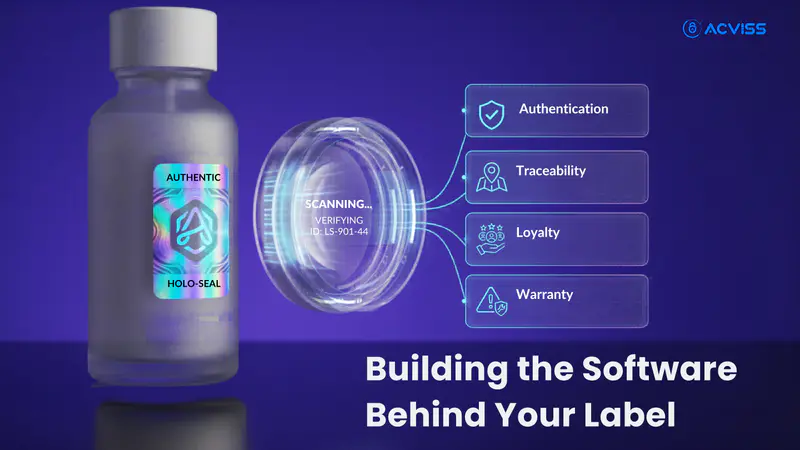
Walk through any retail environment today, and it becomes immediately apparent that labels are no longer confined to their traditional role of carrying static information. They have evolved into interactive gateways, offering consumers a direct connection to the brand, its story, and its authenticity. A simple QR code, often occupying minimal space on the packaging, now carries a disproportionate responsibility. It is expected to reassure, inform, engage, and, in many cases, validate the product's integrity.
However, what most consumers ultimately experience is not the label but the system behind it. The physical label initiates the interaction, but the digital infrastructure that follows determines whether that interaction strengthens trust or quietly undermines it.
For label manufacturers and brand managers who have historically focused on print quality, material innovation, and compliance, this shift introduces a new and often underestimated layer of responsibility.
The Scan as a Brand Moment
The act of scanning has become a habitual behaviour for modern consumers. What was once novel is now instinctive. Data indicates that a significant majority of consumers engage with QR codes on a weekly basis, and a substantial proportion do so daily. More importantly, connected packaging is achieving engagement rates that far exceed traditional digital channels, with scan rates reaching up to 14 per cent.
Yet, the act of scanning itself is not where value is created. It is merely the entry point.
The few seconds immediately following a scan represent a critical brand moment. During this window, the consumer forms an impression that extends beyond the product and into the credibility of the brand. Whether they are attempting product verification, seeking additional information, or exploring promotional content, the expectation is immediate clarity and relevance.
If the response is delayed, unclear, or inconsistent, the interaction fails. Studies suggest that nearly half of users abandon a scan experience if it does not load or resolve quickly. In such cases, the brand does not merely lose an opportunity for engagement; it risks creating doubt where assurance was expected.
When the Experience Breaks: A Common but Invisible Failure
A significant number of brands continue to treat the implementation of secure labels as a complete solution. In reality, it addresses only one part of a larger system.
The failure typically occurs in the post-scan consumer experience, which is often underdeveloped or inadequately integrated. Consumers may encounter landing pages that are generic rather than product-specific, interfaces that are not optimised for mobile use, or verification messages that lack context and clarity. In some cases, the system may respond slowly or fail altogether due to backend inefficiencies.
From a consumer’s perspective, these issues are not interpreted as technical limitations. They are perceived as inconsistencies in the brand itself.
This becomes particularly critical in sectors such as pharma, where product authentication and product safety are closely linked. A vague or delayed response during product verification can introduce hesitation, even when the product itself is genuine. In effect, the absence of a reliable digital experience can undermine the very purpose of implementing anti-counterfeiting solutions.
The Invisible Engine: What a Good Platform Must Deliver

A robust label authentication platform operates as a real-time system that must deliver consistent, accurate, and immediate responses under varying conditions. Its effectiveness depends on a combination of technical performance and user-centric design.
Speed as a Non-Negotiable
Performance is fundamental to trust. The post-scan experience must load within a narrow timeframe, ideally under three seconds, to maintain user engagement. Achieving this requires careful optimisation of API infrastructure, efficient data handling, and the strategic use of technologies such as edge computing and caching.
Observability tools, including frameworks like OpenTelemetry, are increasingly used to monitor system performance by analysing logs, metrics, and request traces. These tools enable organisations to identify latency issues and ensure that the system performs reliably even under scale.
Accuracy and Data Integrity
The primary function of a product verification app is to provide a definitive and reliable response. This requires a high level of data integrity.
Each product unit must be uniquely identifiable through serialisation, ensuring that authentication is not limited to a batch or SKU level. The system must also be capable of detecting anomalies, such as duplicate scans or suspicious patterns, which may indicate counterfeiting or diversion.
Technologies such as blockchain are being adopted to enhance data immutability and transparency. In supply chain management, such systems have demonstrated the ability to reduce tracing times dramatically while improving data accuracy to near-complete reliability. This level of product traceability is becoming increasingly important across industries where brand protection and compliance are critical.
Mobile-First Design
Given that the majority of scans occur on mobile devices, the user interface must be designed accordingly. This involves more than simple responsiveness.
The interface must present information clearly, with an intuitive structure that allows users to quickly understand the outcome of their scan. Elements such as font size, contrast, and navigation must be optimised for usability in real-world conditions, including varying lighting environments.
A poorly designed interface, even if functionally accurate, can reduce user confidence and limit engagement.
Brand-Consistent User Experience
The digital experience following a scan is an extension of the physical product. It must reflect the same level of attention to detail and consistency.
This includes visual identity, tone of communication, and the presentation of key information such as certifications and origin details. A fragmented experience, where the digital interface does not align with the brand’s positioning, can weaken the overall perception of quality and reliability.
What Data Powers the Experience
The effectiveness of a connected label software system is directly linked to the quality and structure of the data it manages. The platform must be capable of storing, processing, and delivering multiple layers of information in real time.
At the product level, this includes manufacturing details, batch information, and expiry dates. From an authentication perspective, it must track the status of each code, including its validity and scan history.
In terms of supply chain management, the system should support track and trace capabilities, enabling visibility into the movement of products across different stages. This is particularly relevant for ensuring compliance and addressing issues related to diversion or grey markets.
Additionally, the platform must serve as a repository for brand content, including usage instructions, sustainability disclosures, and regulatory information such as EUDR requirements. This integration of product authentication with broader IP Protection and Trademark Protection frameworks enhances the overall effectiveness of brand protection strategies.
One Platform, Three Users

A well-implemented label authentication platform operates across multiple layers of the value chain, serving distinct but interconnected user groups.
The Consumer
For the consumer, the primary objective is reassurance. The system must provide clear and immediate confirmation of authenticity, along with relevant product information. Beyond verification, it can also support customer engagement through personalised content and incentives, contributing to higher customer satisfaction.
The Retailer or Distributor
For intermediaries, the platform offers operational visibility. It enables verification at various points in the distribution process, helping to identify inconsistencies, prevent diversion, and strengthen overall supply chain management.
The Brand Manager
From the brand’s perspective, the platform functions as a strategic tool. It provides insights into product movement, identifies potential risks, and supports data-driven decision-making. This aligns product authentication with broader brand verification and anti-counterfeiting solutions.
Beyond Verification: The Engagement Layer
While product authentication remains a core function, the post-scan experience also presents a significant opportunity for engagement.
The scan establishes a direct channel between the brand and the consumer, allowing for personalised interactions based on context and behaviour. Trigger-based marketing, which responds to specific actions or patterns, has been shown to be substantially more effective than traditional approaches.
Brands can leverage this interaction to offer rewards, facilitate reorders, or provide detailed information about sustainability and sourcing. These elements not only enhance customer engagement but also reinforce trust and transparency.
The Strategic Shift for Label Manufacturers
The role of label manufacturers is undergoing a gradual but important transformation. While physical security features remain essential, they are no longer sufficient in isolation.
The competitive advantage increasingly lies in the ability to integrate physical labels with digital platforms. The entity that controls the connected label software effectively controls the flow of information, the quality of the interaction, and, ultimately, the relationship with the consumer.
This shift requires a broader perspective, where the label is viewed not as a standalone product but as part of an integrated system.
The Case for Integrated Authentication Solutions
The adoption of a white-label product authentication solution becomes a logical progression. Such solutions enable brands and manufacturers to implement robust product verification systems without the need to develop complex infrastructure independently.
These platforms support consistent post-scan experiences, scalable track and trace capabilities, and seamless integration with existing systems. More importantly, they ensure that the promise made by the physical label is fulfilled by the digital experience.
The emphasis should not be on technology for its own sake, but on its ability to enhance product safety, strengthen brand authentication, and improve overall customer satisfaction.
What It Costs to Get It Wrong
The impact of an inadequate post-scan experience is often gradual but significant.
It can lead to reduced consumer trust, increased exposure to counterfeit products, and missed opportunities for engagement. In addition, it limits the effectiveness of data-driven strategies, as incomplete or unreliable systems fail to capture meaningful insights.
In industries such as pharma, where product verification is closely tied to safety, the consequences can be more severe. A failure to provide clear and reliable authentication can compromise both compliance and consumer confidence.
A Quiet but Defining Shift
The broader industry landscape is moving towards the concept of digitally connected products. Standards such as GS1 Digital Link are enabling the creation of digital identities for physical goods, effectively linking them to dynamic, web-based profiles.
This development represents a convergence of product traceability, supply chain management, and customer engagement. It reflects a shift from isolated systems to interconnected ecosystems, where data flows seamlessly across different stakeholders.
Rethinking Labels in a Digitally Connected World
Consumers may never fully understand the technical infrastructure that supports a simple scan. However, they experience its outcomes directly.
A seamless, accurate, and well-designed post-scan interaction reinforces trust and strengthens the brand. Conversely, a slow or inconsistent experience introduces doubt, regardless of the quality of the physical product.
For brands and label manufacturers, the implication is clear. The value of a label is no longer defined solely by its physical attributes, but by the system that supports it.
If you are interested in exploring how a robust label authentication platform can enhance your post-scan consumer experience, strengthen brand protection, and support more effective customer engagement, get in touch with us.