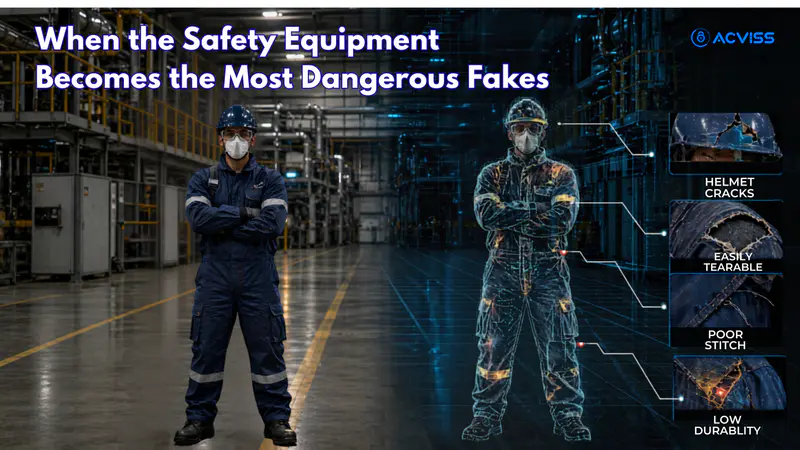
Industrial safety has always relied on a simple assumption: the equipment designed to protect a worker will perform exactly as intended when it matters most. That assumption is now under strain. Across sectors such as construction, oil and gas, pharmaceuticals, manufacturing, and logistics, counterfeit safety equipment has quietly entered the supply chain, creating a risk profile that is both immediate and catastrophic.
Unlike counterfeit luxury goods or consumer electronics, fake personal protective equipment does not merely dilute brand value. It fails at the exact moment it is needed. A helmet that cracks on first impact, a harness that snaps under load, or a respirator that filters nothing more than air can turn routine operations into fatal incidents.
For procurement leaders, HSE managers, and brand owners, this is no longer a peripheral issue. It is a core challenge in product safety, supply chain management, and IP protection.
Why Personal Protective Equipment Is a Prime Target for Counterfeiting

The economics of counterfeit safety equipment are unusually attractive. PPE sits at the intersection of high demand, repeat purchasing cycles, and trust-based procurement decisions.
1. High Margin, Low Scrutiny
Safety equipment is often purchased in bulk, especially in large industrial environments. Procurement teams frequently rely on vendor relationships, certifications, and documentation rather than inspecting each unit. This creates an opportunity for counterfeiters to introduce fake PPE into legitimate supply chains with minimal resistance.
2. Replacement Frequency
Helmets, gloves, respirators, and harnesses are consumables. They are replaced frequently due to wear, regulatory requirements, or safety protocols. This constant demand creates a steady revenue stream for counterfeit operators.
3. Trust-Based Purchase Decisions
Buyers assume that visible certification marks and branding indicate compliance. However, counterfeiters have become adept at replicating trademarks and certification logos, exploiting the very trust systems designed to ensure safety.
The result is a category where counterfeit penetration is both high and underreported, despite the severe consequences.
What Counterfeit Safety Equipment Actually Contains, and What It Does Not

At first glance, fake PPE often appears indistinguishable from genuine products. The difference lies beneath the surface.
1. Certification Fraud
Counterfeit PPE frequently carries fake or misused certification marks such as ANSI, ASTM, or NIOSH. In many cases, the product has never undergone any form of testing. During crisis periods, studies have shown that nearly 60% of imported respirators failed to meet filtration standards, despite claiming compliance.
2. Material Substitution
Authentic PPE is engineered with precise materials designed to absorb impact, resist heat, or filter particles. Counterfeit versions replace these with cheaper alternatives:
Helmets made with brittle plastics instead of high-density polyethene
Harnesses stitched with low-grade fibres lacking tensile strength
Respirators using ineffective filter media
3. Weight and Structural Differences
Subtle variations in weight, thickness, and construction often indicate compromised integrity. These differences are rarely detectable without technical inspection, making product verification essential.
In practical terms, counterfeit PPE does not fail gradually. It fails instantly.
Where Fake PPE Enters the Supply Chain
Understanding the PPE fraud supply chain is critical for effective brand protection and risk mitigation.
1. Grey Market Distributors
Unauthorised distributors often mix genuine and counterfeit stock. Excess inventory, diverted goods, and parallel imports create an opaque supply environment where traceability is weak.
2. Online B2B Platforms
Digital marketplaces have expanded access but reduced oversight. Products marketed with terms such as “industrial grade” or “certified protection” often lack verifiable documentation.
Recent recalls in the UK highlighted safety gear sold through online platforms that failed even basic compliance tests.
3. Fraudulent Certification Bodies
A growing concern is the emergence of fake testing agencies issuing fraudulent certificates. These documents appear legitimate but have no regulatory standing.
Without robust product authentication and traceability systems, these entry points remain difficult to monitor.
Building a PPE Procurement Process That Detects Counterfeits Early

A reactive approach is no longer sufficient. Organisations must embed verification into procurement workflows.
1. Strengthening Supplier Verification
Procurement teams should move beyond price and availability, focusing on:
Verified manufacturer credentials
Direct sourcing from authorised distributors
Cross-checking certification databases
2. Demand Product-Level Authentication
Batch-level verification is no longer adequate. Each unit must be uniquely identifiable and verifiable. This is where product authentication technologies play a crucial role.
Solutions such as non-cloneable labels enable:
Instant product verification at the point of receipt
Validation of manufacturing origin and batch details
Prevention of label reuse or duplication
3. Integrating Track and Trace Systems
Track and trace systems provide end-to-end visibility across the supply chain. When combined with product traceability, organisations can identify:
Points of diversion
Unauthorised distribution channels
Inventory inconsistencies
4. Conducting Randomised Quality Audits
Periodic testing of PPE samples ensures ongoing compliance and discourages counterfeit infiltration.
The Liability Chain: When Counterfeit PPE Causes Harm
The consequences of counterfeit safety equipment extend far beyond operational disruption.
1. Employer Liability
Organisations are legally obligated to provide compliant PPE. Failure to do so can result in:
Regulatory penalties
Civil litigation
Reputational damage
Data indicates that over 70% of accidents in oil and gas refining are linked to improper PPE management, highlighting the scale of risk.
2. Brand and Manufacturer Exposure
Even when counterfeit products originate outside official channels, brand owners face:
Trademark infringement challenges
IP protection costs
Loss of customer trust
3. Distributor Accountability
Distributors found supplying counterfeit goods may face contractual and legal consequences, particularly in regulated industries such as pharma and chemicals.
The liability chain is interconnected, making brand verification and authentication essential across all stakeholders.
Product Authentication as a Strategic Imperative
The shift from reactive detection to proactive prevention is reshaping how organisations approach anti-counterfeiting solutions.
1. Moving Beyond Visual Identification
Traditional methods such as holograms and printed labels are no longer sufficient. They can be replicated with high precision.
2. Non-Cloneable Label Technology
Advanced authentication solutions, such as those enabled through platforms like Certify, introduce unit-level security that cannot be duplicated.
These systems provide:
Unique, non-replicable identifiers for each product
Real-time product verification through mobile or web interfaces
Integration with broader supply chain management systems
3. Enhancing Customer Engagement and Trust
Authentication solutions also enable end users to verify products independently, improving customer satisfaction and reinforcing brand authenticity.
In high-risk sectors, this transparency becomes a competitive advantage.
Regulatory Landscape: India, EU, and the United States
Regulatory frameworks are evolving to address the growing threat of counterfeit PPE.
India
India’s BIS certification requirements mandate compliance for various PPE categories. However, enforcement gaps and fragmented supply chains continue to pose challenges.
The increasing focus on digital track and trace systems is expected to strengthen compliance in the coming years.
European Union
The EU enforces strict PPE regulations under the Personal Protective Equipment Regulation (EU) 2016/425. Recent developments such as the EUDR (European Union Deforestation Regulation) reflect a broader push towards supply chain transparency and product traceability.
United States
The U.S. regulatory ecosystem includes OSHA, NIOSH, and ANSI standards. Recent actions include:
Stricter enforcement of respirator certification
Reclassification of novelty helmets as regulated safety equipment
Increased seizure of counterfeit goods, exceeding USD 12 million in 2024, marking a 23% increase year-on-year
These measures signal a shift towards tighter control, but enforcement alone cannot eliminate counterfeit risks.
The Role of Technology in PPE Safety and Compliance
Technological integration is transforming PPE management from a static process to a dynamic system.
RFID and Smart PPE
In high-risk environments, RFID-enabled systems have demonstrated measurable impact:
Compliance rates increased to 97.6%
PPE loss reduced by over 30%
Operational efficiency improved significantly
Data-Driven Safety Management
Real-time data enables organisations to monitor usage, detect anomalies, and ensure compliance with safety protocols.
Integration with Brand Protection Solutions
Combining authentication technologies with AI-driven monitoring systems strengthens overall brand protection, enabling organisations to detect counterfeit activity across both physical and digital channels.
A Closing Reflection: Safety Cannot Be Assumed
Counterfeit safety equipment represents a fundamental breakdown of trust in the industrial ecosystem. It undermines product safety, compromises worker wellbeing, and exposes organisations to significant legal and financial risk.
The challenge is not limited to identifying fake products after they enter the system. It lies in preventing them from entering at all.
This requires a shift in mindset. Procurement must become verification-driven. Supply chains must become transparent. Brands must adopt robust IP protection and authentication strategies.
The cost of inaction is measured not only in financial terms but in human lives.
Interested in learning more? Get in touch with us to explore how authentication solutions can safeguard your products, your workforce, and your reputation.