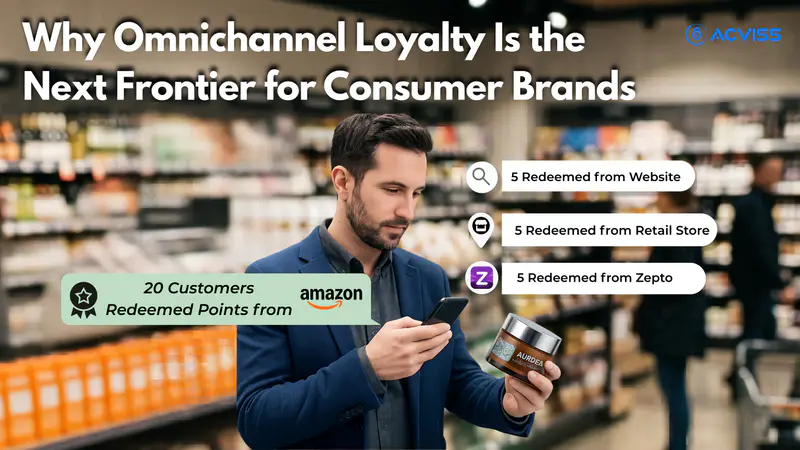
Consumer loyalty has become far more complicated than most brands anticipated. A customer may discover a product on Instagram, compare reviews on Amazon, purchase it from a nearby pharmacy or Kirana store, scan the packaging for product authentication, and later engage with the brand through WhatsApp, email, or a mobile application. From the consumer’s perspective, this is one continuous experience. From the brand’s perspective, it is often five disconnected systems struggling to recognise the same individual.
This disconnect is creating a growing problem across industries, including pharma, cosmetics, food, electronics, luxury goods, and FMCG. Loyalty programmes were originally designed around transactions occurring within controlled ecosystems, such as physical retail stores or direct ecommerce websites. Modern commerce no longer works that way.
Consumers move freely among online marketplaces, offline retailers, quick-commerce apps, distributors, and direct-to-consumer platforms. Yet many loyalty systems still operate in silos, leaving brands with fragmented customer intelligence and incomplete visibility into engagement. This is precisely why omnichannel loyalty programmes are rapidly becoming one of the most important strategic investments for modern consumer brands.
Omnichannel Loyalty Means More Than Being Present Everywhere
The term “omnichannel loyalty” is often misunderstood. Many brands assume it simply means offering loyalty rewards across multiple sales channels. In practice, true cross-channel loyalty goes much deeper than that.
An omnichannel loyalty programme creates a single, continuous relationship between the consumer and the brand, regardless of where the purchase is made. The customer experience remains connected whether the product is purchased through Amazon, a direct ecommerce website, a pharmacy chain, a modern retail outlet, or a local kirana store.
The distinction is important because today’s consumers no longer shop through linear journeys.
Nearly 73% of shoppers engage with multiple channels before making a purchase decision. Around 60–70% of consumers research products online while simultaneously interacting with physical stores. This behaviour is especially visible in sectors where trust and product verification play a major role, such as pharma, nutraceuticals, premium cosmetics, electronics, and food products.
A customer may discover a product online but purchase it offline because of convenience. Another may inspect a product in-store but complete the purchase through a marketplace because of pricing. Consumers do not think in channels anymore. They think in terms of convenience, trust, availability, and experience.
Unfortunately, most loyalty systems still think in channels.
This creates major blind spots for brands.
The Hidden Cost of Fragmented Loyalty Systems

Fragmented loyalty systems create far more damage than most organisations realise. The problem is not simply operational inefficiency. It directly impacts customer engagement, customer satisfaction, retention, and long-term revenue visibility.
Consider how most brands currently collect consumer data:
E-commerce websites capture browsing behaviour and purchase history
Marketplaces provide limited order-level information
Offline retail often captures almost no consumer intelligence
Customer support systems operate independently
Warranty registrations sit in separate databases
Product authentication scans are rarely connected to loyalty systems
Retail distributors and resellers maintain isolated records
As a result, a single customer may exist across six or seven disconnected databases without the brand ever understanding that all those interactions belong to the same person.
This creates several serious business challenges.
1. Incomplete Customer Visibility
Brands struggle to understand actual customer lifetime value because purchases are scattered across multiple channels. A loyal repeat buyer may appear as a first-time customer in several systems simultaneously.
2. Broken Loyalty Experiences
Consumers frequently encounter inconsistent reward systems. Loyalty points earned online may not work in physical stores. Rewards available through direct channels may not apply to marketplace purchases. This inconsistency damages trust and reduces programme participation.
3. Marketplace Dependency
Third-party marketplaces offer scale, but they often operate as customer data black boxes. Brands receive transaction-level visibility but very little behavioural intelligence. The marketplace owns the relationship while the brand becomes increasingly dependent on platform algorithms and advertising costs.
4. Weak Personalisation
Without unified consumer loyalty systems, brands cannot accurately personalise communication, offers, or recommendations. Engagement becomes generic instead of contextual.
For industries heavily affected by counterfeiting and grey market diversion, the problem becomes even more severe. Brands dealing with product safety concerns, Trademark protection challenges, and IP protection risks often lose direct visibility once their products enter third-party channels.
This is where product authentication technologies are beginning to reshape loyalty architecture.
Why Product Authentication Is Becoming Central to Omnichannel Loyalty
Traditionally, product authentication solutions were deployed primarily for Brand protection and anti-counterfeiting purposes. Their role was to help consumers verify whether a product was genuine while helping brands identify suspicious supply chain activity.
That role still matters enormously, especially in industries like pharma, agrochemicals, automotive components, luxury goods, and electronics. However, authentication technologies are now evolving into something much larger: a bridge connecting fragmented customer journeys.
A product authentication scan creates a direct interaction between the consumer and the brand, regardless of where the product was purchased.
That changes the entire loyalty equation.
For example, imagine a customer purchases a skincare product from an e-commerce marketplace. The marketplace may never provide the brand with complete behavioural visibility. However, once the consumer scans the product for brand authentication or product verification, the brand suddenly establishes a direct engagement touchpoint.
The scan can now trigger:
Reward allocation
Educational content
Warranty activation
Customer engagement campaigns
Refill reminders
Product traceability insights
Customer feedback collection
Product safety alerts
Most importantly, the interaction happens independently of the sales channel.
Whether the product came from a pharmacy, a supermarket, a distributor, or a direct ecommerce platform, the authentication scan reconnects the consumer back to the brand ecosystem.
This is why authentication-led loyalty programmes are gaining strategic importance across omnichannel commerce environments.
The Rise of the “Scan Economy” in Consumer Engagement

Consumers today are already comfortable scanning products. QR codes became mainstream during the pandemic, and industries rapidly adopted digital interactions across retail, healthcare, logistics, and food services.
Brands are now leveraging this behavioural familiarity to create smarter engagement ecosystems.
The modern product scan is no longer just a security feature. It is becoming a digital identity layer connecting:
Product Authentication
Product Verification
Track and trace systems
Supply chain management
Customer engagement
Warranty validation
Brand Verification
Product traceability
Consumer analytics
For brands, this creates a significant advantage because scans happen after the purchase and outside traditional retail limitations.
A customer buying from a local kirana store may remain invisible at the point of sale. However, once they scan the product, the brand gains direct visibility into consumer behaviour, purchase geography, usage patterns, and engagement potential.
This is especially valuable in fragmented retail environments like India, Southeast Asia, Africa, and Latin America, where unorganised retail continues to dominate large portions of commerce.
Building a Unified Consumer Loyalty Framework
One of the biggest goals of omnichannel loyalty is building a unified customer identity across all interactions.
This is much harder than it sounds.
A single consumer may:
Purchase through marketplaces
Register products separately
Interact with customer support
Use different email addresses
Buy from offline retail stores
Engage through mobile apps
Scan products for authentication
Without integration, these interactions remain isolated.
The solution lies in creating unified consumer loyalty systems where every interaction contributes to one connected profile.
Authentication-led engagement plays an important role here because verified product ownership becomes the connecting layer between fragmented channels.
For example:
A consumer purchasing a nutritional supplement from a pharmacy scans the product for authentication. The same consumer later buys a refill directly from the brand website and redeems loyalty rewards earned from previous purchases.
From the customer’s perspective, the experience feels seamless.
From the brand’s perspective, two previously disconnected channels are now unified under one customer identity.
This allows brands to develop much richer behavioural intelligence, including:
Repeat purchase patterns
Regional demand trends
Channel migration behaviour
Product usage cycles
Cross-category preferences
Counterfeit risk hotspots
Customer retention signals
This level of visibility was traditionally impossible in fragmented commerce ecosystems.
Why Omnichannel Loyalty Is Becoming Critical for Brand Protection
Most discussions around loyalty programmes focus heavily on retention and rewards. However, omnichannel loyalty is increasingly becoming a Brand protection strategy as well.
This is particularly important for industries vulnerable to:
Counterfeit products
Grey market sales
Unauthorised resellers
Product diversion
Fake warranty claims
Trademark abuse
IP infringement
When consumers regularly authenticate products before using them, brands gain real-time intelligence about suspicious market activity.
For example, unusual scan activity from unexpected geographies may indicate parallel imports or unauthorised distribution. Multiple authentication attempts on identical product codes may indicate counterfeit duplication.
When loyalty systems integrate directly with anti-counterfeiting solutions, brands gain dual benefits:
Stronger supply chain visibility
This creates a much more commercially sustainable approach to Brand protection because customer participation becomes voluntary and reward-driven rather than compliance-driven.
In sectors like pharma, this becomes even more valuable.
Product safety, Product Verification, and customer trust are deeply interconnected. Patients increasingly expect transparency around manufacturing origin, authenticity, expiry validation, and supply chain integrity. Authentication-enabled loyalty systems help address these expectations while simultaneously strengthening customer engagement.
Architecting Omnichannel Loyalty Without Rebuilding Everything

One of the biggest misconceptions around omnichannel loyalty programme integration is that brands must completely rebuild their infrastructure.
In reality, modern omnichannel systems rely more on integration than replacement.
The most successful systems typically combine:
Existing e-commerce platforms
Retail POS systems
Product authentication engines
CRM systems
Mobile applications
Track and trace infrastructure
These systems communicate through APIs and middleware layers that synchronise data in real time.
A strong omnichannel architecture generally includes:
1. Unified Customer Identification
A single identifier, such as a phone number, email address, or authenticated product history, helps prevent fragmented customer records.
2. Real-Time Synchronisation
Purchases, returns, reward redemption, and authentication scans must update instantly across all systems to avoid inconsistent loyalty experiences.
3. Middleware for Legacy Infrastructure
Many traditional retail systems cannot support advanced API integrations directly. Middleware layers help bridge this gap without replacing entire infrastructures.
4. Product-Centric Engagement Models
Modern loyalty systems increasingly focus on verified product ownership rather than only transaction events.
This approach is particularly effective for brands using Bonus loyalty programmes integrated with product authentication and Brand protection technologies.
The Future of Loyalty Will Be Built Around Trust
The future of loyalty is shifting away from points-based marketing towards trust-based engagement ecosystems.
Consumers increasingly expect:
Transparency
Authenticity
Seamless engagement
Cross-channel consistency
Product safety assurance
Personalised interactions
Traditional loyalty programmes were not designed for this level of complexity.
Omnichannel loyalty systems powered by Product Authentication, Track and trace technologies, Product Verification, and unified consumer engagement are helping brands close that gap.
The brands that succeed over the next decade will not simply be the ones with the largest distribution networks. They will be the ones capable of connecting fragmented commerce ecosystems into one intelligent consumer relationship.
That relationship begins long after checkout.
In many cases, it begins with a simple scan.
Fixing the Customer Journey
Modern commerce has fragmented the customer journey, but consumer expectations have become more unified than ever. Brands can no longer afford disconnected loyalty systems that only understand isolated parts of the purchase experience. As consumers move fluidly between marketplaces, offline retail, direct websites, and digital engagement channels, loyalty programmes must evolve to follow them seamlessly across every interaction.
This is where omnichannel loyalty becomes far more than a marketing initiative. Integrated with Product Authentication, Brand Verification, Track and trace systems, and customer engagement platforms, it becomes a powerful engine for retention, trust, supply chain visibility, and Brand protection. Authentication scans are no longer just security checkpoints. They are becoming the digital bridge connecting fragmented commerce ecosystems into one continuous consumer relationship.
Interested in learning more about building omnichannel loyalty ecosystems powered by product authentication and Brand protection technologies? Get in touch with us to explore how Bonus can help create seamless cross-channel loyalty experiences for your consumers.