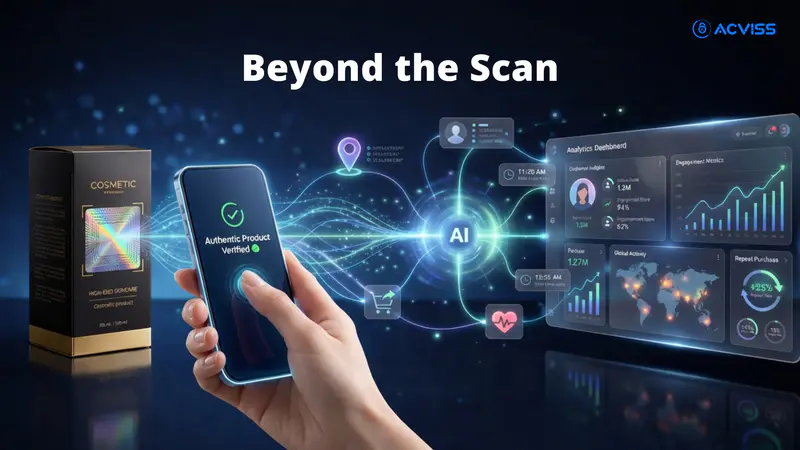
Security labels have long been treated as a finishing step. Printed, applied, inspected, and then largely forgotten. For decades, their role has been narrowly defined within product authentication and anti-counterfeiting. Once a product leaves the factory, the label’s job is assumed to be complete.
That assumption no longer holds.
The emergence of the connected security label has fundamentally changed how brands think about packaging, product verification, and brand protection solutions. A label is no longer a static artefact. It is a dynamic interface. Every scan becomes a data point. Every interaction becomes an opportunity.
This shift reframes the label from a cost centre into a long-term intelligence asset.
The Traditional Label Lifecycle: A One-Time Security Check
Historically, the lifecycle of a security label followed a predictable path:
Designed and printed during manufacturing
Applied to packaging as a tamper-evident or authentication feature
Verified once during distribution or at retail
Rarely engaged with again
In this model, the label supports Trademark Protection, IP Protection, and product safety primarily at the point of sale. Its function is defensive. It answers a single question: Is this product genuine?
While effective to an extent, this approach has clear limitations:
No visibility beyond the first verification
No consumer interaction after purchase
No data capture across the product journey
No feedback loop into supply chain traceability
In an era where counterfeiting networks operate across both physical and digital channels, this static approach is increasingly inadequate.
What Changes When a Label Becomes Connected
A connected security label transforms this lifecycle entirely. The label is no longer just printed. It is linked to a digital platform.
This connection enables:
Real-time scan tracking
Data capture across geographies and channels
Continuous product authentication lifecycle monitoring
Integration with label engagement platforms
Each scan creates a new event. Not just a verification, but a signal.
For example:
A scan in a new geography may indicate grey market diversion
Multiple scans in distant locations may suggest cloning
A post-purchase scan may indicate genuine consumer usage
This is where non-cloneable technology becomes critical. Solutions such as Certify by Acviss ensure that each code cannot be duplicated, establishing a reliable digital identity for every product.
Without this foundation, connected labels risk becoming vulnerable to replication. With it, they become a trusted source of truth.
Post-Sale Scan Events: What Brands Can Actually Learn

The most overlooked value of a connected label lies in what happens after the product is sold.
Every post-sale scan contributes to a growing intelligence layer. Over time, this data reveals patterns that were previously invisible.
Repurchase Signals
When a consumer scans a product after use, it often indicates engagement or intent. Repeated scans can suggest:
Product satisfaction
Likelihood of repurchase
Potential for subscription or reorder prompts
This directly influences customer satisfaction and retention strategies.
Geographic Spread
Scan locations provide insight into where products are actually consumed, not just shipped.
This helps brands:
Validate distribution strategies
Identify unexpected demand clusters
Detect parallel trade or diversion
Channel Compliance
By comparing expected versus actual scan patterns, brands can identify:
Leakage into unauthorised channels
Distributor non-compliance
Retail inconsistencies
This strengthens supply chain traceability and enhances overall brand verification.
The Consumer Engagement Layer: From Security to Experience

A connected label is not only a security feature. It is also a direct communication channel with the consumer.
This is where smart label consumer engagement becomes a strategic differentiator.
A single post-purchase scan can trigger:
Loyalty rewards and points
Product usage guides or tutorials
Warranty registration workflows
Personalised offers and reorder reminders
Platforms such as Bonus by Acviss enable brands to build structured engagement journeys on top of authentication infrastructure.
The implications are significant:
The label becomes part of the customer engagement strategy
Packaging evolves into a digital touchpoint
The “unboxing moment” extends into a long-term relationship
Research indicates that 41 per cent of consumers are more likely to repurchase after a strong post-purchase experience, and this rises further among younger demographics. Connected labels operationalise this insight.
The Distributor and Retailer Layer: Intelligence Beyond the Consumer
The same label that engages consumers also generates value for distributors and retailers.
Each scan contributes to a clearer picture of product movement across the network.
Sell-Through Visibility
Brands can move beyond shipment data to understand actual consumption rates.
This enables:
Better demand forecasting
Reduced overstocking or stockouts
Improved coordination with channel partners
Compliance Monitoring
Connected labels allow brands to monitor:
Whether products are sold in authorised regions
Whether pricing or promotional guidelines are followed
Whether inventory is diverted or misreported
This adds a layer of accountability that traditional systems cannot provide.
In complex ecosystems involving multiple intermediaries, this level of visibility is essential for effective brand protection.
The Product Recall Advantage: From Weeks to Hours
Product recalls have historically been slow, broad, and costly.
Without precise visibility, brands often resort to:
Mass recalls across entire regions
Blanket communication campaigns
Significant financial and reputational impact
A connected label changes this dynamic.
With scan-level traceability, brands can:
Identify exactly which units are affected
Locate where those units are currently active
Notify specific consumers or retailers directly
What once took weeks can now be executed in under 24 hours.
In industries such as pharma, where product safety is critical, this capability can have life-saving implications.
Lifetime Label Value: A New Commercial Metric
The concept of lifetime label value introduces a new way to measure return on investment.
Instead of evaluating a label solely on its cost, brands can assess:
Number of scans per product
Consumer engagement rates
Data points generated across the lifecycle
Impact on repeat purchases and loyalty
A connected label effectively becomes a recurring asset.
It contributes to:
Product authentication
Brand authentication
Consumer insights
Over time, the cumulative value far exceeds the initial cost of implementation.
The Role of Technology: Building a Phygital Ecosystem

The transformation of labels is part of a broader shift towards “phygital” ecosystems. Physical products are now embedded with digital layers.
Key enabling technologies include:
Secure QR codes with encryption
Blockchain-backed track and trace systems
IoT integration for condition monitoring
AI-driven scan pattern analysis
Advanced systems can detect anomalies such as:
Impossible travel patterns across scans
Unusual device activity suggesting cloning
Geographic inconsistencies in product movement
These capabilities strengthen anti-counterfeiting solutions technologies and elevate IP Protection to a proactive discipline.
From Authentication to Continuous Interaction
The most important shift is conceptual.
A label is no longer a checkpoint. It is a channel.
It connects:
The brand to the consumer
The manufacturer to the distributor
The product to its digital identity
This continuous interaction supports:
Product verification at every stage
Enhanced customer engagement
Improved customer satisfaction
Real-time supply chain traceability
It also aligns with emerging regulatory frameworks and sustainability expectations, where transparency and traceability are becoming mandatory.
Rethinking the Role of the Label
For label manufacturers and brands alike, this evolution demands a change in mindset.
The question is no longer:
“Is this label secure?”
It becomes:
“What value does this label generate over time?”
A label that only verifies authenticity is doing the minimum. A label that captures data, engages consumers, supports recalls, and strengthens supply chains is delivering strategic value.
This is the future of connected security labels.
Closing Thoughts
The intersection of product authentication, brand protection solutions, and digital engagement is redefining packaging as an active participant in the product lifecycle.
A connected label, supported by non-cloneable technology and integrated platforms such as Certify and Bonus, transforms a passive element into a living system. It enables brands to move from reactive defence to proactive intelligence.
As counterfeiting grows more sophisticated and customer expectations continue to rise, the brands that succeed will be those that see beyond the point of sale.
They will recognise that the label’s job has only just begun.
Interested in Strengthening Your Product Authentication Strategy?
If you are exploring how connected labels can enhance brand authentication, product verification, and customer engagement, while strengthening supply chain traceability and product safety, it may be time to rethink your approach.
Interested to learn more? Get in touch with us.